
ZipRecruiter Alternatives for Employers: 2026 Restaurant Comparison
By Billy Giordano, Co-Founder, StaffedUp
Former restaurant operator. Built StaffedUp after spending $400/month on Indeed for three months with zero hires — and watching “URGENTLY HIRING” on Facebook get no replies before a Saturday rush.
Last updated: October 2026
For restaurant and hospitality operators, the best ZipRecruiter alternative depends on whether your problem is reach (not enough applicants), quality (wrong applicants arriving), or process (applicants arrive but fall through the cracks). The main alternatives include Indeed, LinkedIn Jobs, Snagajob/Seasoned, Poached/Culinary Agents, and restaurant-specific ATS platforms like StaffedUp. ZipRecruiter costs approximately $299–$899/month per job slot based on third-party estimates from TrustRadius and Capterra — no published rate card exists. For an operator filling roles against hospitality’s 65.5% annual turnover rate, that cost compounds fast when the same position refills multiple times a year. This post runs the numbers and gives you a framework to decide.
What ZipRecruiter Actually Does Well (and for Whom)
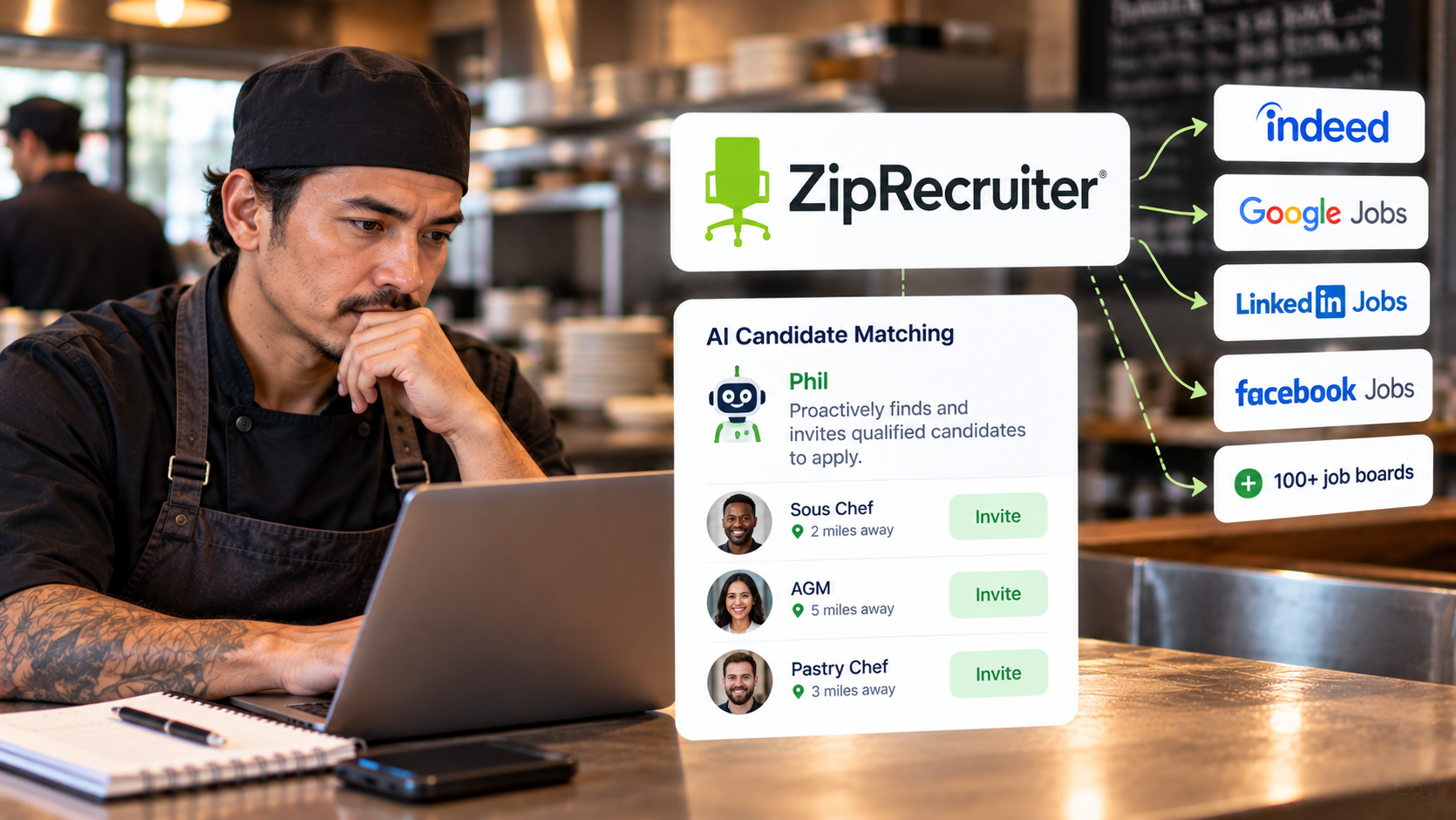
ZipRecruiter’s core product is distribution: one posting reaches 100+ job boards simultaneously. For an operator manually posting to Indeed, Facebook Jobs, and Craigslist in separate windows, that consolidation has real value. Phil, ZipRecruiter’s AI matching technology, proactively identifies candidates in its database who match your posting and invites them to apply — for manager-level or specialized roles (a sous chef, an AGM, a pastry lead), Phil’s proximity matching works reasonably well. And the flat-rate subscription is a legitimate advantage over Indeed’s pay-per-click pricing, where a competitive market can drain a sponsored budget in days; ZipRecruiter’s monthly rate is predictable regardless of application volume. It fits best for operators filling one or two roles per quarter — especially above-the-line roles where resume screening is standard — or operators who already have an internal ATS and just need the distribution layer. Where it gets complicated for restaurants is what happens after applications arrive. For a plain explanation of what an ATS actually does before we get into the comparison, that’s worth a read first.
ZipRecruiter Pricing in 2026: What Operators Actually Pay
ZipRecruiter doesn’t publish a rate card — every employer gets a custom quote based on industry, location, company size, and job volume, and its plans page routes to a sales consultation, not a pricing page. Based on estimates from TrustRadius and Capterra (2025–2026), operators report paying roughly $299–$399/month per slot for Standard, ~$419–$519 for Premium (2–3 concurrent roles), and ~$719–$899 for Pro (high-volume, multi-location), with TrafficBoost visibility credits layering on at roughly $300–$500 each. The slot model charges a flat monthly rate per active job — when a role fills you can reassign the slot, but you pay whether it delivers 5 applications or 500. The free trial runs just 2–4 days, requires a credit card, and auto-converts to paid — a short window for restaurant hiring, where the first qualified applicant might show up on day 3. Pricing opacity is one of the most consistently cited employer complaints across TrustRadius and G2.
Why Restaurant Operators Look for ZipRecruiter Alternatives
Volume without hospitality-specific screening. ZipRecruiter generates application volume, and for a restaurant operator, unscreened volume is often worse than low volume — post a line cook role and 80 applications arrive, none with shift-availability data, several from candidates who one-tap-applied to 40 jobs in the same session. Phil matches on resume keywords and title proximity; there’s no pre-built hospitality screening layer for what actually determines whether someone can work your shifts (availability windows, tip-credit history, ServSafe, radius-to-property). Screening questions exist but are entirely self-configured — every filter built from scratch, and most operators don’t know which to build until they’ve waded through dozens of bad applications.
Per-slot cost math doesn’t fit high-turnover operations. At ~$299–$399/month per Standard slot, a single slot runs roughly $3,600–$4,800/year. BLS JOLTS puts accommodation and food services at 65.5% annual turnover in 2025 — a 50-seat independent turning over five hourly staff a year is refilling those slots repeatedly, with no built-in ATS, no onboarding tools, and no retention layer attached to the spend. It’s a recurring fee for a structural challenge distribution alone doesn’t fix.
No ATS pipeline after applications arrive. ZipRecruiter delivers applications to your inbox; what happens next is your problem — no built-in workflow for tracking candidate status across roles, scheduling interviews, sending automated follow-ups to cut ghosting, or triaging 80 applications in the 20 minutes between lunch and dinner prep. For a GM managing hiring on top of everything else, that inbox becomes a graveyard for qualified candidates who never heard back. StaffedUp platform data — aggregated across thousands of hospitality postings — shows operators using screening and pipeline workflows see 8x more applicants, 77% shorter time-to-hire, and 45% decreased turnover versus distribution-only tools. The mechanism is the screening and workflow layer, not just reach.
ZipRecruiter Alternatives: Side-by-Side Comparison
The table covers the six platforms restaurant operators actually ask about — not Greenhouse or enterprise ATS tools built for corporate HR filling salaried roles. “Hospitality-specific screening” means operator-defined filters for availability, shift types, and role-relevant criteria; “ATS pipeline included” means tracking and managing candidates after application, not just receiving them.
| Platform | Est. Cost | Hospitality Screening | ATS Pipeline | Honest Best For |
|---|---|---|---|---|
| ZipRecruiter | ~$299–$899/mo (est.) | Generic, self-configured | ❌ | 1–2 roles/quarter; manager-level roles |
| Indeed | Variable (PPC, bid-dependent) | Generic knockout Qs | ❌ inbox only | High volume; works best with an ATS underneath |
| LinkedIn Jobs | Recruiter Lite ~$140–$170/mo (est.) | Limited hourly context | ❌ | Manager, chef, GM roles — not FOH/BOH hourly |
| Snagajob / Seasoned | Custom quote | Moderate, hourly-focused | Limited | Hourly volume for QSR/casual dining |
| Poached / Culinary Agents | ~$99–$299/mo (est.) | Strong, hospitality-native | Limited | FOH/BOH sourcing in major metros; limited outside big cities |
| StaffedUp | $1 first post → $29/mo | ✅ operator-defined | ✅ full pipeline | Distribution + screening + pipeline in one place |
Pricing figures are third-party estimates (TrustRadius, Capterra, and provider guides); ZipRecruiter and several others quote each employer individually. Verify current pricing before committing.
The “Honest Best For” column is doing real work: ZipRecruiter doesn’t lose every row, LinkedIn wins for one type of role, and Snagajob and Poached each have a specific use case. For a broader ATS comparison across the category, how leading restaurant ATS platforms compare covers it in more detail.
Why ZipRecruiter and a Restaurant ATS Aren’t Mutually Exclusive
Here’s what most comparison posts won’t tell you: a StaffedUp posting distributes to ZipRecruiter, Indeed, Monster, and the broader network automatically — you don’t have to choose between ZipRecruiter’s reach and an ATS pipeline; you get both from a single posting, in under three minutes from your phone. What the ATS layer adds on top of that reach: operator-defined screening (you set the availability windows, radius, and role criteria, and qualified applicants are filtered before they hit your inbox), plus SmartMatch scoring, one-way video interviews, interview scheduling, and digital onboarding in the same place — instead of juggling a ZipRecruiter inbox, an Indeed inbox, and a spreadsheet. Sean O., who runs an Irish Pub & Grill in Chicago, spent $400/month on Indeed for three months with zero hires, then posted on StaffedUp for $1 and had a qualified applicant in 18 hours. Marisol V. went from 60 unscreened applications to 5 who actually wanted to work her shifts — not a smaller pipeline, a better one. Transparency: if you have a robust internal ATS and only need a distribution layer, ZipRecruiter alone may be the right call; if you’re managing hiring from an email inbox and gut feel, the ATS layer is where you recover the time.

Cost-Per-Hire Math for High-Turnover Hourly Operations
BLS JOLTS shows accommodation and food services reached a 65.5% annual turnover rate in 2025 (the long-run average since 2001 is 75.6%), and the sector’s quit rate hit 4.3% in March 2026 — the highest of any tracked industry. This is structural, not cyclical: you’ll be refilling the same roles this year, next year, and the year after. Here’s the cost math across platforms:
| Scenario | ZipRecruiter Standard (est.) | StaffedUp ($29/mo flat) |
|---|---|---|
| 1 role, fills in 1 month | ~$299–$399 | $29 |
| 3 concurrent roles, 1 month | ~$897–$1,197 | $29 (unlimited posts) |
| 5 concurrent roles, 6 months | ~$8,970–$11,970 | $174 |
| Annual (5 roles, 65% turnover) | ~$18,000–$24,000/yr | $348/yr |
ZipRecruiter figures are third-party estimates (TrustRadius, Capterra, 2025–2026); your actual quote will differ by market, industry, and volume.
Even one bad hire from an unscreened application flood carries replacement costs that can offset months of subscription spend — industry estimates put hourly replacement costs at several times an employee’s monthly wages, though no single authoritative figure covers all restaurant contexts. The comparison isn’t ZipRecruiter’s ~$299/slot versus StaffedUp’s $29 as equivalent products — it’s distribution with no ATS versus distribution plus ATS for $29/month. What you pay, and what you get after the application arrives, are different questions. For the retention side of this math, strategies that actually reduce restaurant turnover covers it.
Which ZipRecruiter Alternative Is Right for Your Restaurant?
Two questions to answer before choosing any platform: Is my problem reach (not enough applicants) or quality (wrong applicants)? And do I have a system to manage what arrives, or am I working from my email inbox? If the answer to the second is “email inbox and gut feel,” adding more distribution without a pipeline makes things worse — more applications you can’t process, more candidates who never hear back. A quick read: filling 1–2 manager or chef roles a year and comfortable screening manually → ZipRecruiter Standard may be cost-justified for its flat-rate predictability; filling 3+ hourly roles concurrently with no time to screen → ZipRecruiter’s reach plus an ATS underneath (StaffedUp distributes to ZipRecruiter, so you get both); tight budget and need qualified applicants fast → StaffedUp’s $1 first post; a multi-location group with 5+ concurrent roles → StaffedUp’s multi-location plan; niche FOH roles in a major metro → Poached or Culinary Agents as a sourcing supplement alongside an ATS. This post is written by StaffedUp — we’re in this category and distribute to ZipRecruiter — and the read above reflects our honest take on when each tool wins. For unfiltered operator reviews, TrustRadius and G2 have them.
Post your first job for $1. Your posting distributes to ZipRecruiter, Indeed, Monster, and the broader network — you keep the reach, and operator-defined screening filters the inbound. If a qualified applicant isn’t in your inbox within 24 hours, you pay nothing and the charge reverses automatically. Under three minutes from your phone — no demo, no setup call, no contract. After the first post, it’s $29/month for unlimited active posts.
Frequently Asked Questions
Is ZipRecruiter worth it for restaurant employers in 2026?
ZipRecruiter’s distribution reach is real — 100+ job boards, Phil AI matching, and a sizable candidate database are genuine assets. For manager-level or specialized roles where you hire once or twice a year, it can be worth it. For high-turnover hourly FOH/BOH roles, volume-without-screening is the core issue: the platform delivers applications, but it doesn’t solve what happens when 80 arrive with no shift-availability data and no pipeline to manage them.
How much does ZipRecruiter cost per month for employers in 2026?
ZipRecruiter doesn’t publish a rate card. Based on estimates from TrustRadius and Capterra (2025–2026), employers report Standard ~$299–$399/month per slot, Premium ~$419–$519, and Pro ~$719–$899. Your actual quote depends on industry, location, company size, and slot volume — all pricing routes to a sales conversation, and pricing opacity is one of the most consistently cited employer complaints across TrustRadius and G2.
Is Indeed better than ZipRecruiter for hourly hospitality hiring?
Different models, different risks. Indeed charges per click on sponsored posts — costs vary with market competition and can spike unpredictably. ZipRecruiter charges a flat monthly rate per slot — more predictable, potentially more expensive for low-volume hiring. The more important question for hospitality operators isn’t Indeed versus ZipRecruiter; it’s whether either platform alone, without an ATS underneath it, solves the screening problem for shift availability and role-specific criteria.
What is ZipRecruiter’s Phil AI, and does it work for restaurant roles?
Phil is ZipRecruiter’s AI matching technology — when you post a role, it identifies matching candidates in the database and invites them to apply, genuinely speeding up early applicant flow. For restaurant roles, the limitation is that Phil matches on resume keywords and title proximity; it doesn’t natively filter for shift-window availability, tip-credit experience, ServSafe, or property radius. Every hospitality-specific filter gets configured from scratch — there’s no pre-built template bank.
Can I use ZipRecruiter and a restaurant ATS at the same time?
Yes — and for most restaurant operators, that’s the better approach. ZipRecruiter provides distribution reach; an ATS provides the pipeline management and screening layer the platform doesn’t include. StaffedUp distributes your posting to ZipRecruiter and the broader network automatically, so you get that reach plus operator-defined screening and pipeline management in one inbox — without managing two separate platforms or paying for ZipRecruiter separately on top of an ATS subscription.
How do I try a ZipRecruiter alternative without a long commitment?
Post your first job on StaffedUp for $1 at staffedup.com/hire. Your posting distributes to ZipRecruiter, Indeed, Monster, and the broader network — you keep the distribution reach — and operator-defined screening filters the inbound. If a qualified applicant isn’t in your inbox within 24 hours, you pay nothing; the charge reverses automatically. Under three minutes from your phone, no demo or setup call. After the first post: $29/month, unlimited active posts.

Sources
- U.S. Bureau of Labor Statistics, Job Openings and Labor Turnover Survey (JOLTS) — accommodation and food services turnover 65.5% (2025), long-run average 75.6%; quit rate 4.3% (March 2026).
- National Restaurant Association, Restaurant Job Openings data (2026).
- ZipRecruiter pricing and feature data: third-party estimates from TrustRadius and Capterra (2025–2026); ZipRecruiter does not publish official rates — verify your quote directly.
- StaffedUp platform data: 8x more applicants, 77% shorter time-to-hire, 45% decreased turnover — internal aggregate.

Hire Smarter, Faster
StaffedUp simplifies hiring for restaurant & hospitality operators. Post your first job for $1.