The Best Applicant Tracking Systems in 2026: An Honest Guide for Operators Who Actually Hire Hourly Workers
By Billy Giordano, Co-Founder, StaffedUp · Updated: June 2026
Vendor disclosure: This guide was written by the team at StaffedUp. It compares applicant tracking systems with a specific focus on restaurants, hospitality, and hourly-workforce businesses — a buyer profile most “best ATS” roundups overlook entirely. StaffedUp is a vendor in this category, and we’ve kept that front and center. Every head-to-head section includes an honest “don’t pick StaffedUp if…” callout, because the goal here is the comparison a peer would give you, not a marketing deck.
Most “best applicant tracking systems” lists are written for corporate recruiters filling a handful of salaried roles a year. This guide is written for the operator filling 40 hourly roles across multiple units. It explains which systems actually fit that work, where the pricing math gets dangerous, and where StaffedUp is the wrong choice.
Key takeaways
- Most “best ATS” roundups were built for corporate recruiters hiring salaried employees. Hourly hiring has fundamentally different requirements — from applicant behavior to pricing economics.
- The right hiring platform for a 5-unit restaurant group looks nothing like the right tool for a 200-person SaaS company. Buyer profile matters more than any single feature.
- Per-employee pricing models punish high-turnover businesses. Understand the pricing math before you sign anything.
- StaffedUp is a vendor in this category, and this guide includes explicit “don’t pick us if” callouts in every comparison section.
- For most hospitality operators, the best recruiting tool is the one where a floor manager can move from job post to interview scheduled in under 10 minutes on a phone.

How we evaluated these systems — and why our perspective is different
I built StaffedUp because the tools available to me as a restaurant owner didn’t work for how I actually hired. They were designed for HR departments reviewing résumés on desktops — not for a manager trying to fill a line cook opening between lunch and dinner service. That operator experience is the lens this guide is written through.
It also means I have a bias, and I’d rather name it than pretend otherwise. StaffedUp is an ATS in this category. So this guide does something competitor roundups don’t: it includes honest “don’t pick StaffedUp if…” callouts in every head-to-head section.
Our evaluation criteria reflect what actually matters in hourly hiring: hospitality fit (text apply, two-way SMS, multi-unit dashboards, mobile manager usability, payroll and scheduling integrations); pricing-model transparency; real time-to-hire impact; applicant volume; and retention support. We also reviewed G2 categories, third-party roundups, and direct operator feedback to pressure-test our own view.
One scope note: this guide covers systems that operators in restaurants, hotels, retail, and other hourly-workforce industries are actually evaluating. It does not cover enterprise corporate-recruiting platforms like Workday, SAP SuccessFactors, or Taleo in depth — those tools are not designed for hourly hiring, and recommending them to a restaurant operator would be doing you a disservice. If you want foundational grounding first, here’s what an applicant tracking system actually does.
What’s actually different about hiring hourly workers
Hourly hiring is a different sport, and most ATS roundups never acknowledge it.
Start with turnover. The accommodation and food services sector consistently runs among the highest separation rates in the U.S. economy, according to the Bureau of Labor Statistics’ JOLTS data. High turnover means high hiring volume. High volume changes the economics of every hiring software decision you’ll make.
Then there’s applicant behavior. Hourly candidates apply from their phones, often without a résumé, frequently within minutes of seeing a post. A tool that requires a desktop upload or a 15-field form loses a chunk of those applicants before they finish. Corporate recruiting platforms are optimized for the opposite workflow — résumé parsing, structured scorecards, multi-stakeholder review. That’s the right design for an engineering hire and the wrong design for a dishwasher opening.
Multi-unit complexity compounds the problem. A restaurant GM doesn’t need talent analytics dashboards. They need to see which of their four locations is short on line cooks this week and push a job to Indeed from their phone between services. Enterprise tools built for centralized HR departments add friction for the manager who is also, this afternoon, running the line.
Speed matters more per role, too. When you lose a line cook, you’re burning overtime today. A 14-day time-to-hire that’s perfectly acceptable for a salaried role becomes a P&L problem in a restaurant.
In our experience working with operators, the systems that win are the ones that compress the gap between “job posted” and “candidate in the door.” The features that follow from this — text/SMS apply, one-click distribution to Indeed, Google for Jobs, and Facebook Jobs, two-way SMS, SmartMatch-style scoring, a genuinely mobile manager interface, and integrations with restaurant scheduling and POS — are the checklist this guide builds toward.
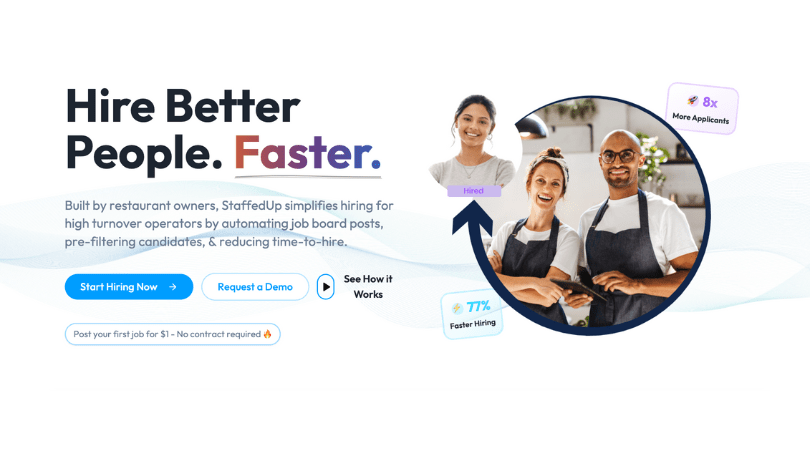
Operators using tools built specifically for hourly hiring consistently report faster time-to-fill and higher applicant volume than those forced into generic corporate platforms. StaffedUp’s own named clients have seen 8x more applicants and 77% faster hiring — those are our first-party verified numbers, not industry averages. If you want the restaurant-specific deep dive, here’s hiring software built for restaurants.
Top applicant tracking systems in 2026 — at a glance
The table below covers both hospitality-native tools and general recruiting platforms operators commonly evaluate. Where a vendor doesn’t publish pricing, we’ve said so rather than invent a number. Estimated figures are flagged.
| System | Best for | Starting price (ballpark) | Hospitality fit | Key strength | Honest limitation |
|---|---|---|---|---|---|
| StaffedUp | Restaurants, hospitality, hourly teams | $1 first job post; flat-rate plans | High — text apply, SMS, multi-unit | SmartMatch scoring, fast setup | Not built for staffing agencies |
| Harri | Large hotel groups, national chains | Contact for pricing | High — hospitality-native enterprise | Deep hospitality workflows | Heavier onboarding for small operators |
| Hireology | Franchise, auto, healthcare, restaurants | Contact for pricing | Medium-High — broad frontline focus | Wide industry coverage | Less hospitality-specific depth |
| Workstream | High-volume frontline hiring | Contact for pricing | High — text-first apply, SMS | Fast-cycle frontline workflows | Generalist across hourly industries |
| HigherMe | Frontline hourly hiring | Contact for pricing | High — text apply focus | Simple frontline setup | Narrower feature depth |
| Homebase Hiring | Very small hourly teams | Free tier; paid plans | Medium — paired with scheduling | Bundled with scheduling | Limited at multi-unit scale |
| 7shifts Hiring | Existing 7shifts users | Add-on to 7shifts plans | Medium — scheduling-first | Tight scheduling link | Hiring add-on, not standalone ATS |
| JazzHR | Small businesses, mixed roles | ~$75/month (estimated) | Medium — general SMB platform | Clean UI, transparent pricing | Weak on text apply, restaurant integrations |
| Workable | SMB to mid-market salaried hiring | Contact for pricing | Low — built for salaried roles | Strong sourcing and ATS depth | Over-engineered for hourly volume |
| Greenhouse | Mid-to-large structured hiring | ~$6,000–$12,000+/yr (estimated) | Low — corporate recruiting tool | Best-in-class structured hiring | Wrong fit and pricing for hourly |
| BambooHR | SMB with HRIS + light ATS | Contact for pricing | Low — HR-suite focus | Combined HR and hiring | Hiring is secondary to HR features |
| Manatal | Staffing agencies, general recruiting | ~$15/user/month (estimated) | Low — recruiter-focused | Affordable per-user pricing | Not hospitality-specific |
The clearest divide in this landscape is between hospitality-native tools (StaffedUp, Harri, Hireology, Workstream, HigherMe) and general platforms (JazzHR, Workable, Greenhouse, BambooHR, Manatal). The native tools are built around how hourly candidates actually behave. The general platforms are built around structured salaried hiring and then stretched to cover everything else. For most restaurant operators, that distinction decides the shortlist before any feature comparison begins.
For the restaurant-focused comparison in more depth, here’s our restaurant applicant tracking system guide.

Best applicant tracking systems by buyer profile
The single biggest mistake in ATS selection is buying for someone else’s business. A flat ranked list ignores that the right tool depends entirely on your size, structure, and the roles you fill most. Here’s how it breaks down.
Single-location restaurant or café (under 30 employees)
You need fast setup, no IT overhead, mobile-first usability, automatic distribution to Indeed and Facebook Jobs, and no long-term contract. Strong fits include StaffedUp, JazzHR, Homebase Hiring, and Workstream. Greenhouse, iCIMS, and Workday are overbuilt and overpriced for this profile — you’d pay enterprise rates for features you’ll never open.
Multi-unit restaurant group or franchise (3–50 locations)
Here the requirements shift. You need per-location visibility, centralized reporting, manager-level access control, automated screening across high volume, and POS/scheduling integrations. Strong fits include StaffedUp (SmartMatch AI scoring, multi-unit dashboard, My Staff auto-recruiting), Harri, and Hireology.
The decisive question to ask any vendor: can a GM at Location 12 post a job and review candidates without involving corporate HR? If the answer is no, cross it off. Multi-unit operators including Blaise Pastoret of LHM Hospitality and Ryan French of MDP Restaurants Group run StaffedUp across their groups.
Hotel, resort, or large-scale hospitality operation
Large hospitality operations hire across F&B, housekeeping, front desk, and banquet — often with heavy seasonal spikes and possible union considerations. Harri and Hireology fit well here. StaffedUp covers the F&B and hourly components. Very large groups with dedicated HR teams sometimes run a hybrid: a hospitality-native platform for frontline hourly roles and a separate HRIS for corporate and salaried positions.
Corporate / office / non-hourly hiring
This is the honest “don’t pick StaffedUp” callout. If most of your roles are salaried, knowledge-worker positions, the tools in this guide aren’t your best primary choice. Greenhouse, Lever, Workable, BambooHR, and Rippling are built for structured collaborative hiring and will serve you better. We’re not the right fit here, and we’d rather say so.
Staffing agency or multi-client hiring
Agencies need client-separated pipelines, high cross-industry volume, and compliance documentation. Manatal, Bullhorn, JazzHR, and Workable are designed for that work. StaffedUp is not built for staffing agencies — full stop.
ATS pricing models explained — and why per-employee pricing can hurt high-turnover businesses
Pricing is where hourly-workforce operators get quietly burned. Most ATS pricing was designed for businesses that don’t turn over their staff frequently. There are three models worth understanding before you take a single sales call.
Per-seat / per-user (Greenhouse, Lever) charges by the number of recruiter or HR seats accessing the system — not by employee count. This can work even at high hiring volume if your HR team is small.
Per-employee / per-month (common in HCM-embedded tools like Paycor, Paycom, ADP, and Rippling) charges by total headcount. That’s the trap for high-turnover businesses.
Flat-rate / subscription (JazzHR, Manatal, StaffedUp) charges a predictable monthly cost regardless of volume. This is usually the most economical model for hourly hiring.
Here’s the math that most competitor guides don’t spell out. A restaurant with 80 employees and 120% annual turnover is effectively replacing its entire workforce every 10 months. At $7 per employee per month, that’s $560/month — roughly $6,720 a year just for platform access, before any actual hiring work. A flat-rate subscription in the $200–$400/month range covers the same volume for meaningfully less.
Enterprise tools rarely publish pricing. Third-party estimates put Greenhouse at roughly $6,000–$12,000+/year for mid-size teams and iCIMS around $6–$9 per employee per month at scale. Treat all of these as directional figures that change based on your negotiation and contract terms.
When you’re on a pricing call, ask for total contract value — not just the per-seat or per-month rate — plus implementation fees, per-job-posting fees, integration fees, and renewal pricing.
Once you’ve chosen a platform, implementation follows a fairly predictable rhythm:
| Timeframe | What to expect |
|---|---|
| Week 1 | Setup, integrations, job templates loaded |
| Week 2 | First jobs posted, applicant flow begins |
| Weeks 3–4 | SmartMatch scoring calibrated to role needs |
| Month 2 | First time-to-hire data; refine screening |
| Month 3 | Multi-unit rollout; manager training complete |
| Month 6 | Retention signals emerge; onboarding embedded |
The 10 features hospitality operators should require from any ATS
Use this as a shopping checklist for any vendor — including us. Every item applies equally to evaluating competitors.
- Text / SMS-first apply. Hourly candidates apply from phones, often without résumés. Any tool that requires a desktop upload or a long form loses applicants before they finish. One-tap mobile apply is non-negotiable.
- Two-way SMS candidate communication. “Is this still open?” and “Can I come in Thursday?” go unanswered in email. Two-way SMS from inside the platform keeps candidates warm and cuts ghosting.
- One-click distribution to Indeed, Google for Jobs, and Facebook Jobs. Manually posting to six boards is the operator’s most wasted hour. Require proof of automated distribution, not just a claimed integration.
- AI / SmartMatch-style candidate scoring. When 80 applications land for one opening, you need a 0–100 relevance score that surfaces the top candidates immediately. StaffedUp’s SmartMatch applies consistent screening criteria with human oversight — it ranks for you, it doesn’t decide for you. Ask any vendor to demo this on a realistic role. Here’s more on AI recruitment in hospitality.
- Multi-unit / multi-location dashboard. A GM should see all open roles across all locations, move candidates between them, and spot which manager hasn’t touched their pipeline in 48 hours — without calling corporate.
- Manager-level mobile interface. If reviewing candidates requires a laptop and a full browser session, it won’t get used. Require a demo on an actual phone, not a mobile-responsive website.
- Digital onboarding / new hire paperwork. The best hiring software closes the loop from offer accepted to Day 1 ready. Paper I-9s and emailed PDFs create no-shows. Ask whether digital onboarding is included or a paid add-on.
- Integration with restaurant scheduling and POS. Toast, 7shifts, Square, and Aloha hold the operational truth. A system that doesn’t connect means double entry and data gaps. Ask for integration documentation, not a claim.
- Interview scheduling automation. Coordinating three interview slots over text is a manager time sink. Auto-scheduling that presents calendar links to candidates and syncs with the manager’s calendar should be baseline.
- One-way video interview capability. For high-volume screening, one-way video lets you assess communication style before investing scheduling time. Confirm whether it’s included or a premium add-on.
Honest head-to-head — StaffedUp vs. the systems restaurants actually evaluate
This is where the honest-vendor framing matters most. Each comparison covers where a tool wins, where it loses, and when you should pick something other than StaffedUp.
Hospitality-native platforms
StaffedUp vs. Harri. Harri is the enterprise hospitality ATS — stronger for large hotel groups and national chain rollouts with dedicated HR and compliance teams. StaffedUp wins for independent operators, regional groups, and businesses that want fast setup without enterprise onboarding. Don’t pick StaffedUp if you’re a 200+ location franchise with a full HR and compliance department. Harri’s enterprise depth will serve you better. For deeper context, here’s our ATS for the hospitality industry overview.
StaffedUp vs. Hireology. Hireology spans automotive, healthcare, and franchise retail alongside restaurants — broader industry coverage but less hospitality-specific depth, and pricing that trends higher. If your business spans multiple frontline industries, Hireology’s breadth is an advantage. If you’re purely hospitality, StaffedUp’s focus shows.
StaffedUp vs. Workstream / HigherMe. Both are frontline-worker tools with strong text apply and SMS workflows. They’re worth demoing if your primary need is high-volume, fast-cycle frontline hiring with minimal configuration. Compare integration depth and multi-unit capabilities directly — that’s usually where the difference shows.
General SMB hiring platforms
StaffedUp vs. JazzHR. JazzHR is a solid general SMB platform with a clean UI, transparent pricing around $75/month (estimated), and wide integrations. It’s weaker on hospitality-specific features — text apply, SMS, restaurant integrations. A good fit if your restaurant group also has corporate or office roles to fill.
StaffedUp vs. Workable. Workable is a mid-market generalist. It’s strong on sourcing and recruiting depth for knowledge-worker roles, with higher starting pricing and workflows optimized for salaried hiring. For high-volume hourly hiring, it’s generally over-engineered.
Enterprise tools — an honest “not for this audience” assessment
Greenhouse is purpose-built for structured, collaborative salaried hiring at mid-to-large companies. It’s among the best tools in the world for that work. It is not designed for hourly hiring. Pricing (an estimated $6,000–$12,000+/year minimum) and implementation complexity make it the wrong choice for most restaurant operators.
Workable, BambooHR, and Rippling earn the same framing — strong tools for their intended audiences, wrong fit for most hospitality operators reading this guide.

How to run an ATS demo that actually exposes the gaps
Sales-led demos show the best-case scenario with clean data. What you need to see is what happens with your roles and your workflow. The most common feedback we hear from operators: the demo looked great, and the daily reality didn’t match. Almost always, the demo never tested the messy parts.
Require these during any demo:
- “Post a real opening for Server or Line Cook right now while I watch — distribute it to Indeed and Google for Jobs, and show me what it looks like on a phone.”
- “Show me what happens when 50 applications come in overnight — how do I see who to call first?”
- “Log in on your phone and review a candidate while I watch.”
- “Show me a candidate receiving a text apply link — what’s their experience?”
- “Pull up a working Toast, 7shifts, or Square integration — not a slide.”
- “What does the system do when a candidate no-shows for an interview?”
- “Walk me through the pricing contract line by line — implementation, integrations, and renewal included.”
If a vendor offers a trial, use it to post a real job at a real location. Track applicant volume, response rate, and time-to-first-interview. If they won’t offer a trial or live pilot, treat that as a red flag.
StaffedUp offers a $1 first job post so you can run a real opening and see the applicant flow before committing to anything.
Frequently asked questions
What is the best applicant tracking system for restaurants and hospitality in 2026?
For hospitality and hourly-workforce operators, the strongest options include StaffedUp, Harri, Hireology, Workstream, and HigherMe — each built around the workflows and applicant behaviors common in hourly hiring. For salaried, knowledge-worker hiring, Greenhouse, Lever, and Workable consistently rank at the top. The right choice depends on your size, industry, and the roles you fill most. Our restaurant hiring software guide goes deeper on restaurant-specific options.
What is the best ATS for small businesses?
For small restaurants and single-location operators, tools with flat-rate pricing, fast setup, and mobile-first features fit best — including StaffedUp, JazzHR, and Homebase Hiring. Small businesses should avoid per-employee pricing models, which get expensive fast at high turnover rates. The best platform for a small business is the one a floor manager can actually use between shifts.
How much does an applicant tracking system cost?
Pricing varies widely by model and vendor. Flat-rate SMB tools (JazzHR, Manatal, StaffedUp) typically run $75–$400/month. Mid-market platforms (Workable, Hireology) range from roughly $300–$800/month. Enterprise tools (Greenhouse, iCIMS) start at an estimated $6,000–$12,000+/year. All third-party figures are estimates that shift based on headcount and contract terms. Always ask for all-in pricing including implementation, integrations, and renewal.
What’s the difference between an ATS and an HRIS?
An ATS manages recruiting and hiring — job posting, candidate tracking, screening, scheduling, and offers. An HRIS manages employee data after hire — payroll, benefits, time tracking, and compliance. Some platforms (Rippling, BambooHR, Paycom) combine both. Most dedicated recruiting tools (StaffedUp, Greenhouse, Workable) focus on hiring and integrate with separate payroll systems. For most restaurant operators, a focused ATS that connects to existing scheduling and payroll is more practical than an all-in-one suite.
Is there a free applicant tracking system worth using?
A few tools offer free tiers (Manatal, Zoho Recruit), but they typically limit job postings, candidate records, or integrations in ways that make active hiring impractical. For most businesses hiring regularly, a paid platform with real support and integrations pays back faster than a free tool that forces workarounds. StaffedUp offers a $1 first job post so you can test the platform on a real opening before committing.
How do I get started evaluating the best applicant tracking systems for my operation?
Start by identifying your buyer profile: single location, multi-unit group, or large hospitality enterprise. Then require a live demo with your actual roles — not a canned presentation. Ask every vendor to post a server or line cook job on-screen, show you the mobile manager experience, and walk through the pricing contract line by line. You can post your first job for $1 at StaffedUp to test real applicant flow before making any long-term commitment.
Is StaffedUp the right fit for your operation?
Choosing among the best applicant tracking systems is a real decision, and the honest answer is that the right one depends on your business — not on whichever vendor ranks first in a list.
The buyer-profile and head-to-head sections above are designed to point you toward the right direction regardless of where you land. If StaffedUp fits, the fastest way to verify it is to run a real opening and watch the applicant flow yourself.
Post your first job for $1 at StaffedUp.
Sources
- Bureau of Labor Statistics: Job Openings and Labor Turnover Survey (JOLTS), Accommodation and Food Services sector
- National Restaurant Association: State of the Restaurant Industry (background reference)
- Bureau of Labor Statistics: Occupational Outlook Handbook, Food and Beverage Serving Workers (background reference)
- Clementine SEO

Hire Smarter, Faster
StaffedUp simplifies hiring for restaurant & hospitality operators. Post your first job for $1.