
Toast Hiring Alternatives: When to Add an ATS
By Billy Giordano, Co-Founder, StaffedUp
Former restaurant operator. Built StaffedUp after losing a line cook before a Saturday rush — posted “URGENTLY HIRING” on Facebook to zero replies, then spent $400/month on Indeed for three months and hired nobody. That experience is why this platform exists.
Last updated: October 2026
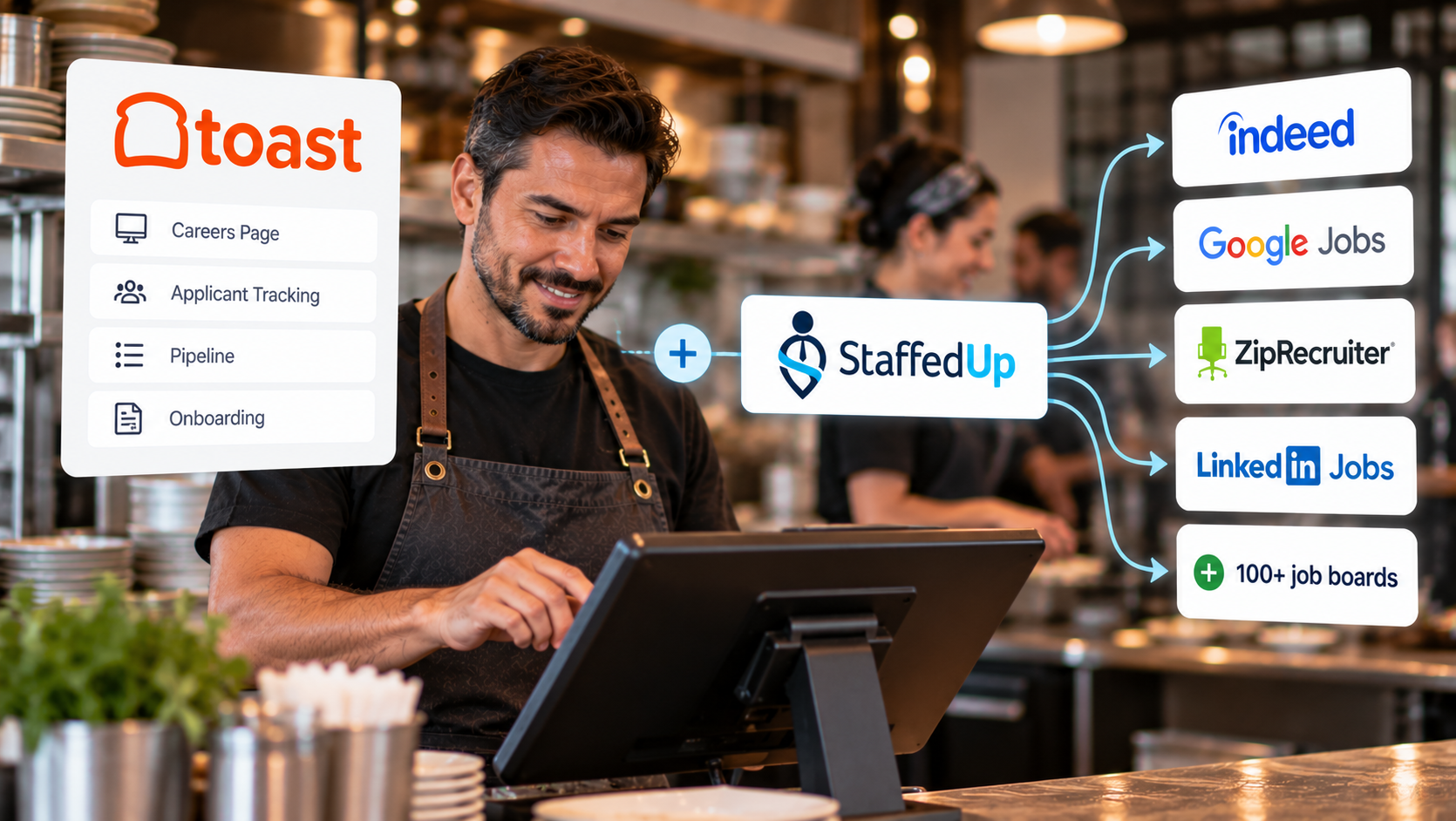
The right Toast hiring alternative isn’t always a full platform switch — sometimes it’s one layer added to what you already have. Toast includes a built-in recruitment module on certain paid plans at additional cost: it posts to an internal Jobs Dashboard or a company Careers Page, tracks candidates through a pipeline, and hands hired applicants directly to Toast Payroll onboarding. What it doesn’t do natively is distribute your posting to Indeed, Google Jobs, ZipRecruiter, or any external job board. If you’re hiring one or two people a year and your candidates already know where to find your careers page, Toast Recruitment is probably enough. If you’re filling multiple roles, dealing with no-shows, or competing for applicants against every other restaurant in your market, you likely need more reach than one careers page provides.
What Toast Recruitment Actually Includes in 2026
Toast Recruitment is an applicant tracking module built into the Toast Payroll & Team Management product (available on the Payroll Pro package) — not a separate hiring application; it lives inside the payroll stack. According to Toast’s own support documentation, the posting workflow is explicit: internal postings go to the Jobs Dashboard visible to existing employees, external postings go to your company’s Careers Page, and selecting “Both” displays the requisition on both. That’s the full distribution scope — no third-party board integration appears anywhere in the documented workflow. The candidate pipeline runs five manual stages (Pre-Interview, Interview, Rejected, Offers, Hired), and the Recruitment Dashboard shows requisition status and reports.
The genuine strength is the onboarding handoff: when a candidate moves to “Hired,” they flow directly into Toast Payroll without re-entering data. If you’re already deep in the Toast ecosystem, that’s a real time saver. Recruiting functionality is available on certain paid plans at additional cost, and plan structures change — verify current inclusions and pricing directly with Toast before any budget decision. For operators still working out what an applicant tracking system actually does for a restaurant, that link covers the basics first.
Why Toast Is a POS Company, Not a Hiring Company
This isn’t a criticism — it’s a product-category reality. Toast built one of the best point-of-sale systems in the restaurant industry; payroll, labor tracking, and tip management are its core. Recruitment was added as a module within the payroll product, not designed from the ground up as a purpose-built hiring tool. The practical consequence: a payroll product’s hiring module reflects payroll priorities — data handoff, compliance, records — not hiring priorities like speed, reach, job distribution, candidate volume, and no-show prevention. Think of it as a Swiss Army knife blade versus a chef’s knife: the Swiss Army knife has a blade and you can cut with it, but when you need to break down forty pounds of mise en place before service, you reach for the chef’s knife. Toast Recruitment works — it’s just not what the tool was designed to do at volume. Restaurants that need a full hiring workflow — distribution, automated screening, SMS engagement, scheduling, digital onboarding — typically end up assembling it from multiple tools, each with its own login and data entry. A dedicated ATS solves that assembly problem.
When Toast Hiring Is Enough (Honest Answer)
Don’t buy software for a problem you don’t have. There are real situations where Toast Recruitment is the right answer: you’re making fewer than 3–4 hires a year; your roles don’t require high-volume screening or fast-cycle hiring; your candidates already know your restaurant (regulars, referrals, walk-ins); the module is already bundled in your plan at no additional cost; or you have a dedicated manager who can manually post to external boards and follow up with applicants daily. In those cases, the onboarding handoff to Toast Payroll is worth more than anything you’d gain from switching — you’d be paying for reach you don’t need. The question that determines your category: when did someone last apply to a job at your restaurant who didn’t already know you existed? If you can’t remember, your reach problem is real. If it happens regularly, you’re probably fine.
The Specific Moments Toast Hiring Falls Short
Gap 1: No multi-board distribution. Toast’s support documentation is clear — postings go to the Jobs Dashboard or your Careers Page, which means your job is invisible on Indeed, Google Jobs, ZipRecruiter, and Monster, where applicants are actually searching. The National Restaurant Association’s job-openings tracker puts context around how many open roles the industry carries at any moment — and how many other operators your careers page is competing against for the same applicant pool.
Gap 2: Candidate velocity and no-shows. Restaurant applicants apply from their phones and expect same-day contact. If another restaurant texts a candidate back in 8 minutes and you check your email that evening, you’ve already lost them. Toast Recruitment has no documented automated candidate re-engagement, two-way SMS workflow, or no-show follow-up sequence; pipeline movement is manual. This is where ghosting and no-shows compound fast — the slower your response, the higher the interview no-show rate.
Gap 3: Screening depth. Toast’s five-stage pipeline moves candidates manually. There are no documented automated screening questions, disqualification triggers based on availability or radius, or scoring on operator-defined criteria — which matters when the alternative is interviewing twenty people to find two who can actually work your hours.
The business stakes: accommodation and food services ran a 65.5% annual turnover rate in 2025 (BLS JOLTS), with hundreds of thousands of open restaurant and accommodation roles at any given time. In a business where two-thirds of your staff turns over every year — and replacing one hourly employee runs well into the thousands of dollars once you count recruiting, onboarding, and lost productivity — a hiring tool that only posts to your own careers page is a structural disadvantage that compounds fast.

| Step | Toast Careers Page (manual) | Dedicated Restaurant ATS |
|---|---|---|
| Job goes live | Careers page only | Indeed, Google Jobs, ZipRecruiter, Monster — simultaneous |
| Application received | Email notification, manual check | Auto-screened against operator criteria |
| Candidate contacted | Manager manually emails or calls | Automated text/email within minutes |
| Interview scheduled | Phone/email back-and-forth | Auto-scheduling link sent to candidate |
| No-show follow-up | Manual, if remembered | Automated re-engagement sequence |
| Onboarding handoff | Flows into Toast Payroll | Digital onboarding included; integration varies |
Keeping Toast POS and Adding a Dedicated ATS
Here’s the part that trips operators up: Toast POS and Toast Recruitment are separate products. Adding a dedicated ATS doesn’t touch your point-of-sale, payroll processing, tip management, labor-cost tracking, or any of the reasons you chose Toast. You’re not making a statement about Toast — you’re filling a gap it wasn’t designed to fill. The parallel workflow in practice: you post a role through a dedicated ATS, it distributes to major boards simultaneously, qualified applicants are screened against your criteria, candidates complete digital onboarding paperwork, and you add the hired employee to Toast scheduling. No double entry on the POS side; the hiring workflow and the operational data live in separate systems doing separate jobs well. Questions to ask any ATS vendor about Toast integration before signing: Does your platform connect to Toast POS? What does that integration actually do — shift sync, labor data, employee-profile handoff? Can you show me working documentation? Demand a live demonstration of the specific mechanic, not a slide deck.
Toast Hiring vs. Dedicated Restaurant ATS — Feature Comparison
Every Toast claim below traces to its primary-source support documentation; every StaffedUp claim comes from the verified platform data set. Verify current Toast plan inclusions directly, as plan structures change.
| Feature | Toast Recruitment | StaffedUp |
|---|---|---|
| Job board distribution | Careers Page + Jobs Dashboard only | Indeed, Google Jobs, ZipRecruiter, Monster + network — one post |
| Automated screening | Not documented | Operator-defined criteria; unqualified filtered before your inbox |
| Candidate SMS engagement | Not documented | Automated text-based engagement |
| Interview scheduling | Manual stage movement | Auto-scheduling link to candidate |
| Time to post (phone) | Module setup required | Under 3 minutes, no desktop |
| Monthly cost | Additional cost on paid plan — verify with Toast | $1 first post → $29/month, unlimited posts |
| Onboarding handoff | Native to Toast Payroll — genuine strength | Digital onboarding included |
| Guarantee | None documented | Qualified applicant in 24 hours or you pay nothing |
“Qualified” means the candidate meets the role criteria you set, is within your radius, is available for your hours, and completed the application. Toast feature rows reflect its documented support materials; capabilities not listed in Toast’s documentation are marked “not documented,” not assumed absent.
What to Look for in a Toast Hiring Alternative
Use this before you evaluate any platform — including StaffedUp. 1. Multi-board distribution — specifically which boards, automatically, at no extra cost per board; don’t accept “we post to job boards,” ask them to show a live Indeed posting from an account like yours in two minutes. 2. Automated screening — operator-defined filters (availability, radius, experience, shift preference) that screen before the application reaches your inbox; requirements vary by state, so check your rules before building a workflow. 3. SMS/text engagement — restaurant applicants aren’t checking email at 2 PM Tuesday; if your ATS doesn’t text within minutes, you’re losing them. 4. Interview scheduling automation — a calendar link to the candidate should be baseline, not an upgrade. 5. Pricing transparency — the full number: base, per-board fees, implementation, renewal terms; some contracts run one to three years with early-termination fees, and StaffedUp’s $29/month includes unlimited posts with no penalty. 6. A real trial — any platform that won’t let you post an actual job before a contract is asking you to buy blind; the $1 first post exists for this. For multi-location operators, also ask about posting multiple locations from one dashboard with role-level permissions. For the broader landscape, the top restaurant ATS platforms covers the full category.
What Operators Experience Adding StaffedUp to Toast
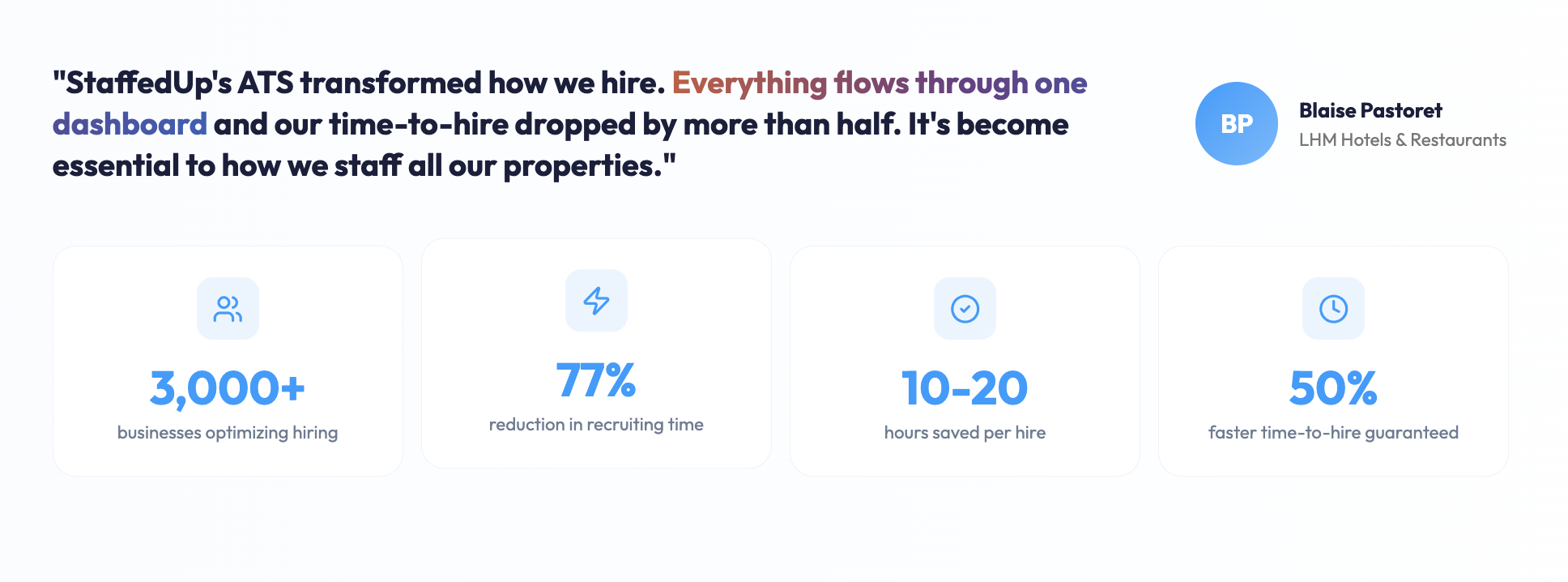
We built StaffedUp after the exact failure this article describes — a Facebook post to zero replies, then $400/month on Indeed for three months with no hires. These are real operator outcomes. Sean O., who runs an Irish Pub & Grill, had been spending $400/month on Indeed for three months with zero hires; he posted on StaffedUp for $1 and had a qualified applicant 18 hours later. Danielle K., who runs an independent bar, posted Thursday night, had three qualified applicants by Friday morning, and hired for Saturday service. Marisol V., at a seasonal bar and grill, received 60 applications and screened to 5 who met her availability and position requirements — the screening story that matters to any operator buried in a pile where half the candidates can’t work the shifts being filled. Across StaffedUp postings, operators see 8x more applicants, 77% shorter time-to-hire, and 45% decreased turnover compared to previous methods. On the cost math: preventing a single bad hire — which runs well into the thousands of dollars to replace — covers years of a $29/month subscription.

Keep Toast — add the reach for $1
Post your first job for $1. It distributes to Indeed, Google Jobs, ZipRecruiter, and more — simultaneously — with screening that filters applicants before they reach your inbox, all alongside the Toast setup you already run. If a qualified applicant isn’t in your inbox within 24 hours, you pay nothing and the charge reverses automatically. Under three minutes from your phone — no demo, no setup call, no contract, cancel in-app. After the first post, it’s $29/month for unlimited active posts.
Frequently Asked Questions
Does Toast have a built-in applicant tracking system?
Yes. Toast Recruitment is a module available on certain paid Toast Payroll plans at additional cost. It includes a candidate pipeline, a careers page for external applicants, an internal Jobs Dashboard, and a handoff to Toast Payroll onboarding when a candidate is hired. It does not include native distribution to external job boards — postings go to Toast’s own infrastructure only. Verify current plan inclusions and pricing directly with Toast, as plan structures change.
Can Toast post jobs to Indeed or other job boards automatically?
No — not natively. Toast’s own support documentation shows job postings going to an internal Jobs Dashboard or an external Careers Page only; there’s no documented third-party board integration in the recruitment workflow. If you need Indeed, Google Jobs, ZipRecruiter, or simultaneous multi-board distribution, you’ll need a dedicated ATS or to post to those boards manually.
Can I use a separate ATS and still keep Toast POS?
Yes. Toast POS and Toast Recruitment are separate products. Adding a dedicated hiring platform doesn’t affect your point-of-sale, payroll, tip management, or scheduling. A dedicated ATS handles the hiring workflow — distribution, screening, candidate engagement, digital onboarding — while Toast handles your operational and payroll data. The two run in parallel without conflict.
Is Toast Recruitment enough if I’m only hiring occasionally?
If you’re making fewer than 3–4 hires a year with no screening complexity, and candidates find you through word of mouth or walk-ins, Toast Recruitment is likely sufficient — and the onboarding handoff to Toast Payroll is a genuine advantage if you’re already in that ecosystem. The case for adding a dedicated ATS gets clear when you’re filling multiple roles simultaneously, competing in a high-demand market, or experiencing consistent no-shows and ghosting.
What are the most important features in a Toast hiring alternative?
Multi-board job distribution (confirm which boards, automatic, no extra per-board cost), automated screening against operator-defined criteria, SMS/text candidate engagement, interview-scheduling automation, transparent all-in pricing, and a real trial option before any contract. Hiring and screening requirements vary by state — check your specific rules before building any workflow.
How do I try a dedicated restaurant ATS without committing to a contract?
StaffedUp offers a $1 first job post — no demo, no setup call, no contract, no desktop, posted from your phone in under three minutes. The guarantee: a qualified applicant in your inbox within 24 hours, or you pay nothing and the charge reverses automatically. “Qualified” means the candidate meets the role criteria you set, is within your radius, is available for your hours, and completed the application. Start at staffedup.com/hire.
Sources
- Toast, Toast Payroll: Get Started With Recruitment and Manage Applicants in the Recruitment Module — posting workflow (internal Jobs Dashboard / external Careers Page), five-stage pipeline, payroll onboarding handoff.
- U.S. Bureau of Labor Statistics, Job Openings and Labor Turnover Survey (JOLTS) — accommodation and food services annual turnover 65.5% (2025).
- National Restaurant Association, Restaurant Job Openings Economic Indicators.
- StaffedUp platform data: 8x more applicants, 77% shorter time-to-hire, 45% decreased turnover — internal aggregate.

Hire Smarter, Faster
StaffedUp simplifies hiring for restaurant & hospitality operators. Post your first job for $1.