
Nonprofit Hiring Software: What Actually Works on a Mission-Driven Budget (2026)
By Billy Giordano, Co-Founder, StaffedUp
Former restaurant operator. Built StaffedUp after running lean teams on zero HR budget — losing a line cook before a Saturday rush taught us what every nonprofit ED learns eventually: when you’re short-staffed, the work doesn’t stop. The mission still has to deliver.
Last updated: September 2026
Nonprofit hiring software is an applicant tracking system (ATS) built or priced for mission-driven organizations that need to fill paid staff roles without a dedicated HR team or a corporate recruiting budget. Pricing ranges from free (with real limitations) to $75–$420/month for general-market tools; for verified 501(c)(3) organizations, StaffedUp’s discount brings that to approximately $7.25/month. If your biggest hiring problem is volume, reach, or screening time, software helps. If it’s compensation competitiveness, no software solves that alone. This post covers both.
What Is Nonprofit Hiring Software — and What It Doesn’t Replace
Nonprofit hiring software is an applicant tracking system: a platform that collects applications, screens candidates against operator-defined criteria, and routes qualified applicants to the hiring manager. You post once, the platform distributes to multiple job boards, and screening filters run before an applicant lands in your inbox — so you see the people who meet your requirements, not everyone who clicked apply. How the StaffedUp ATS works covers the full mechanism; the short version is that it replaces a spreadsheet and a cluttered inbox with a pipeline one person can actually manage.

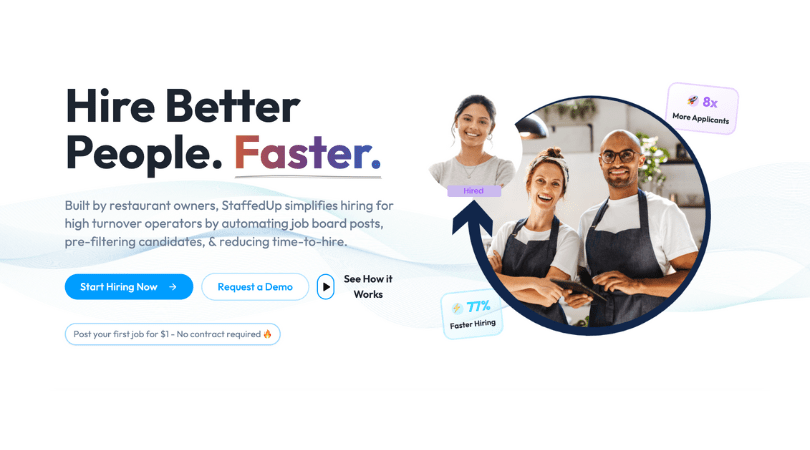
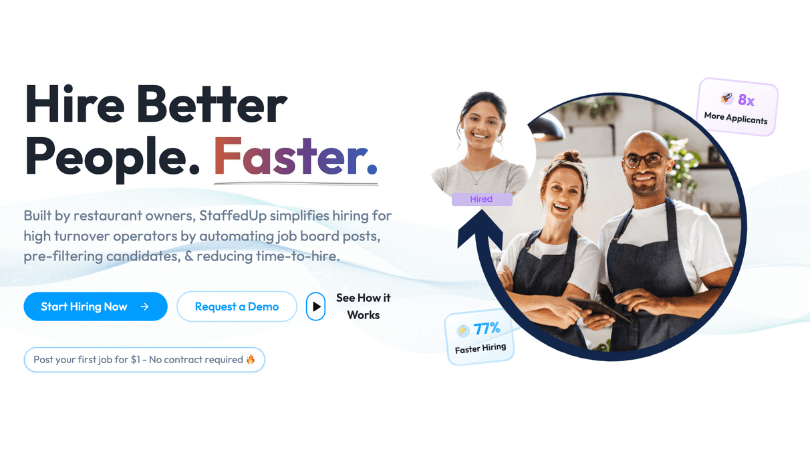
What it is not. It’s not a volunteer management platform — Volgistics, Galaxy Digital, and InitLive handle volunteer sign-ups, shift scheduling, and hour tracking; an ATS is built exclusively for paid-staff hiring, and many nonprofit leaders conflate the two. It’s not an HRIS or payroll system; it stops at the hire. And it doesn’t fix salary competitiveness: if a candidate chooses a corporation’s $72,000 offer over your $48,000, no software changes that math — what it does is help you move faster once candidates apply, so you don’t lose mission-aligned people because someone else responded first. The sector isn’t small, with the Bureau of Labor Statistics putting nonprofit employment at roughly 12.8 million jobs, and 38% of nonprofits plan to add staff this year. Across StaffedUp postings, organizations see 8x more applicants compared to posting without distribution (internal platform data, not independently audited) — the volume is there; the challenge is filtering it.
The Real Cost of Nonprofit ATS Software in 2026: Free, $7/Month, or $75–$420+
Free ATS tools exist. Most free tiers cap active postings at one to three roles, offer limited or no multi-board distribution, and require manual follow-up — fine for an organization hiring one or two people a year with a reliable referral network. For organizations running simultaneous searches or struggling with screening volume, the math changes fast. StaffedUp’s full pricing has the complete breakdown:
| Option | Monthly | Annual | Active Job Limit | Multi-Board | Screening |
|---|---|---|---|---|---|
| Free ATS (typical) | $0 | $0 | 1–3 jobs | Manual only | Basic or none |
| StaffedUp (501c3 rate) | ~$7.25 | ~$87 | Unlimited | Yes — auto-distributed | Operator-defined criteria |
| JazzHR Hero (annual) | $75 | $900 | 3 jobs | Yes | Standard |
| JazzHR Plus (annual) | $269 | $3,228 | 200 jobs | Yes | Advanced |
| Enterprise ATS (typical) | $200–$500+ | $2,400–$6,000+ | Unlimited | Yes | Advanced |
JazzHR pricing as publicly listed, 2026 — confirm directly with the vendor before committing; add-on fees apply for candidate texting and eSignatures on the Hero plan. Enterprise ranges are directional.
The nonprofit discount, specifically: verified 501(c)(3) organizations get 75% off StaffedUp’s standard $29/month rate — approximately $7.25/month, about $87/year, for unlimited active posts. The $1 first post applies to everyone; after it, verified nonprofits pay the discounted rate. Details and the verification process are on the StaffedUp for nonprofits page. Meanwhile, replacing a bad hire runs well over $2,000 for an hourly role and far more for a manager, and a six-week open program-coordinator seat carries real cost in lost capacity, volunteer overload, and service-delivery gaps that dwarfs a year of ATS fees at any tier.
How Nonprofits Compete for Talent Without Matching Corporate Salaries
The salary gap is real, and no hiring software closes it. What software changes is speed and process quality: a clear posting, quick acknowledgment, and timely communication tell mission-driven candidates your organization is worth joining even at lower pay, while a slow, disorganized process signals the opposite. The Careers in Nonprofits data makes the point sharply — the top barrier nonprofit leaders report is a lack of qualified candidates (38%), ahead of salary competition (32%). That’s a sourcing-and-screening problem, and it’s the one software is built for.
Speed matters more than most organizations realize. A mission-aligned candidate is often interviewing at nonprofits and for-profits simultaneously; a nonprofit that responds within eighteen hours beats a corporation that takes two weeks to schedule a first call, because the slower party loses on momentum. When one person hand-reviews 80 applications, the five qualified, mission-aligned candidates surface after three have accepted other offers — the problem isn’t reach or compensation, it’s screening time. Across StaffedUp postings, organizations report 77% shorter time-to-hire (internal platform data, not independently audited). For writing a posting that attracts mission-aligned applicants, that guide covers structure and language.
Grant Funding and ATS Costs — How to Justify Hiring Software in Your Budget
Many grant agreements cap administrative costs, so an ED evaluating hiring software faces a predictable objection: program expense or administrative one? Three framings work for most funders — verify with your specific grant agreement and program officer before reallocating budget lines, since policies vary. Capacity-building: many foundations and government funders explicitly fund technology that makes the organization more effective at delivering its mission, and an ATS that reduces time-to-hire, cuts manual screening, and lowers turnover is a traceable capacity investment. Program support: if the role is a program role, the cost of hiring that person can often be allocated to the program budget, and ATS software used to hire that staff member follows the same logic. ROI for the board: an open program-coordinator role at a $45,000 salary represents roughly two months of lost program capacity during an eight-week vacancy, and a delayed or failed hire costs well into the thousands once you count recruiting, onboarding, and the organizational impact of the gap. Against that, StaffedUp at the verified nonprofit rate costs about $87/year — a program-supplies line item, not an administrative-technology budget fight.

Questions to Ask Every Vendor Before You Book a Demo
Put these to any platform you evaluate, including us: Is there nonprofit pricing, and is it advertised clearly? How are seasonal and part-time hires counted — per seat, per hire, or unlimited? Is there a contract or setup call? How long does setup take for a one-person operation? What happens if you get no qualified applicants? And can it handle multiple simultaneous roles without per-job fees? StaffedUp’s answers: 75% off for verified 501(c)(3)s, unlimited applications and hires, no contract (15-day notice before your next bill), under three minutes from a phone with no demo, a qualified applicant within 24 hours or $0 for the month, and unlimited active posts.
When Does a Nonprofit Actually Need Hiring Software?
No vendor page will publish this section. Here it is anyway. You probably don’t need it right now if you hire fewer than two or three people a year for easy-to-fill roles; your biggest challenge is compensation, not volume or speed; you only manage volunteers with no paid staff; your referral network fills roles reliably within a week or two; or you have zero budget even at the discounted rate. You probably do need it if you’re posting to Idealist, Indeed, LinkedIn, and local boards manually and tracking applicants in an inbox or spreadsheet; roles stay open four or more weeks and you don’t know whether the problem is reach, screening, or response time; you’re getting 30+ applications for a single role and one person reviews them all; you’ve lost a candidate because your response was slower than a competitor’s; or a mission-critical role stayed open long enough to affect program delivery.
Decision Checklist — check all that apply
☐ A role has been open four or more weeks in the past 12 months
☐ We post to multiple job boards manually
☐ We track applicants in email or a spreadsheet
☐ We’ve received 30+ applications for one role and screened them all by hand
☐ One person handles all hiring on top of other responsibilities
☐ We’ve lost a candidate because we responded too slowly
☐ We plan to hire three or more people in the next 12 months
☐ We’re hiring for mission-critical roles where a vacancy affects program delivery
0–2 checked: a free ATS or spreadsheet is probably fine. 3–5: you’re losing time and possibly candidates — a $7.25/month tool is worth the experiment. 6+: open roles are actively costing you mission delivery; this is an operational priority.
How StaffedUp Works for Nonprofits
You post a job once, and StaffedUp auto-distributes it to Indeed, Google Jobs, Monster, and the broader network. Operator-defined criteria run before an applicant lands in your dashboard — qualified means what you define: role requirements, availability, hours, location radius, completed application. Setup takes under three minutes from a phone; no desktop, no setup call, no contract. Pricing: $1 for your first job post, then approximately $7.25/month for verified 501(c)(3)s with unlimited active posts. The guarantee: a qualified applicant in your inbox within 24 hours of the job going live, or the charge reverses automatically and you pay nothing for that month. Across the platform, operators see 8x more applicants, 77% shorter time-to-hire, and 45% decreased turnover (StaffedUp’s own reporting, not independently audited). One customer, Sean O., who operates an Irish pub in Chicago, spent $400/month on Indeed for three months and made zero hires; his first StaffedUp post cost $1 and a qualified applicant was in his inbox within 18 hours — a customer account, not an audited case study, but the same pattern as the ED who has posted to Idealist for eight weeks and received nothing mission-aligned.
Post your first job for $1. Under three minutes from your phone — no contract, no setup call, no demo. If a qualified applicant — meeting your criteria, available for your hours, within your radius, with a completed application — isn’t in your inbox within 24 hours, you pay nothing and the charge reverses automatically. Verified 501(c)(3) organizations then pay approximately $7.25/month for unlimited active posts.

Frequently Asked Questions
What is the best hiring software for small nonprofits on a tight budget?
It depends on how often you hire. For one or two hires a year in easy-to-fill roles, a free ATS is usually sufficient. For nonprofits running three or more searches annually or managing simultaneous openings, a tool with automatic multi-board distribution and operator-defined screening is worth the cost — for verified 501(c)(3)s, StaffedUp’s 75% discount brings that to approximately $7.25/month, about $87/year, for unlimited active posts.
How much does nonprofit hiring software cost per month?
General-market ATS tools start around $75/month (JazzHR Hero, annual billing, three-job cap) and run to $420/month or more, with add-on fees on entry-level plans — confirm with any vendor before committing. Verified 501(c)(3) organizations qualify for StaffedUp’s 75% discount, approximately $7.25/month. Free tiers exist but typically cap active postings at one to three with limited or no multi-board distribution.
Can nonprofit hiring software manage both staff and volunteer applications?
Most ATS platforms, including StaffedUp, are built for paid-staff hiring pipelines. Volunteer coordination is a separate function served by platforms like Volgistics, Galaxy Digital, or InitLive, so an organization managing both will likely need both tools. Employment law draws a clear line between paid employees and unpaid volunteers under the FLSA — see the DOL’s FLSA guidance (Fact Sheet #14A covers nonprofits); rules vary by state, so consult qualified counsel.
What’s the difference between hiring software and volunteer management software?
Hiring software (an ATS) manages the pipeline for paid roles from posting through application, screening, interviewing, offer, and onboarding. Volunteer management software handles unpaid volunteer coordination: sign-ups, shift scheduling, hour tracking, and communication. They’re different products for different functions, and using the wrong tool for the wrong pipeline creates gaps in both.
How do I justify hiring software costs in a grant budget?
Frame it as a capacity-building investment that increases program-delivery capacity by shortening vacancies; if you’re hiring program staff, allocate the ATS cost as a direct program expense rather than administrative overhead; and present the cost-of-vacancy ROI to your board — an open program role costs far more in lost capacity than roughly $87/year in software at the nonprofit rate. Verify with your specific grant agreement and program officer first; funder policies vary.
How can I try StaffedUp for my nonprofit?
Post your first job for $1 at staffedup.com/hire — no contract, no setup call, no demo, under three minutes from a phone. If you’re a verified 501(c)(3), contact StaffedUp to apply the 75% discount to your account. A qualified applicant is guaranteed in your inbox within 24 hours of the job going live, or the charge reverses automatically — $0 for the month. Cancellation requires 15-day notice before the next billing cycle.
Sources
- Careers in Nonprofits / PNP Staffing Group, 2026 Nonprofit Salaries and Staffing Trends Report — 38% plan to add staff, 47% maintain; top hiring barriers: lack of qualified candidates (38%), salary competition (32%).
- U.S. Bureau of Labor Statistics — nonprofit-sector employment, approximately 12.8 million jobs.
- U.S. Department of Labor, Wage and Hour Division, Fair Labor Standards Act, including Fact Sheet #14A on nonprofit organizations.
- StaffedUp, Not-for-Profit hiring software — 75% discount for verified 501(c)(3) organizations.
- JazzHR — publicly listed pricing, 2026; confirm directly with the vendor.
- StaffedUp platform data: 8x more applicants, 77% shorter time-to-hire, 45% decreased turnover — internal, not independently audited.

Hire Smarter, Faster
StaffedUp simplifies hiring for restaurant & hospitality operators. Post your first job for $1.