
No Tax on Tips: The 2026 Restaurant Operator Playbook
By Billy Giordano, Co-Founder, StaffedUp
Former restaurant operator. Built StaffedUp after spending $400/month on Indeed for three months and getting zero hires. Tipped-staff hiring is the hardest operational problem in restaurants — and this law changes the pitch.
Last updated: August 2026
The Short Answer for Operators
In April 2026 the IRS finalized the OBBBA’s “no tax on tips” rules (TD 10044). Employees in qualifying occupations — servers, bartenders, bussers, baristas — can deduct up to $25,000/year in qualified tips from federal income tax for 2025–2028. Your payroll tax obligations don’t change; FICA still applies. But your W-2 reporting changes starting with 2026 earnings — and the law is a recruiting lever you probably haven’t used yet.
What No Tax on Tips Actually Means for Your Payroll
The One Big Beautiful Bill Act (OBBBA), signed July 4, 2025, added IRC §224 — a federal income tax deduction for “qualified tips,” finalized by the IRS as TD 10044 in April 2026. The deduction belongs to your employee, not to you: up to $25,000 per year in qualified tips comes off their federal taxable income, for itemizers and non-itemizers, retroactive to January 1, 2025, through the 2028 tax year. It phases out above $150,000 MAGI ($300,000 joint) and sunsets after 2028 unless Congress extends it — worth stating accurately to staff making multi-year decisions.
In practice: a server earning $20,000 in qualified tips in the 22% bracket saves roughly $4,400 in federal income tax — at filing, not per paycheck. That’s the sentence to brief your managers with, because the most common floor question will be “why does my check look the same?” The deduction shows up on the annual return, not the weekly check; your withholding, remitting, and FICA obligations are unchanged. Across StaffedUp postings, tipped-role candidates are already asking whether the restaurant they’re interviewing with knows about the law — operators who can answer clearly have an edge, starting with a job description that says so.
The FICA Reality: What Still Comes Out of Every Tip Dollar
Say this clearly to every manager: FICA is unchanged. The OBBBA created a deduction, not an exclusion — as RSM US confirms, tips remain fully subject to FICA and other employment taxes. Both the employee’s and employer’s 7.65% shares of Social Security and Medicare apply to all reported tip income, and the $20/month reporting threshold is unchanged (IRS Topic 761). Advertise “no tax on tips” without the FICA caveat and you’re setting up a first-payday disappointment. Be precise — federal income tax on qualified tips, not all taxes.
New W-2 Requirements in 2026: Box 14b and Box 12 Code TP
This is the section most operators haven’t seen — and the one that causes real problems if missed. Starting with earnings in 2026 (the W-2s your staff receive in January 2027), three elements are mandatory: Box 12 code TP (qualified cash tips), Box 12 code TT (qualified overtime), and Box 14b — the employee’s Treasury Tipped Occupation Code (TTOC). The IRS granted penalty relief for 2025; that window is closed, and 2026 is mandatory.
The TTOC is the piece payroll guides underplay: the code determines whether the tips qualify at all. Report the non-qualifying default (code 000) and an eligible server can’t claim the deduction — your error, their cost. The final regulations list more than 70 qualifying occupations; Treasury’s occupation-code list covers a full restaurant roster: 101 bartenders, 102 wait staff, 104 bussers and barbacks, 105 chefs and cooks, 107 counter workers and baristas, 108 dishwashers, 109 hosts. Dual-role employees can carry up to two codes. Confirm each employee’s code with your payroll provider.
Four things to do now — not in December: map every tipped employee to their TTOC today; configure payroll to separate voluntary tip revenue from service-charge revenue; confirm your payroll provider supports Box 12 TP and Box 14b for 2026 W-2s (timelines vary — verify before October); and document each TTOC assignment in the employee’s file. Managing a payroll overhaul while also hiring is exactly the split-focus problem that slows operators down — the ATS handles the hiring half so this project gets your attention.

Mandatory Service Charges vs. Voluntary Tips: The Line That Can Cost You
TD 10044 is explicit: qualified tips are paid voluntarily by the customer — no service charges, mandatory automatic gratuities, or amounts paid in digital assets. If you add an automatic 18–22% gratuity on parties of six or more, those amounts are wages under existing IRS rules, not tips: your staff can’t deduct them, and you can’t report them as qualified tips on the W-2.
Some operators are asking whether to convert auto-grat to a suggested gratuity so staff can benefit. It’s a legitimate question with no universal answer — converting changes payroll classification, may affect tip pooling, and carries state-specific wage-and-hour implications. Don’t change your service-charge structure based on a blog post — including this one. Take it to your CPA. One fix regardless: your POS must separate voluntary tips from mandatory service charges before either number hits payroll. If they flow into one bucket, you have a 2026 W-2 problem to fix now — and how clearly staff understand their take-home is a turnover lever in its own right.
State Conformity: Where the Federal Deduction Helps — and Where It Doesn’t
The federal deduction is real everywhere; the state impact depends on where you operate. Nine states have no income tax, so the federal deduction is the full benefit. Among the 41 income-tax states, Ballotpedia’s May 2026 tracking counts roughly 19 conforming (Iowa, Montana, and North Dakota among them) and roughly 21 not — including California, New York, Illinois, New Jersey, Connecticut, Hawaii, and D.C. New York’s governor has proposed a state-level exclusion, but as of this writing it’s a proposal, not law — verify with the state before promising New York staff anything.
| Bucket | States | Impact on Your Staff |
|---|---|---|
| No state income tax | AK, FL, NV, NH, SD, TN, TX, WA, WY | Federal deduction is the full benefit |
| Conforms | IA, MT, ND + ~16 others (per Ballotpedia) | Double benefit — federal + state |
| Does NOT conform | CA, NY, IL, NJ, CT, HI, DC + others | Federal only; state tax on tips unchanged |
| Pending / partial | NY proposal pending; others moving | Confirm before communicating to staff |
Source: Ballotpedia tracking, May 2026. Not exhaustive, and state legislation is moving — verify your state’s Department of Revenue before acting. In a non-conforming state, be accurate: staff get the federal break, not the state one. Multi-state groups can standardize job-post language with multi-location hiring tools.
The §45B FICA Tip Credit: The Operator Benefit Most Restaurants Never Claim
There’s an operator-side piece of the tax code that goes unclaimed at most operations every year. Under IRC §45B, you receive a general business credit equal to the employer FICA (7.65%) you pay on tips above the amount needed to bring an employee’s cash wage to the applicable floor — and for food and beverage establishments, that floor is frozen at $5.15/hour, the federal minimum as of January 1, 2007. Nearly two decades frozen means nearly all tip income qualifies at most restaurants. The OBBBA left the restaurant-side credit fully intact, and it stacks with the employee deduction — both depend on accurate tip tracking and correct W-2 reporting.
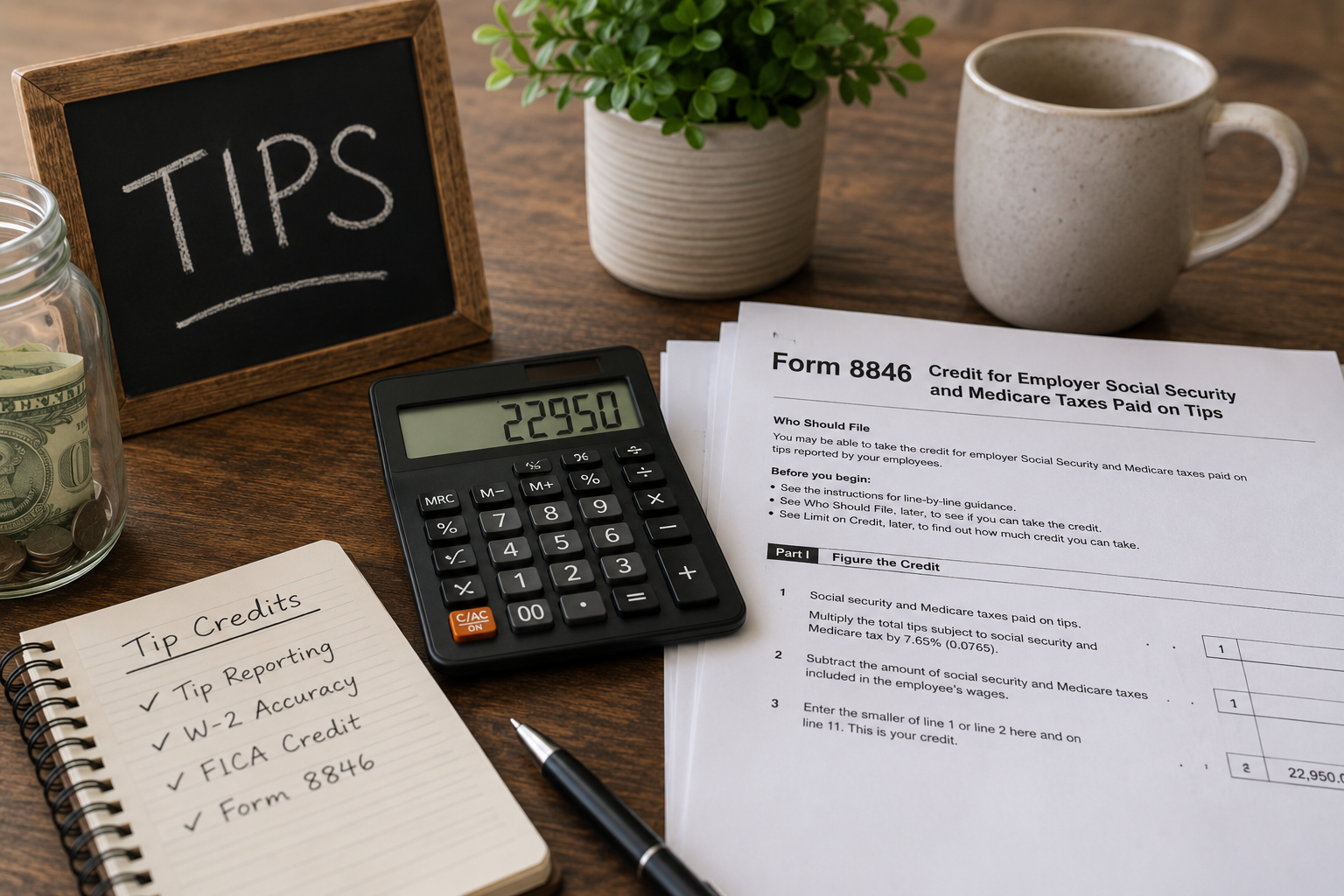
The scale: a restaurant with $300,000 in reported annual tips owes $22,950 in employer FICA on those tips (7.65%), and because of the frozen floor, the credit approaches that full amount at most full-service operations. You’re not double-dipping — §45B(c) reduces your FICA deduction by the credit amount — but a dollar-for-dollar credit beats a deduction in almost every scenario, and it’s one form. Run your number with your CPA using the IRS Form 8846 instructions.
How to Use No Tax on Tips as a Recruiting Lever in Your Job Posts
This is the section no tax firm has written — and the one that affects how many applications you get this week. The server who just watched a TikTok about the tips deduction is comparing your listing to the one down the street, and the post that speaks to what she just heard wins. The honest framing rule first: mention the benefit, but be accurate — federal income tax only, voluntary tips only, 2025–2028, and in a non-conforming state, say the state tax is unchanged. Overpromising costs more in staff trust than the recruiting win is worth.
Three copy options, by placement:
Job-post bullet: “Tips are yours — and under the 2025 federal law, up to $25,000/year in qualified tips is deductible from federal income tax. Keep more of what you earn.”
Job-post paragraph: “We’re a tip-positive operation. Federal law now lets servers and bartenders deduct up to $25,000 in qualified tips per year from federal income taxes — real money back at tax time.”
Offer letter / onboarding: “Your W-2 will carry your Treasury Tipped Occupation Code so you can claim the federal tips deduction on your return. We make sure the reporting is right so you get the full benefit.”
Have your employment attorney or HR advisor review any offer-letter language — requirements vary by state. Brief your floor managers with one usable sentence: “Federal law lets you deduct up to $25,000 in tips from your federal income taxes — it shows up on your tax return, not your paycheck, and your W-2 will have the right codes to claim it.” Danielle K., an independent bar operator, posted a role on a Thursday night through StaffedUp, had three qualified applicants by Friday morning, and hired for Saturday — that’s the speed of this window, and candidates who know about the law are choosing where to apply.
The pitch just got better — use it first
Post your next server or bartender role for $1. If a qualified applicant isn’t in your inbox within 24 hours, you pay nothing — the charge reverses automatically. Under 3 minutes from a phone, no demo, no contract, cancel in-app.
Your 2026 Compliance Checklist: Six Steps Before Your Next Payroll Run
| # | Action | Why It Matters |
|---|---|---|
| 1 | Map every tipped employee to their TTOC (bartender 101, server 102, busser 104, etc.) | Code 000 means an eligible employee can’t claim the deduction — your error, their cost |
| 2 | Track voluntary tips separately from service charges in payroll | Auto-grat is wages, not tips — mixing buckets creates W-2 errors |
| 3 | Confirm your payroll provider supports Box 12 TP and Box 14b for 2026 | Timelines vary — confirm before October |
| 4 | Verify POS tip reporting flows to payroll with no service-charge mixing | The likeliest trigger of a January 2027 W-2 correction cycle |
| 5 | Check your state’s conformity status and brief staff accurately | CA, NY, IL and others don’t conform — no assumed state break |
| 6 | If you’re not claiming §45B, flag it for your CPA before year-end | Dollar-for-dollar credit on employer FICA — one form (8846) most operators never file |
§45B eligibility, your wage floor, and the credit-deduction interaction require a payroll-specific calculation. This isn’t tax advice — take it to your CPA.
Frequently Asked Questions
Does the no-tax-on-tips deduction apply to restaurant employers directly?
Not the way most operators expect. The deduction reduces your employees’ federal income tax on qualified tips — it doesn’t reduce what you withhold, remit, or owe as an employer. What changes for you is the W-2: starting with 2026 earnings, you report each tipped employee’s occupation code in new Box 14b and qualified tips in Box 12 code TP.
Do FICA taxes still apply to tip income under the new law?
Yes, fully. The OBBBA created a deduction, not an exclusion, so tips remain subject to FICA and other employment taxes — both 7.65% shares apply to all reported tip income, and the $20/month reporting threshold is unchanged. Nothing in the law changed withholding procedures or FICA rates; IRS Topic 761 still governs the mechanics.
What are the new W-2 reporting requirements for tips in 2026?
Beginning with amounts earned in 2026, employers report the Treasury Tipped Occupation Code in new Box 14b and qualified tips in Box 12 code TP (qualified overtime uses TT). Box 14 was split into 14a and 14b, and dual-role employees can carry up to two codes. Penalty relief covered 2025 only — 2026 is mandatory, so confirm your payroll provider’s support now.
Do mandatory service charges or auto-gratuities qualify for the deduction?
No. Qualified tips must be paid voluntarily by the customer and don’t include service charges, mandatory automatic gratuities, or amounts paid in digital assets. Auto-grat on large parties is wages, not tips. Whether to convert your structure to a suggested gratuity is a decision to make with your CPA — it changes payroll classification and carries state-specific wage-and-hour implications.
How do I post a job that uses this law to attract tipped applicants?
Lead with an accurate benefit line — federal income tax only, voluntary tips only, through 2028 — using one of the copy options above. Then post at staffedup.com/hire: your first post is $1, and if a qualified applicant isn’t in your inbox within 24 hours, you pay nothing — the charge reverses automatically. Under 3 minutes from a phone, no demo, no contract, then $29/month with unlimited active posts.
Sources
- IRS — Treasury Decision TD 10044, final regulations under IRC §224, April 2026, and the occupation-list announcement.
- U.S. Department of the Treasury — Tipped Occupations detailed list (TTOC codes).
- IRS — Form 8846 instructions (§45B credit); Topic No. 761 (tips withholding and reporting).
- RSM US — technical analysis of TD 10044 and 2026 W-2 requirements.
- Ballotpedia — state conformity tracking, May 2026 (named reference; verify with your state’s Department of Revenue).

Hire Smarter, Faster
StaffedUp simplifies hiring for restaurant & hospitality operators. Post your first job for $1.