
How Much Does It Cost to Post a Job on Indeed in 2026?
By Billy Giordano, Co-Founder, StaffedUp
Former restaurant operator. Built StaffedUp after spending $400/month on Indeed for three months and getting zero hires — then watching a line cook walk out two hours before a Saturday rush with no pipeline to backfill.
Last updated: September 2026
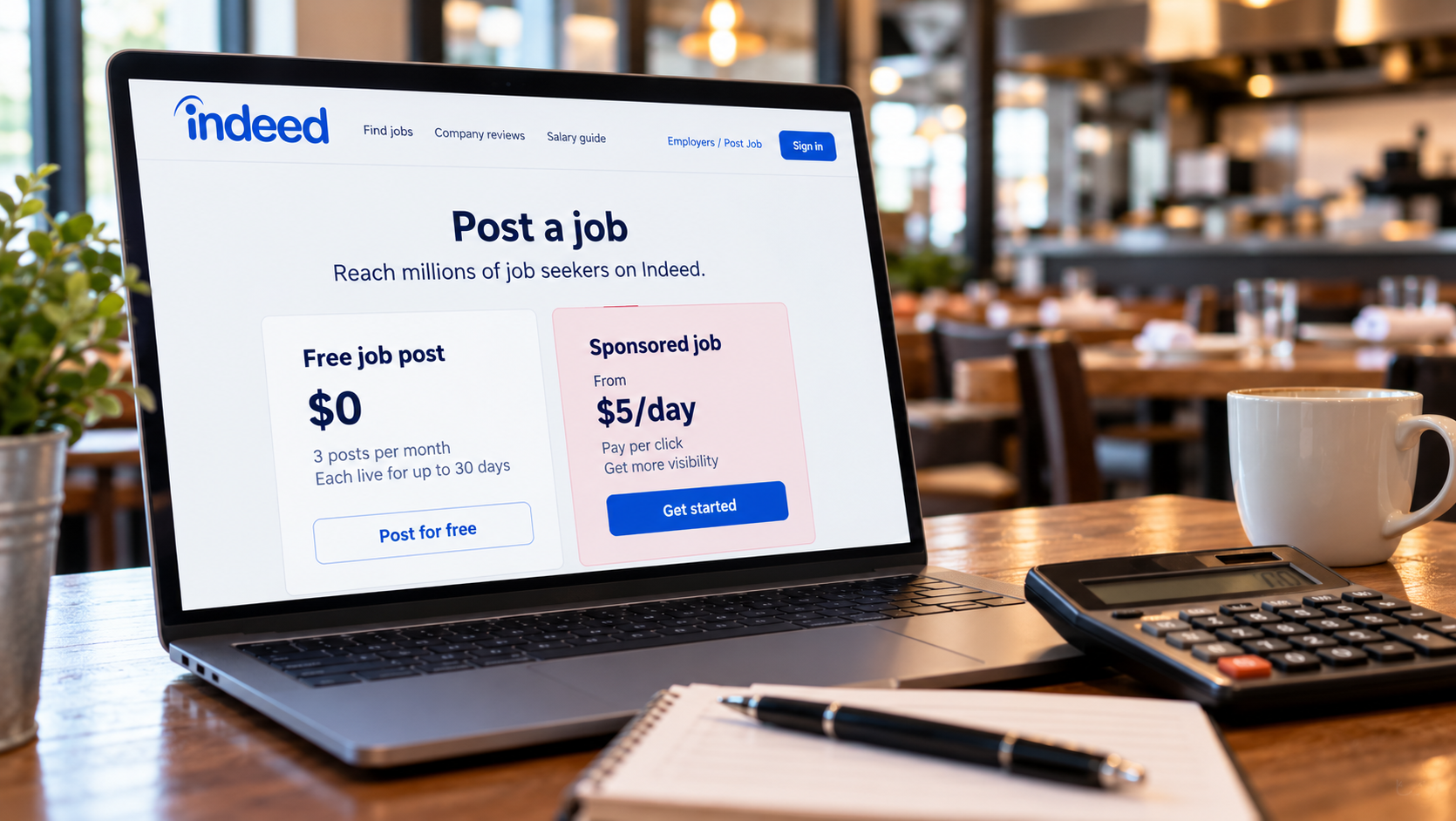
In 2026, posting a job on Indeed is free for up to three postings per calendar month — but free organic visibility is nearly gone for most operators following Indeed’s March 31, 2026 policy change. Sponsored Jobs are the real product now. The interface shows a $5/day minimum, but employer pricing guides consistently report an enforced floor near $25/day per posting since July 2025 (Indeed doesn’t publish this — verify in your account). Indeed retired the pay-per-application model on December 18, 2023; today it’s pay-per-click. Effective cost per application typically lands between $15 and $50 once you divide total click spend by applications that actually complete.
Indeed Pricing Quick Reference (September 2026)
| Tier | Cost | What You Pay For | Key Catch |
|---|---|---|---|
| Free post | $0 | Up to 3/month, 30-day window | Near-zero organic visibility post-March 2026 unless ATS-integrated |
| Sponsored (daily budget) | ~$25+/day per posting* | Clicks to view your listing | Budget is an average, not a cap — up to 7.5× daily budget per week |
| Sponsored (monthly budget) | $150+/month per posting | Started applications | Bills monthly or when account hits $500 balance |
| Resume database | ~$120–$300/month | Access to candidate database | Separate subscription; not bundled with posting |
*The ~$25/day figure is buyer-reported (July 2025); Indeed doesn’t publish it as a rate card. The $150/month floor is on Indeed’s employer help center. Verify both in your account before budgeting.
Free Job Posts — What “Free” Really Means After March 2026
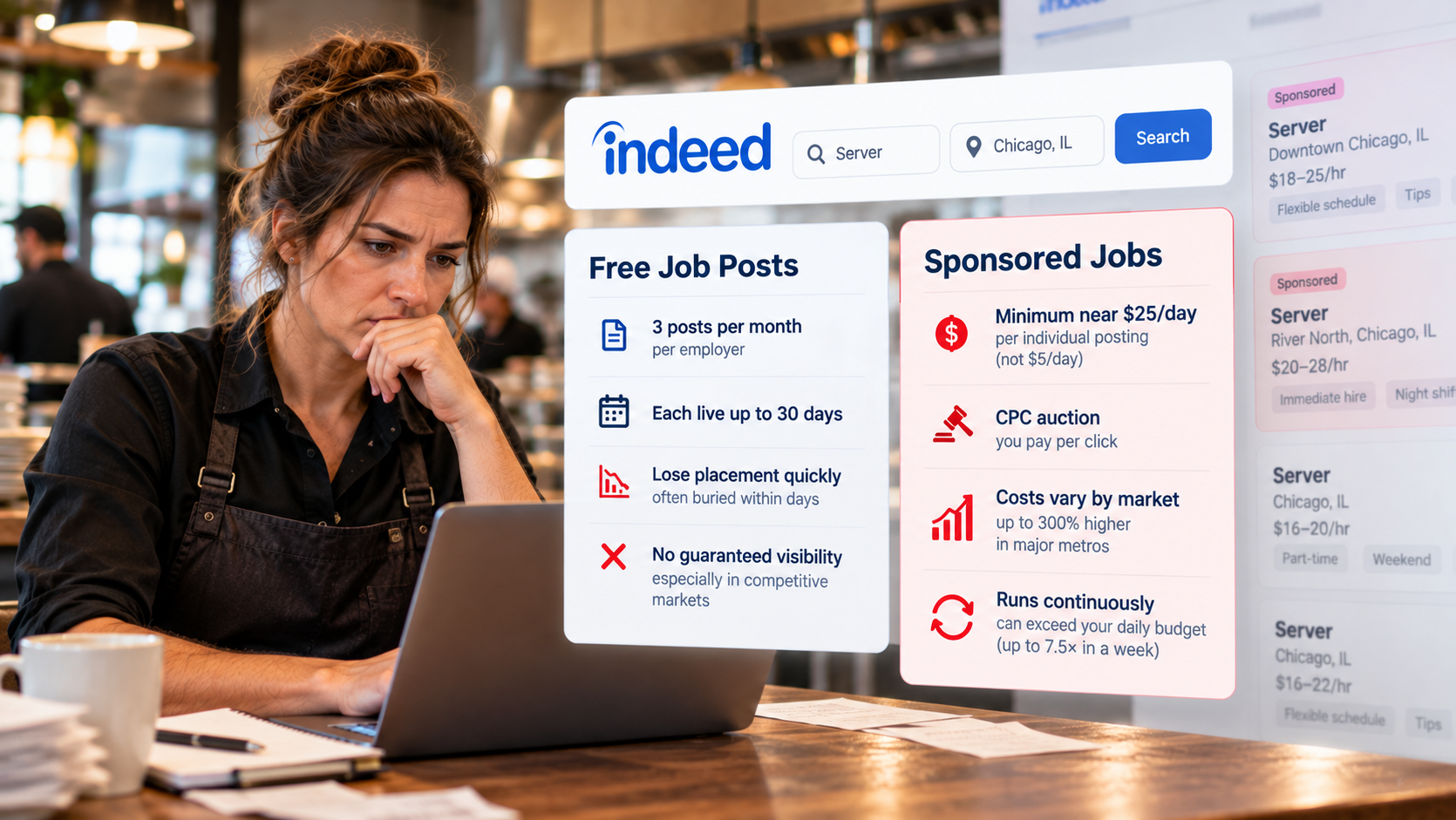
Free posts are capped at three per calendar month, each live up to 30 days. That window sounds useful, but a free server post in a competitive market loses placement to newer listings within a couple of days — by day five it’s buried, and you can be live and still get nothing. The bigger change hit March 31, 2026: Indeed eliminated free organic visibility for jobs sent through single-source XML or API feeds that don’t route through an ATS integration with Indeed Apply. Indeed’s own spokesperson put it plainly — organic visibility for free jobs “is not guaranteed nor will it be consistent over time, particularly in competitive roles or locations.” In restaurant hiring, your server or line cook role competes against dozens of sponsored listings in any metro market. This isn’t a knock on Indeed; it’s the math of a sponsored-first marketplace. To make free posts work as hard as possible, start with a tight, specific listing — here’s how to write a restaurant job posting that actually pulls qualified applicants.
Sponsored Jobs — the Real Daily Minimum (It’s Not $5)
Sponsored Jobs run on a CPC auction: set a daily budget, pay each time a job seeker clicks, and placement depends on your bid against every other employer chasing the same candidates. The interface shows $5/day, but since July 2025 employer pricing guides consistently report an enforced minimum near $25/day per individual posting (Indeed doesn’t publish it — check what your account accepts). Your daily budget is an average, not a strict cap: Indeed won’t exceed 7.5× your daily budget in a week on continuous plans, so a $25/day budget can produce a $175/week charge. The default is “Run continuously,” meaning a sponsored job keeps spending until you manually close it — set a calendar reminder, because operators have come back from vacation to four-figure bills they never intended to run. CPC rates vary sharply: metro rates can run up to 300% higher than rural markets for the same title, so a $25/day server post in Chicago’s River North buys far fewer impressions than in a smaller market. The model isn’t broken — it’s a competitive auction. The problem is that most independent operators don’t realize they’ve entered a continuous auction, in a market where larger chains routinely outbid them by multiples.
Pay-Per-Click vs. Pay-Per-Application — What Changed in December 2023
Indeed ran a pay-per-application model from 2021 and retired it on December 18, 2023 following significant billing complaints; today the engine is pay-per-click. With a daily budget you’re charged when job seekers click to view your post; with a monthly budget you’re charged when they click to start an application — two different actions at two different price points, so read the billing terms before choosing. Invoices arrive on the first of the month or when your balance reaches $500, whichever comes first; running several sponsored jobs at once, that $500 trigger can hit mid-month without warning. Most guides written before 2024 still quote PPA rates of $15–$50 per application as if that’s the current model — it isn’t. And what clicks actually buy you is visibility and traffic, not applications, interviews, or hires. Clicks are the input; applicants are the output, and the gap between those two numbers is where most operators get surprised.
What Does It Actually Cost for a Restaurant Role?
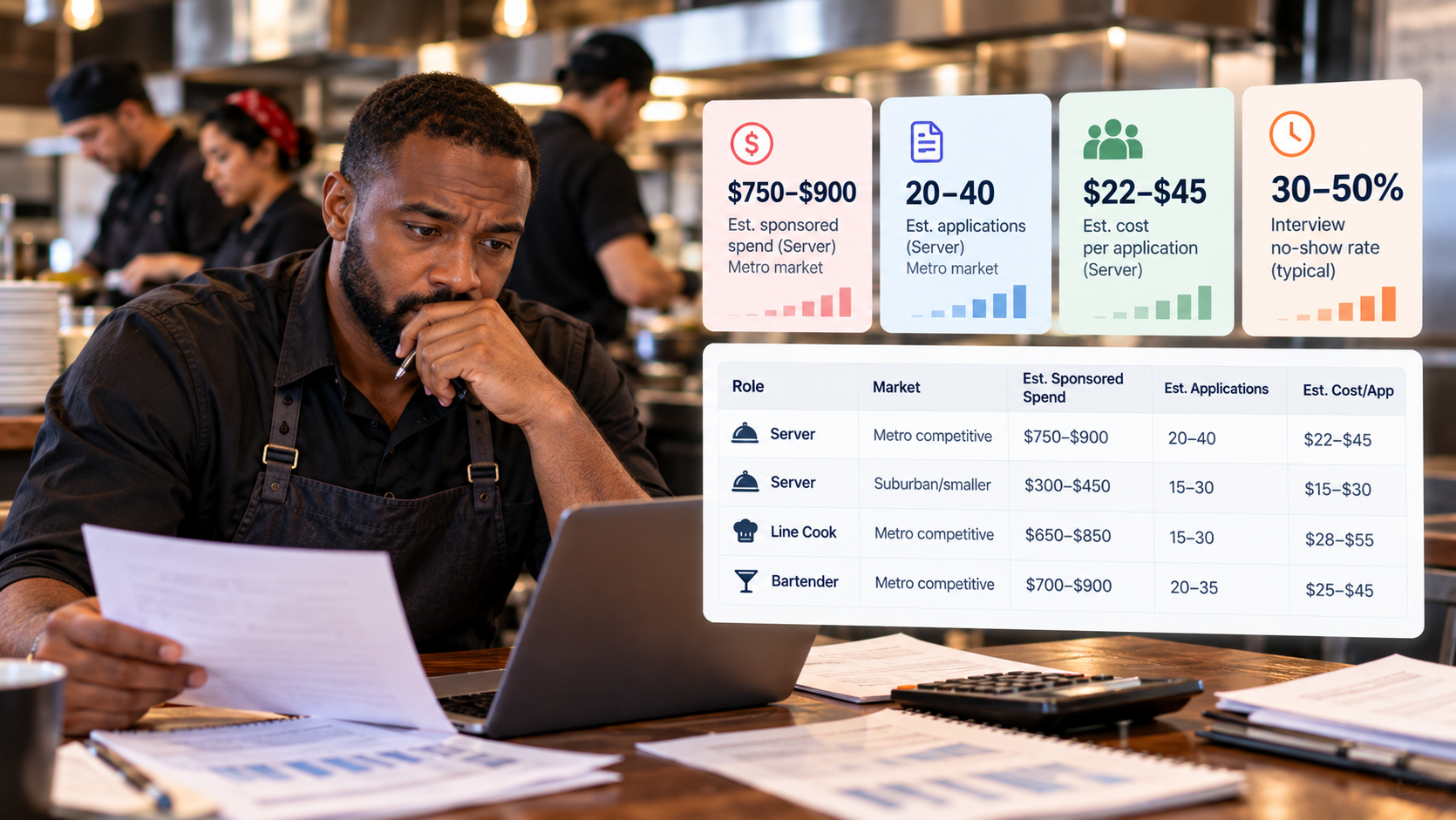
The sponsored spend isn’t the whole cost. Add manager review time (30–60 minutes per role to sort, screen, and message is conservative), interview no-shows (operators consistently report 30–50% of scheduled interviews don’t appear), and repost cycles when the first 30-day window produces nothing. BLS JOLTS data shows accommodation and food services turnover at 65.5% in 2025 — meaning many operators run Indeed campaigns six to eight times a year for the same role, not once. The monthly cost becomes an annual line item that compounds across every position. We ran Indeed for three months at roughly $400/month for BOH roles: $1,200 in spend, zero hires. We know what it feels like to be two people short on a Saturday because the pipeline was empty.
| Role | Market | Est. Sponsored Spend | Est. Applications | Est. Cost/App |
|---|---|---|---|---|
| Server | Metro competitive | $750–$900 | 20–40 | $22–$45 |
| Server | Suburban/smaller | $300–$450 | 15–30 | $15–$30 |
| Line Cook | Metro competitive | $650–$850 | 15–30 | $28–$55 |
| Bartender | Metro competitive | $700–$900 | 20–35 | $25–$45 |
Illustrative estimates based on typical competitive sponsored spend, reported metro CPC multipliers, and average application-to-click ratios from third-party pricing guides. Actual spend and volume vary by market and competition — verify current CPC rates in your Indeed dashboard before budgeting.
The Hidden Costs — Applications, Ghosting, and Manager Time
Sponsored posts buy visibility and clicks — more applications — but do nothing to screen them. In restaurant hiring, raw volume is a trap: you can receive 40 applications on a sponsored server post and find 30 are mass-applies from people who submitted to 80 jobs that day. Of the remaining 10, half won’t respond to scheduling outreach; of the five who schedule, two or three no-show. Every application that doesn’t lead to a hire still cost you a click, so cost-per-hire runs dramatically higher than cost-per-application — and it’s cost-per-hire that determines whether the spend was worth it. Manager time compounds the bill: sorting and messaging applicants for one role takes three to four hours, which at $25/hour manager-equivalent labor is $75–$100 in hidden cost before a single interview. And when a hire doesn’t work out in the first two weeks — which happens regularly, at a cost well into the thousands of dollars once you count recruiting, onboarding, and lost productivity — you restart the campaign, spend the clicks again, and spend the manager hours again. Marisol V., who runs a seasonal bar and grill in Pensacola, received 60 applications from an Indeed campaign; five actually wanted to work. The other 55 cost her real click spend that delivered nothing. It’s what happens when a click-volume model meets an industry with notoriously high application-to-interview dropout. For a deeper look at screening applicants before they hit your inbox, that’s covered separately.
Is Posting on Indeed Worth It for Your Restaurant?
Most vendor pages won’t write this section. We will — because the answer isn’t always “spend more on ads.”
| Your situation | Indeed verdict |
|---|---|
| Single location, 1–2 open shifts, smaller market | Free tier might be enough with realistic expectations; sponsored ROI is marginal |
| Single location, metro market, competitive role | Sponsored required; budget $25+/day and expect a 2–4 week campaign |
| Multi-location, ongoing hourly turnover (65%+ per BLS JOLTS) | Per-role, per-location spend compounds fast; multi-board distribution with built-in screening may be more cost-effective |
If you’re filling one server slot every few months in a slower market, the free tier — with honest expectations about placement — may actually do the job. That’s a real outcome, not a consolation prize. If you’re running a multi-location group with ongoing turnover, run the math on $25+/day per open role per location across the full year before you commit; at scale, that spend compounds fast. The honest comparison isn’t “Indeed vs. nothing” — it’s “Indeed alone vs. Indeed plus a screening layer.”
How Does an ATS Integration Affect Indeed Posting Costs?
StaffedUp distributes jobs to Indeed as part of our ATS integration — so we have a direct stake in this argument. We’re making it anyway because the math is real.
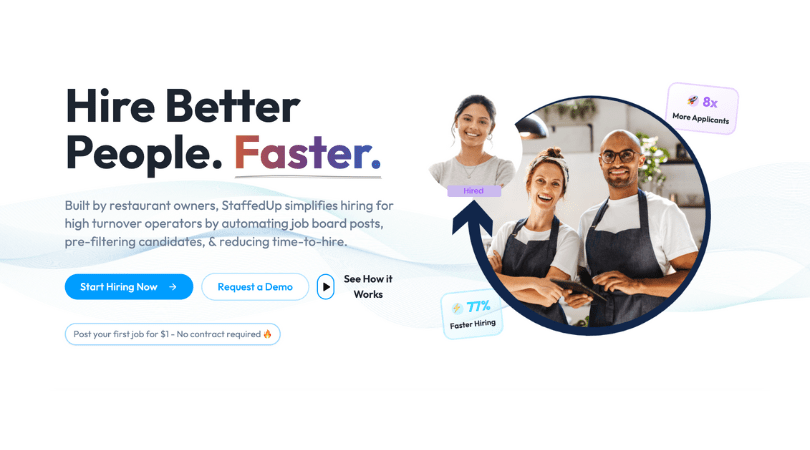
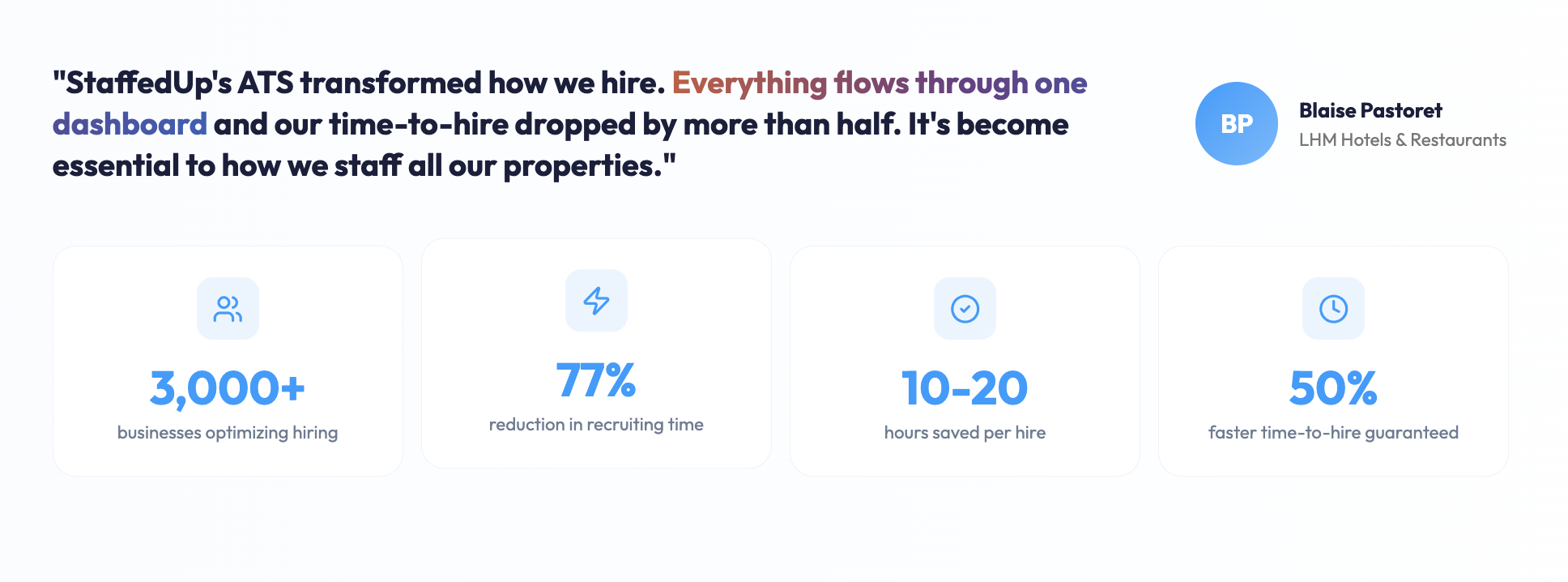
Beginning March 31, 2026, roles sent to Indeed through single-source XML or API feeds no longer receive free organic visibility unless routed through an ATS that supports Indeed Apply. Indeed narrowed access to free organic traffic and gave priority placement to jobs coming through a compliant ATS integration or sponsored campaigns. Routing through a compliant ATS changes this: employers using a supported ATS can still receive organic visibility that directly-posted single-source listings no longer get. With the StaffedUp + Indeed integration, open positions post to Indeed automatically when you mark them “Hiring” in your dashboard — no manual repost, no copy-paste — through a compliant connection that preserves your organic eligibility under the March 2026 policy. Because that same post distributes to additional boards and screens applicants against your criteria first, the per-role cost equation changes materially versus running sponsored-only campaigns on Indeed alone. Danielle K., who runs an independent bar in St. Louis, posted Thursday night, had three qualified applicants by Friday morning, and hired for Saturday. Sean O., who runs an Irish Pub & Grill in Chicago, spent $400/month on Indeed for three months with zero hires, then had a qualified applicant 18 hours after his $1 StaffedUp post. Across StaffedUp postings, operators see 8x more applicants, 77% shorter time-to-hire, and 45% decreased turnover; for multi-unit groups, the enterprise tools manage every location from one dashboard. How the StaffedUp ATS works covers the integration mechanics.
Spend $1, not $25/day
Post your first job for $1. A qualified applicant — meeting the role criteria you define, available for your posted hours, within your radius, with a completed application — lands in your inbox within 24 hours or you pay nothing; the charge reverses automatically. No contract, no demo, no setup call, posted from your phone in under three minutes. After the first post, it’s $29/month for unlimited active posts.
Frequently Asked Questions
Is it really free to post a job on Indeed in 2026?
Yes, with significant limits. Free posts cap at three per calendar month, each live up to 30 days. After March 31, 2026, free posts lost reliable organic visibility for most posting methods — unless your jobs route through a compliant ATS integration with Indeed Apply. In practice, “free” on Indeed in 2026 means limited reach with no guaranteed applicant flow, particularly for competitive restaurant roles in metro markets.
What is the minimum daily budget to sponsor a job on Indeed?
The interface lists a $5/day minimum. Since July 2025, employer pricing guides consistently report an enforced minimum near $25/day per individual sponsored posting — though Indeed doesn’t publish it as a rate card figure, so confirm what your own account accepts. The monthly budget minimum is listed on Indeed’s help center at $150/month.
Does Indeed charge per click or per application in 2026?
Indeed retired the pay-per-application model on December 18, 2023 following billing complaints. Today it’s pay-per-click: with a daily budget you’re charged per click-to-view; with a monthly budget you’re charged when a job seeker starts an application. If you’re reading a guide that quotes PPA rates as the current model, that information is more than two years out of date.
Why did my free Indeed job posting stop getting applications?
Two reasons. First, each free post stays live up to 30 days before losing placement to newer listings — in competitive restaurant roles that can happen within 48 hours. Second, Indeed operates as a sponsored-first marketplace; organic listings receive less consistent visibility than before March 2026. In metro markets, a free server or line cook posting can become effectively invisible within two to three days.
How much does it cost to hire a server or line cook through Indeed?
It depends on your market and how many applicants you screen before finding one who shows up. In a competitive metro market, a 30-day sponsored server posting can run $750–$900 in click spend alone — before manager screening time, interview no-shows, or repost cycles. Effective cost per application commonly lands between $15 and $50, but cost-per-application is not cost-per-hire. (These are illustrative estimates — verify current CPC rates in your dashboard before budgeting.)
How can I try StaffedUp as an alternative to paying more on Indeed?
Your first job post is $1, then $29/month for unlimited active posts. A qualified applicant — meeting the criteria you set, available for your posted hours, within your radius, with a completed application — lands in your inbox within 24 hours or you pay nothing; the charge reverses automatically. No contract, no setup call, no demo. Post from your phone in under three minutes at staffedup.com/hire.
Sources
- U.S. Bureau of Labor Statistics, Job Openings and Labor Turnover Survey (JOLTS) — accommodation and food services turnover 65.5% (2025).
- National Restaurant Association, Restaurant Job Openings Economic Indicators.
- Indeed Employer Help Center, Managing Sponsored Job Budgets. Indeed’s discontinuation of pay-per-application (Dec 18, 2023) per SHRM and Staffing Industry Analysts reporting. Buyer-reported ~$25/day floor per employer pricing guides (2025–2026); not published by Indeed.
- StaffedUp platform data: 8x more applicants, 77% shorter time-to-hire, 45% decreased turnover — internal aggregate.

Hire Smarter, Faster
StaffedUp simplifies hiring for restaurant & hospitality operators. Post your first job for $1.