
Hireology Alternatives for Restaurant and Hospitality Operators: An Honest Evaluation (2026)
By Billy Giordano, Co-Founder, StaffedUp
Former restaurant operator. Built StaffedUp after spending $400/month on Indeed for three months without a single hire — then watching an “URGENTLY HIRING” Facebook post get zero replies before a Saturday rush.
Last updated: September 2026
Hireology is built for franchise compliance and structured multi-location hiring, and it does that well. If you’re a restaurant or hotel operator who needs faster hourly hiring without an approval-chain bottleneck, five alternatives are worth evaluating: StaffedUp, Harri, Workstream, HigherMe, and TalentReef — each a different trade-off.
Why Restaurant Operators Are Searching for Hireology Alternatives
Operators typically hit one of three walls: pricing surprises at the demo, approval workflows that slow frontline hires, or needed features turning out to be separate add-ons. Any one is enough to prompt the search — and the labor context makes it urgent.
BLS JOLTS data puts the accommodation and food services quits rate at 4.5% as of the June 2026 release — the highest of any tracked industry, more than double the 2.2% private-sector average, and corroborated by the FRED series. Even eased from 5.5% a year earlier, the takeaway holds: the candidate who applies Monday is interviewing elsewhere by Wednesday, and a 72-hour approval chain costs you the hire. A GM posting a server role at 11pm can’t wait two business days for sign-off while the candidate down the block accepts a simpler offer. Hireology’s design solves a real compliance problem for large franchise systems; operators searching for alternatives are the ones for whom that isn’t the primary problem. For the broader landscape, see our evaluation of the best ATS for restaurant hiring.

What Hireology Is Built For — And Where It Creates Friction for Hourly Teams
Hireology does several things genuinely well: standardized application stages, compliance documentation, approval chains across locations, franchisor-level reporting, and centralized candidate tracking, which G2 and Capterra reviewer themes consistently praise. It also serves automotive, healthcare, and retail alongside hospitality — real value for holding companies across industries.
That breadth is where friction begins for restaurants. A platform optimized for dealerships and hospital systems is built for structured HR workflows, not for the GM filling a counter position before Thursday’s rush. The approval chain is the pain point: compliance-first design routes hiring through DM-level sign-off, protecting brand standards at scale but creating a 48–72 hour gap during which an applicant accepts elsewhere. It also doesn’t address the biggest loss point — pre-interview ghosting, since hourly applicants expect a response within hours.
What Hireology Actually Costs, and Questions to Ask on Your Demo Call
Aggregators list Essentials around $249/month and Professional around $499/month, with All-In-One custom. Higher tiers bundle more — Professional typically adds career-site upgrades, referrals, text-to-apply, onboarding, and discounted background checks and skills tests, while All-In-One layers in payroll, tax, and compliance. Cost climbs with each tier, so a 10-location group using the full stack spends well above the base. Ask for a written total before signing.
Questions to ask on your demo call:
- What’s the total monthly cost for my location count, including add-ons, and which capabilities are bundled versus billed separately?
- How does background screening work — per check, per hire, or per location?
- Is there a contract, and what are the cancellation terms if I leave early?
- What does implementation cost, and what’s my support path when a GM has a problem at 10pm on a Friday?
For context, StaffedUp is $29/month flat with unlimited active posts and a $1 first post — no screening add-ons, setup fees, or overages. That’s a different category of tool. Both have a place; the question is which problem you’re solving.
| Cost Layer | Hireology (third-party sourced*) | StaffedUp |
|---|---|---|
| Base subscription | ~$249–$499/month (unconfirmed) | $29/month |
| Onboarding | Bundled at higher tiers | Included |
| Background screening | Discounted add-on / per check | Via integrations |
| Contract | Quote-based; confirm terms | No contract; cancel in-app |
| Setup | May carry charges | Under 3 minutes; no setup call |
*Hireology pricing sourced from third-party aggregators, not confirmed by Hireology. Confirm all costs before budgeting. For what StaffedUp includes, see pricing and what’s included.
The 5 Best Hireology Alternatives for Restaurant and Hospitality Operators
General lists tend to recommend BambooHR, Workable, or Greenhouse — white-collar tools with no meaningful restaurant relevance. Here’s the restaurant-and-hospitality-specific shortlist.
1. StaffedUp
Verdict: Purpose-built for restaurant and hospitality operators — the lowest cost of entry here, and the only one with a published price and a 24-hour qualified-applicant guarantee.
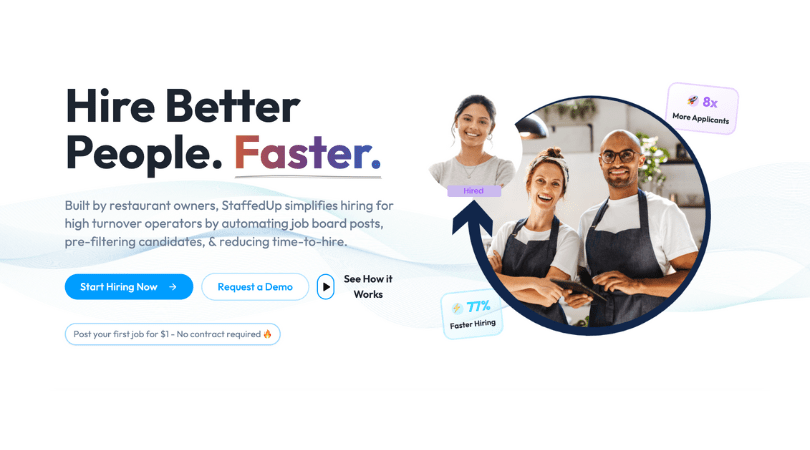
What it does well: Post once and your job distributes to major boards including Monster. Operator-defined screening filters mass-apply volume before applicants reach your inbox. Platform data shows 8x more applicants, 77% shorter time-to-hire, and 45% decreased turnover, with setup under 3 minutes from a phone. Sean O. runs an Irish Pub & Grill; he spent $400/month on Indeed for three months without a single hire, then posted for $1 on StaffedUp and had a qualified applicant within 18 hours.
Honest friction: Less compliance-infrastructure depth than Hireology for large franchise groups needing DM-level approval chains across 50+ locations. Best fit: Independents, small multi-unit operators (1–15 locations), seasonal operations. Price: $1 first post, $29/month after, no contract, unlimited posts. See how StaffedUp screens and routes applicants.

2. Harri
Verdict: Full HCM suite for mid-to-large hospitality groups — the most operationally complete tool here, and the heaviest.
What it does well: Recruiting, scheduling, labor optimization, compliance, and engagement in one platform. For full-service groups and hotels where workforce management matters as much as hiring, the depth is real. Honest friction: G2 and Capterra reviewer themes cite mobile app bugs, missed notifications, and payroll-calculation issues, and add-on modules carry meaningful cost. Less optimized for QSR speed or a hiring-only fix. Best fit: Full-service groups and hotels where scheduling and labor matter as much as the hire. Price: Custom; request a quote.
3. Workstream
Verdict: SMS-first, mobile-first hourly hiring with AI screening built in — strong for high-volume QSR franchise groups.
What it does well: Text-apply workflows, voice and video AI screening, and multi-location tools built around how hourly applicants actually apply — on a phone, not at a desk. Honest friction: Workstream markets itself as a top Hireology alternative — evaluate that with skepticism. Less hospitality-specific depth than restaurant-only tools, and pricing isn’t public. Best fit: QSR franchise operators with high volume who need AI screening speed at the top of the funnel. Price: Not public; request a quote.
4. HigherMe
Verdict: Franchise-restaurant-focused ATS built for the franchise GM workflow.
What it does well: Centralized hiring hub with location-level speed, in-store text-to-apply via QR code, and connected onboarding in the same platform — the franchise workflow is built into the design, with fast setup and no IT. Honest friction: Third-party sources note feature-depth limits at 10+ locations with sustained high volume, and an interface less intuitive for operators new to ATS tools. Best fit: Franchise groups (QSR and fast-casual) where consistent process across locations is the goal. Price: Not public; request a quote.
5. TalentReef
Verdict: Multi-location franchise ATS with in-store kiosk capability, most useful where walk-in applications are a real hire source.
What it does well: Geo-targeted distribution, in-store kiosk applications for walk-ins, and compliance workflows. Acquired by Mitratech in 2022, it fits operators already in that compliance ecosystem. Honest friction: Reviewer themes cite a dated interface, onboarding-portal issues where profiles fail to load (forcing new hires to reapply), and posting edits that require customer service. Product direction has shifted toward compliance since the acquisition — for operators seeking speed, third-party sources call it a lateral move from Hireology, not an improvement. Best fit: Large franchise groups already in the Mitratech ecosystem, or kiosk-heavy operations. Price: Not public; request a quote.
The Two Problems Every Alternative Has to Solve
Two failure points decide whether a hiring tool works for restaurants. The first is the approval chain: a counter position opens Tuesday, the GM posts it, the DM approves Thursday afternoon, and the Wednesday applicant accepted elsewhere Thursday morning — what a 48-hour cycle costs when candidates field multiple offers. Speed-first tools (StaffedUp, Workstream, HigherMe) remove that gap; compliance-first tools (Hireology, TalentReef) trade it for auditability.
The second is mass-apply. Structured questions help filter, but they don’t screen out someone who applied to 40 restaurants in one session with no intent to show. Operators using StaffedUp’s operator-defined criteria have gone from 60 applications down to 5 that matched the role.
When Hireology Is Still the Right Answer for Restaurant Operators
No vendor page will write this section; we will, because it’s true. Hireology is the right call in four cases: franchise groups at 50+ locations with dedicated HR, where the approval chain that frustrates a 5-unit operator is the accountability a 75-unit director needs; multi-industry operators who need one platform across dealerships, healthcare, and restaurants; operators where compliance documentation is a legal priority (requirements vary by state and franchise agreement — check with legal counsel first); and operators where Hireology already works, since switching carries retraining and transition cost rarely worth the mid-season disruption.
The honest bottom line: if compliance consistency across 50+ locations with a central HR team is your priority, Hireology is defensible. If speed-to-hire, cost predictability, and field-manager simplicity matter more — especially under 20 units without dedicated HR — the alternatives deserve a serious look first.

How to Choose: A Framework by Group Size and Hiring Volume
The right hiring tool isn’t the cheapest — it’s the one that produces qualified applicants. Industry estimates put the cost of a bad hourly hire well over $2,000, so a $249/month platform that generates slow approvals and no hires costs more than a $29/month tool with a 77% shorter time-to-hire.
| Your situation | Likely best fit | Why |
|---|---|---|
| Single-location independent | StaffedUp | Lowest cost, fastest start, no overhead |
| 2–5 units, independent group | StaffedUp | Multi-unit dashboard, $29/mo flat, no contract |
| 5–15 units, growing | StaffedUp or HigherMe | Depends on whether speed or compliance is primary |
| 15–50 units, franchise | Workstream, HigherMe, or Harri | Depends on volume, scheduling, compliance needs |
| 50+ units, dedicated HR | Hireology or Harri | Compliance and approval-workflow depth justify cost |
| Hotel/resort (full HCM) | Harri | Workforce-management breadth beyond recruiting |
| QSR, very high volume | Workstream or TalentReef | Text-apply and volume screening built for it |
Changing platforms mid-season is painful, so evaluate alternatives in your slow season — the $1 StaffedUp first post means the test costs a dollar. The right tool is also upstream of retention: qualified applicants who want the job turn over less than volume candidates who took the first offer.
The cheapest test you’ll run this quarter
If you’re evaluating Hireology alternatives, the easiest test costs almost nothing. Post your first job on StaffedUp for $1. If a qualified applicant isn’t in your inbox within 24 hours, you pay nothing — the charge reverses automatically. No setup call, no demo, no contract, under 3 minutes from your phone. If it works, you’ve found your answer. If not, you’ve spent a dollar.
Frequently Asked Questions About Hireology Alternatives
Is Hireology good for restaurants?
It depends on unit count and compliance needs. For franchise groups at 50+ locations where standardized approval chains and compliance documentation are the primary driver, it does that well. For independents and small multi-unit operators where hiring speed is the priority, the structured workflow can cost you candidates while DM approval is pending. Under 20 units without a dedicated HR team, the alternatives above are worth evaluating first.
How much does Hireology cost per month?
Hireology uses quote-based pricing and doesn’t publicly list current figures. Third-party review sites show Essentials around $249/month and Professional around $499/month, with All-In-One custom — none confirmed by Hireology directly. Higher tiers bundle more, and some capabilities are add-ons. Ask for a written breakdown of all fees, including overages, on your demo call. StaffedUp is $29/month flat with no add-on fees.
What is the best ATS for multi-location restaurant hiring?
It depends on unit count and primary need. For 1–15 units prioritizing speed and cost: StaffedUp ($29/month, 77% shorter time-to-hire per platform data). For 15–50 units prioritizing franchise compliance: Workstream or HigherMe. For 50+ units needing compliance infrastructure: Hireology or Harri. For full hospitality HCM: Harri. The right answer is which problem you’re solving, not which tool has the most features.
What are the biggest complaints about Hireology from restaurant operators?
Recurring themes in G2 and Capterra reviews: approval-workflow slowness that delays frontline hiring, pricing opacity where add-ons aren’t bundled in the base tier, and interface friction for field managers. Candidate tracking and compliance draw consistent praise — speed and cost predictability are where friction surfaces most.
How does Hireology compare to Harri for restaurant hiring?
Different tools, different problems. Hireology leads with structured approval chains and compliance documentation — best for franchise compliance priorities. Harri leads with full workforce management (recruiting, scheduling, labor, compliance) — best for full-service groups where operations extend beyond hiring. Hireology is narrower; Harri is broader but heavier to implement. If you only need a hiring fix, both may be more than you need.
How do I try StaffedUp as a Hireology alternative?
Post your first job for $1 at staffedup.com/hire. If a qualified applicant isn’t in your inbox within 24 hours, you pay nothing — the charge reverses automatically. No setup call, no demo, no contract, under 3 minutes from a phone.
Sources
- Bureau of Labor Statistics. Job Openings and Labor Turnover Survey (JOLTS), Table 4 — Quits by industry, seasonally adjusted (June 2026 release). bls.gov/jlt
- Federal Reserve Economic Data (FRED). Quits Rate: Accommodation and Food Services, series JTS7200QUR.
- National Restaurant Association. Restaurant Economic Indicators.
- G2 and Capterra — Hireology reviewer themes cited as aggregate patterns, not individual quotes.
- StaffedUp platform data: 8x applicants, 77% shorter time-to-hire, 45% decreased turnover (internal aggregate).

Hire Smarter, Faster
StaffedUp simplifies hiring for restaurant & hospitality operators. Post your first job for $1.