
Applicant Tracking System Cost: What Restaurants Pay in 2026
By Billy Giordano, Co-Founder, StaffedUp
Former restaurant operator. Built StaffedUp after spending $400/month on Indeed for three months and getting zero hires — then posting “URGENTLY HIRING” on Facebook and getting zero replies when we lost a line cook before a Saturday rush. This is the pricing breakdown I wish existed when I was the operator.
Last updated: September 2026
For a single-location restaurant, applicant tracking system cost runs $1–$100/month on restaurant-specific platforms. StaffedUp is $1 for the first job post, then $29/month flat — unlimited active posts, no contract. Homebase’s hiring tools start free for one location, then $24.95–$99.95/location/month. CareerPlug and Harri both require a sales call before revealing price. Generic SMB tools run $250–$3,000/year. Enterprise platforms (Greenhouse, iCIMS, Lever) run $10,000–$140,000+/year — tools no independent restaurant operator needs. The rest of this post is the math behind those numbers, a comparison table, and an honest section on when you don’t need any of this.
What Does an Applicant Tracking System Actually Cost?
Accommodation and food services is among the highest-separation industries in the U.S. economy — BLS JOLTS data consistently shows separation rates that outpace almost every other sector. Restaurants hire more often than almost any other business type, which changes the ATS cost math entirely compared to how software pricing is usually discussed for office environments.
The useful question isn’t “what does an ATS cost?” It’s “what does it cost per hire at my actual hiring volume?” A $100/month platform that helps you place 10 people is cheaper per hire than a $29/month tool that gets you one. And “free” tiers typically limit job postings, candidate records, or integrations in ways that make active hiring impractical once you’re running two or more open roles — worth evaluating, but check the actual limits before you bank on it.
| Tier | Who It’s For | Price Range | Notes |
|---|---|---|---|
| Free | 1 hire/quarter or less | $0 | Posting/record limits make active hiring impractical |
| SMB flat-rate | Single-location, hiring regularly | $29–$100/mo | Where most restaurant-specific tools live |
| Per-location | Multi-location workforce tools | Varies by count | Compounds quickly at 5+ locations |
| Mid-market | Regional groups, 5–50 locations | $3,000–$15,000/yr | Usually requires a sales call |
| Enterprise | Large chains, 50+ locations | $10,000–$140,000+/yr | Greenhouse, iCIMS, Lever — not for independents |
Mid-market and enterprise ranges reflect industry research estimates. StaffedUp and Homebase pricing verified at their sites, September 2026.

The Four ATS Pricing Models — And Which Fits Restaurants
Understanding the model matters more than comparing sticker prices; two tools at the same monthly rate can cost very different amounts by month six. Per-user/per-seat charges for each manager with access — it scales with headcount, not hiring volume, so it punishes growing teams. Per-vacancy charges each time you open a role (Indeed’s sponsored model) — fine for occasional hiring, expensive fast when you’re backfilling the same server slot three times a quarter. Flat-rate is one monthly fee for unlimited posts and applications — the best model for high-turnover restaurant hiring, and what StaffedUp uses. Per-location charges one fee per site (Homebase’s model) — fine at one or two locations, compounding at three or more. Per-module/add-on looks cheap on the sticker; the real price is in the charged features (video interviews, onboarding, reporting).
Hidden Costs to Watch in ATS Pricing
The sticker price is rarely the steady-state price. Watch for per-location fees that compound as you grow; implementation and onboarding fees ($500–$5,000+ on enterprise tools); integration fees ($30–$100/month to connect payroll, POS, or onboarding beyond base integrations); premium support (phone or live chat as a paid tier — email-only support doesn’t work when your ATS is the reason you’re going into Saturday short three shifts); and annual billing lock-in (10–20% savings are real, so is the commitment — verify cancellation requirements before signing a year). One honest note: StaffedUp’s $29/month includes unlimited active posts, no setup fee, and no per-location charges — that’s on the pricing page, not in the fine print.
Restaurant ATS Cost Comparison: StaffedUp vs. Harri vs. Homebase vs. Sprockets vs. CareerPlug
| Platform | Starting Price | Model | Published? | Honest Notes |
|---|---|---|---|---|
| StaffedUp | $1 first post, then $29/mo | Flat-rate | Yes | Unlimited posts; no per-location fee; 24-hr qualified-applicant guarantee |
| Homebase | Free (1 loc) / $24.95–$99.95/loc/mo | Per-location | Yes | Scheduling-first; hiring tools on Plus and above; per-location fees compound |
| Harri | Quote-based | Custom | No — sales call | Enterprise/multi-unit hospitality depth; single-location operators should expect a redirect |
| CareerPlug | Custom (Limited, Hire, Grow) | Custom | No — sales-gated | Clean interface; no prices published; every CTA routes to a contact form |
| Sprockets | Not published (historical ~$99–$119/mo — unverified) | Per-location/candidate | No | Screening overlay — works alongside an ATS, not instead of one; confirm pricing directly |
Homebase pricing verified September 2026 via joinhomebase.com and third-party sources. StaffedUp verified at its pricing page. Harri confirmed quote-based; CareerPlug sales-gated; Sprockets historical range only. Contact each vendor for your specific configuration.
Homebase is excellent for scheduling and labor-cost management — if you already use it there, the hiring layer is a genuine add-on, just model the per-location cost first. Harri has deep hospitality features for 10+ location operators. CareerPlug’s lack of published pricing is a real barrier for independents. Sprockets fills a niche — hourly screening designed to sit alongside your workflow, not replace it.
Multi-Location Cost: What the Per-Location Model Actually Costs
| Locations | Homebase Essentials (~$24.95/loc) | Homebase Plus (~$59.95/loc) | StaffedUp ($29 flat) |
|---|---|---|---|
| 1 | $24.95/mo | $59.95/mo | $29/mo |
| 3 | $74.85/mo | $179.85/mo | $29/mo |
| 5 | $124.75/mo | $299.75/mo | $29/mo |
| 10 | $249.50/mo | $599.50/mo | $29/mo |
Homebase rates verified September 2026; StaffedUp rate is the published flat price. Neither figure is a quote — contact each vendor for your configuration.
If you’re running 5 locations on Homebase Plus for hiring and scheduling, you’re paying ~$300/month for the hiring layer alone — on a platform not built primarily for hiring. StaffedUp’s flat $29/month covers the full portfolio at the ATS level. Whether that trade-off makes sense depends on how much of your operational workflow lives in Homebase. If you’re deep in their scheduling and payroll, that matters. If you’re using it mainly out of habit, run the numbers. More on how StaffedUp handles multi-location hiring.
ROI Math: What Does It Cost You NOT to Have an ATS?
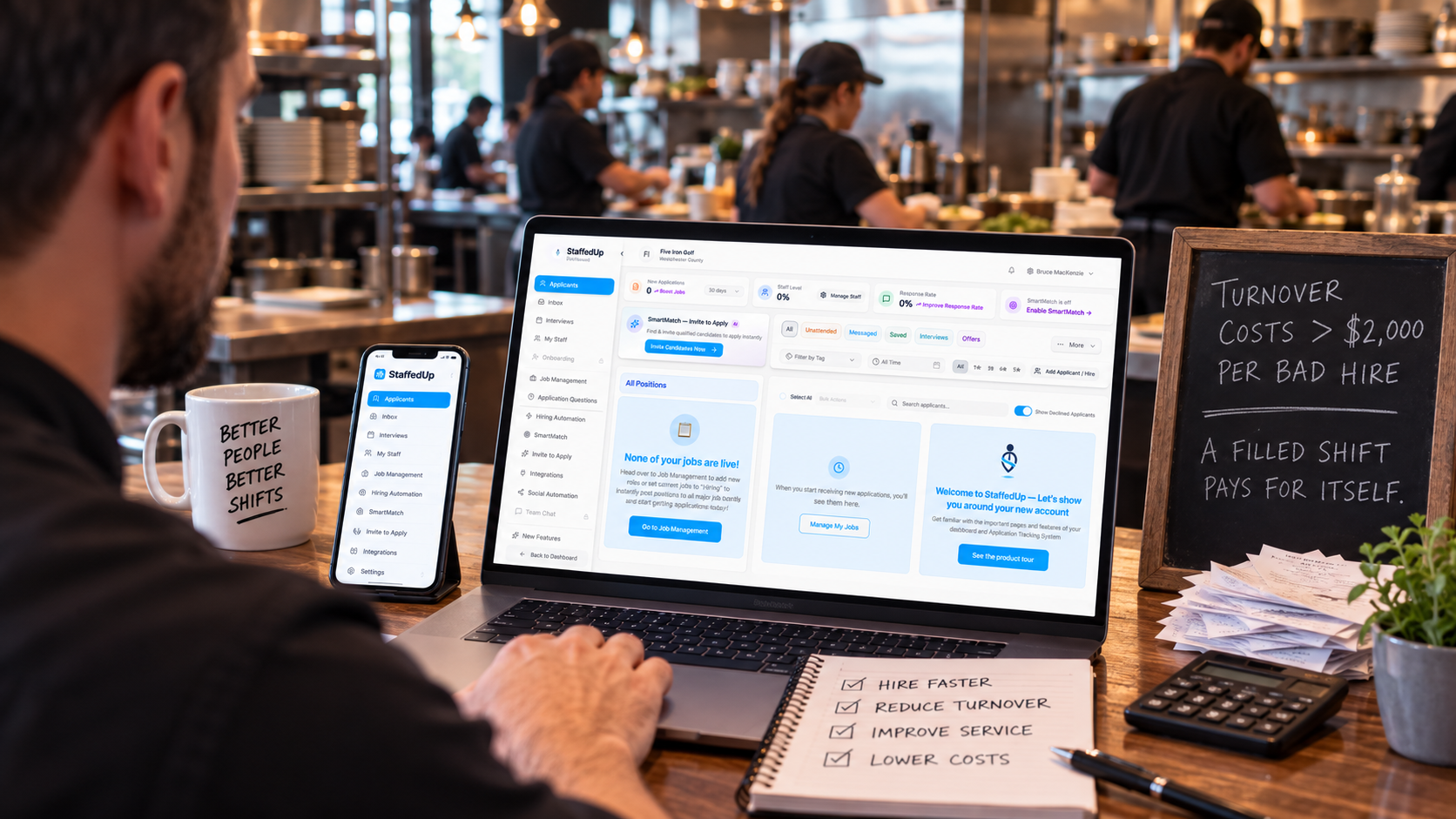
Industry research consistently identifies staffing and retention as top operational challenges — the National Restaurant Association’s State of the Industry research returns to the financial impact of turnover repeatedly. A bad hourly hire runs well over $2,000 once recruiting, onboarding, training, and lost productivity are counted — before the more diffuse cost of degraded service and crew morale while you’re understaffed. The unfilled-role cost is harder to number, but you’ve felt it: three weeks without a line cook means overtime for the people who stayed, degraded ticket times, and a kitchen running on adrenaline instead of process. That’s what the $29/month is measured against — not some abstract “ATS value.”
The per-hire math: StaffedUp is $29/month ÷ 4 hires = $7.25 per hire. Indeed sponsored posts run $5–$15 per click, with a 3–5% apply rate and 15–20% hire rate by operator math — roughly $75–$150+ per hire before any manager review time. Agency/temp placement typically runs 20–30% of first-year salary: a line cook at $18/hour × 2,080 hours is $37,440/year, so a 20% fee is $7,488 per placement — absorbable if rare, punishing as a regular channel.
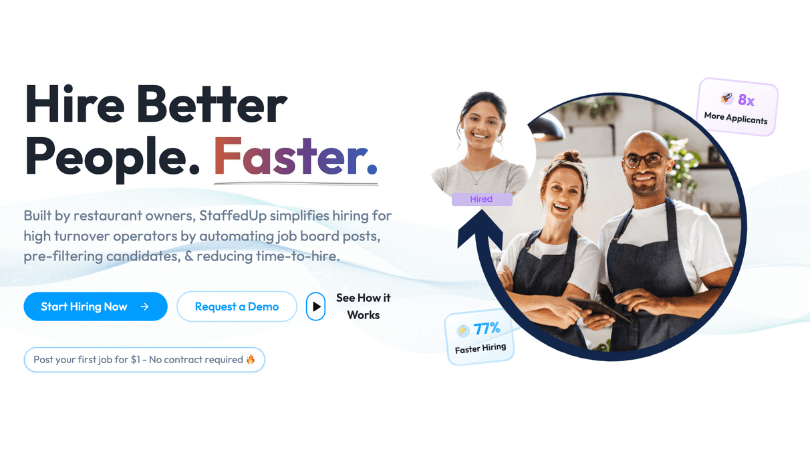
Sean O., who runs an Irish pub and grill in Chicago, spent $400/month on Indeed for three months and made zero hires. He posted his first StaffedUp job for $1, and a qualified applicant was in his inbox within 18 hours. Across StaffedUp postings, operators see 8x more applicants, 77% shorter time-to-hire, and 45% decreased turnover versus prior methods — platform data figures, so your results depend on follow-up speed. ROI on hiring software is real but not automatic. More on how to decrease restaurant turnover beyond hiring.
When You Don’t Need an ATS (Honest Answer)
We built StaffedUp. We want you to use it. We’re also going to tell you when you probably don’t need it.
You hire twice a year, one role at a time. A free Indeed post, Facebook Jobs, or a note in your network might be all you need. If you’re filling one role every six months and have time to review 20 applications manually, the economics of $29/month don’t clearly win.
You already have a workflow that works. If your current system reliably gets qualified people in your door without constant firefighting, don’t fix what isn’t broken. ATS software is for operators who are losing candidates in the process — if you’re not losing candidates, you don’t have that problem.
You’re pre-revenue or haven’t opened yet. Your first-hire challenge is usually a brand problem (nobody knows you) and a network problem (you haven’t built one). An ATS solves neither. Get your name out first.
The shift point — when you do need it. The moment you’re running two or more open roles at once; losing applicants because you can’t respond fast enough on top of running a kitchen; or spending over $100/month on sponsored posts without consistent hires. That’s when the math flips — not because software is magic, but because the process you’re already running costs more than you’re accounting for. We built StaffedUp for operators who’ve hit that point. If you haven’t, we’ll be here when you do.
How to Evaluate ATS Pricing Without Getting Burned by a Demo
Bring this list to every vendor conversation, whatever platform you’re evaluating:
- Get the all-in price, not the starting price. Ask: “What will I pay in month 12 with my actual locations, users, and integrations?” — in writing, before you sign.
- Ask about per-location and per-user fees explicitly, even if they’re not on the pricing page. “Does adding a second location change my bill?” is a pre-signature question.
- Find out what’s not included. Video interviews, digital onboarding, background-check or POS/payroll integration — ask which are add-ons before the demo starts.
- Ask about contract length and cancellation. Month-to-month vs. annual, early-exit terms, notice required. Employment software terms vary by vendor — verify directly.
- Run a real job posting in the demo. Not a canned recording — your actual open role, the mobile manager experience, where qualified applicants land. If they can’t do it in a demo, they can’t do it in production.
- Post $1 before you book any call. If a platform lets you (StaffedUp does), run the real test first. Applicant quality answers the ROI question faster than any sales presentation.
Post your first job for $1. If a qualified applicant — one who meets your criteria, is available for your hours, and is within your radius — isn’t in your inbox within 24 hours, you pay nothing; the charge reverses automatically. No demo, no setup call, no contract. Under 3 minutes to post from a phone, then $29/month for unlimited active posts. The $1 trial exists because the guarantee is the pitch — not the pitch deck.
Frequently Asked Questions
How much does an applicant tracking system cost per month for a restaurant?
For a single-location restaurant, expect $0–$100/month. Free tiers exist but typically limit posting volume or candidate records in ways that make active hiring impractical. Most restaurant-specific ATS tools run $29–$100/month on a flat-rate or per-location model. Enterprise platforms (Greenhouse, iCIMS, Lever) run $10,000–$140,000+/year — not relevant for independent operators.
What is the average ATS cost for a small restaurant or hospitality business?
Industry research estimates the SMB ATS range at $250–$3,000/year, but that includes generic HR tools not built for restaurant hiring. Restaurant-specific platforms with flat-rate pricing start lower: StaffedUp is $29/month ($348/year) with unlimited active posts. The more useful number is cost-per-hire: at $29/month and 4 hires per month, that’s $7.25 per hire.
Are there free applicant tracking systems that actually work for restaurants?
Free tiers are real, but read the limitations first. Homebase offers a free plan for one location covering scheduling and time tracking — hiring tools require the Plus plan. Most free-tier products limit active job posts, candidate records, or integrations in ways that become impractical for a restaurant running multiple open roles. For occasional hiring, a free tier can be enough; for ongoing hiring, a paid platform typically earns back its cost quickly.
What hidden fees should I watch for in ATS pricing?
Watch for per-location fees (each site billed separately), implementation and onboarding fees ($500–$5,000+ on enterprise tools), integration fees for payroll or POS connections, premium support tiers, and add-on charges for features like video interviews or digital onboarding. Always ask: “What will I pay in month 12 with my actual configuration?” — not “What’s the starting price?”
How does ATS pricing change when I have multiple restaurant locations?
Significantly, depending on the model. Per-location tools charge separately for each site — 5 locations on Homebase Essentials runs ~$124.75/month; 10 on the Plus plan runs ~$599.50/month. Flat-rate tools charge one fee regardless of location count, which is almost always more economical at 3+ locations. Enterprise tools use per-employee or custom pricing that requires a sales conversation.
How do I try StaffedUp without committing to a monthly subscription?
Post your first job for $1 at staffedup.com/hire. If a qualified applicant — one who meets your criteria, is available for your hours, and is within your radius — isn’t in your inbox within 24 hours, you pay nothing; the charge reverses automatically. No demo, no setup call, no contract. Under 3 minutes to post from a phone. After the first post, the platform is $29/month.
Sources
- U.S. Bureau of Labor Statistics, Job Openings and Labor Turnover Survey (JOLTS) — accommodation and food services separation data. bls.gov/jlt.
- National Restaurant Association, State of the Industry — staffing and retention data.
- StaffedUp pricing: verified $1 first post / $29/month flat-rate. staffedup.com/hiring-software-pricing.
- Homebase pricing: per-location tiers verified September 2026 via joinhomebase.com and third-party review sources. Harri (quote-based), CareerPlug (sales-gated), and Sprockets (historical range only) confirmed at the same date — verify current pricing with each vendor.
- StaffedUp platform data: 8x more applicants, 77% shorter time-to-hire, 45% decreased turnover — internal aggregate.

Hire Smarter, Faster
StaffedUp simplifies hiring for restaurant & hospitality operators. Post your first job for $1.