
Senior Living Hiring Software: A Dining Director’s Honest Evaluation Guide
By Billy Giordano, Co-Founder, StaffedUp
Former restaurant operator. Built StaffedUp after watching good hiring tools work for restaurants — and realizing no one was building that same speed and screening logic for senior living dining rooms, where the turnover problem is just as bad and the stakes for residents are higher.
Last updated: September 2026
If you’re filling dining servers, dietary aides, line cooks, and dishwashers, choosing the right senior living hiring software matters more than most operators realize. Roles that draw from the restaurant labor pool carry roughly 40% annual turnover in senior living, require fast posting and mobile-first applications, and go to the first operator who responds. For RNs, CNAs, and licensed clinical staff, you need a healthcare credentialing ATS. For dining and F&B roles, you need something built for the hospitality labor pool — faster, simpler, and distributed where those candidates actually look. This guide helps you figure out which tool fits your situation.
Why Senior Living Dining Roles Have the Highest Turnover in the Building
The 2026 McKnight’s/Ziegler State of the Senior Living Workforce survey put average senior living turnover around 35%, with dining staff near 40% — tied with CNAs and just behind RNs. Your dining room is turning over at clinical rates, with none of the clinical hiring infrastructure. And the broader labor market is only tightening: PHI projects 9.7 million total direct-care job openings from 2024 to 2034. Dining roles aren’t counted in that clinical figure, but they draw from an overlapping pool that senior living, hospitals, and home health are all fighting over.
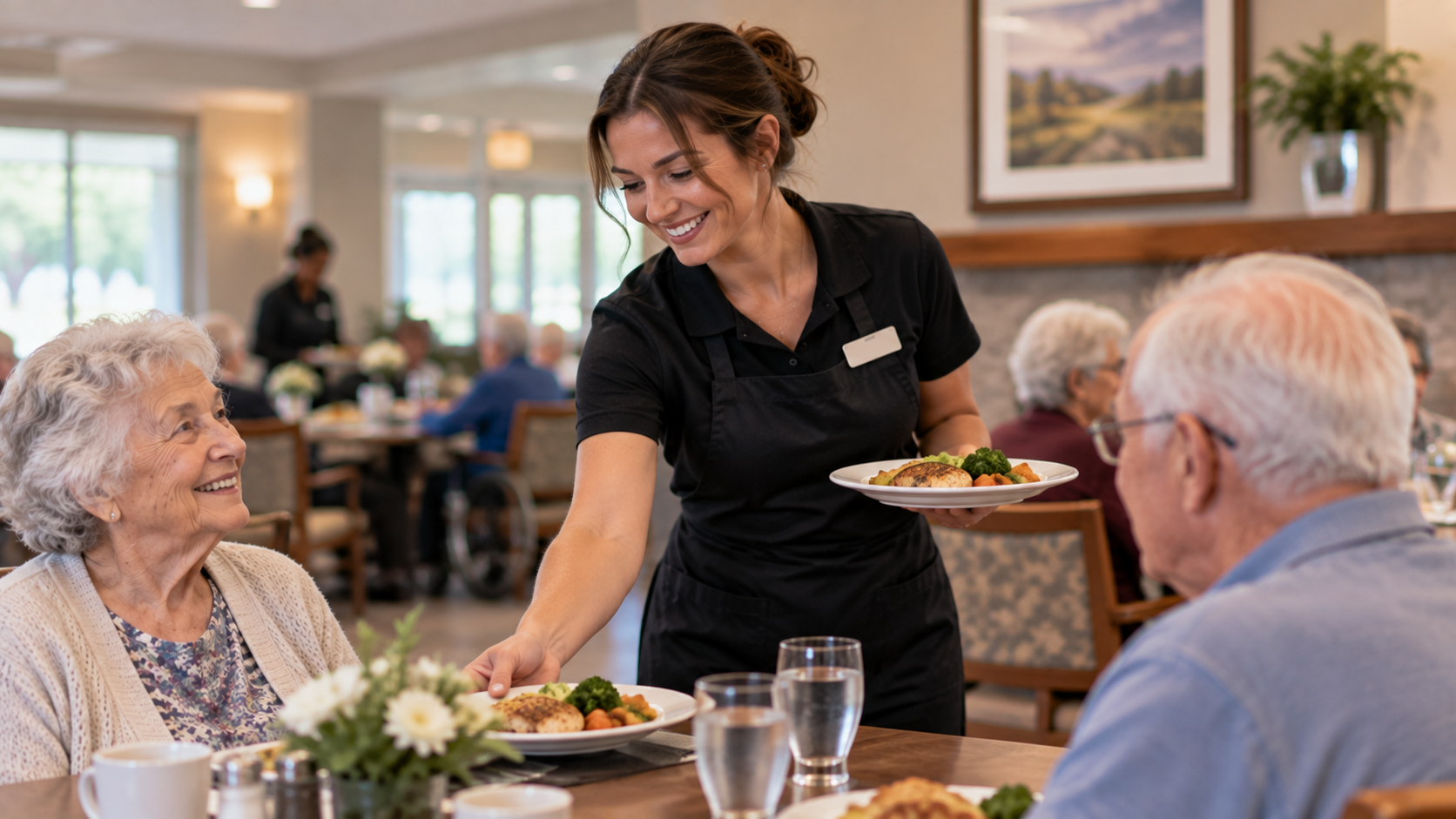
The reason dining roles turn over at this rate is structural. Wages are comparable to fast-casual restaurants, schedule flexibility is often worse, and the physical demands are similar — but the candidates you’re competing for are the same people applying to the burger place down the road, the hotel breakfast shift across town, and the school cafeteria system. They filed five applications in the time it took your HR team to log into your current system. The roles span a real range — servers, dietary aides, line cooks, dishwashers, dining room and dietary managers — each with its own hiring window: a dietary manager hire is a three-week process; a dishwasher hire should be 48 hours if your pipeline works. If it takes two weeks to fill a dishwasher role, the pipeline is broken, not the candidate pool. The tactics that cut turnover in restaurants translate directly to senior living dining, because the candidates come from the same pool.
Background check requirements for food-service staff in senior living vary by state. Check your state’s long-term care licensing agency for current requirements before finalizing any hiring process.

What Makes Hiring for Dining and F&B Roles Different from Clinical Hiring
| Dimension | Clinical (RN, CNA, LPN) | Dining/F&B (Server, Cook, Dishwasher) |
|---|---|---|
| Primary credential check | License verification (state board) | Food handler cert (varies by state), background check |
| Candidate source | Healthcare job boards, clinical networks | Restaurant/hospitality boards, general boards |
| Application device | Mix of desktop and mobile | Predominantly mobile |
| Time-to-fill expectation | 2–6 weeks (credential verification) | 48–72 hours (or you lose them) |
| Competing employers | Other senior living, hospitals, home health | Restaurants, hotels, fast-casual, school food service |
| ATS category that wins | Healthcare credentialing ATS | Hospitality-native ATS |
A clinical ATS with a five-day credentialing workflow isn’t built for dining-server speed — by the time it sends its first automated follow-up, your candidate has accepted a job at a hotel. The screening logic differs too: for clinical roles it means credentials and compliance; for dining roles it means availability for the posted hours, commute radius, and whether the candidate is seriously applying or mass-applying across 40 listings. Those are hospitality screening criteria — what a restaurant ATS is built to filter for. And dining applicants apply from phones: an application requiring a desktop login or more than five minutes loses candidates before they finish.
What to Look For — and What to Deprioritize
Not every platform feature earns its cost for dining roles. What matters: post-once distribution to the boards dining candidates use (Indeed, Google Jobs, ZipRecruiter, Monster); a mobile-first application under three minutes with no login; operator-defined screening criteria for availability, commute radius, and role commitment; mass-apply filtering; a background-check pass-through; and no contract or 12-month lock-in. What NOT to over-weight for a dishwasher hire: license-verification workflows, clinical credential tracking, Joint Commission compliance documentation. Those matter enormously for your clinical ATS — for a dining hire, they add cost and friction for capability you never use. The goal isn’t more applicants; it’s not spending Tuesday afternoon sorting 40 unqualified ones.
Background checks, briefly. Most states require criminal background checks for all employees in licensed senior living communities — including dining staff — plus a sex-offender registry check for resident-facing staff and food-handler permit verification where state code requires it. A platform that integrates a background-check pass-through covering criminal history and sex-offender status is appropriate for dining roles; full clinical credentialing is overkill for a server. Requirements vary by state and licensure type — confirm current mandates with your state’s long-term care licensing authority. Nothing here is legal advice.
When to Use a Hospitality ATS vs. a Healthcare ATS
No vendor competing on this topic will write this section, but you deserve a straight answer before spending money on the wrong tool. Use a hospitality-native ATS (like StaffedUp) when you’re hiring dining servers, dietary aides, line cooks, dishwashers, and activities staff; when you need qualified applicants in 24–48 hours; and when you run one community or a small portfolio with a lean HR team. Use a healthcare ATS (Apploi, symplr, Activated Insights) when you’re hiring RNs, LPNs, CNAs, and medication aides requiring license verification; when you need clinical credentialing at scale across multiple state boards; and when you’re a large regional operator with a dedicated compliance function. If you have 80 residents and three open dining-server shifts this weekend, you don’t need a $500/month clinical ATS with a 90-day implementation — you need qualified candidates in front of you within the hour.
What StaffedUp is and isn’t: we’re a hospitality-native platform built by restaurant operators to fill dining, F&B, and hourly hospitality roles fast, with qualified applicants screened by your criteria. We are not a clinical credentialing platform and we don’t pretend to be — for RNs, CNAs, and licensed staff, talk to Apploi or symplr; they’re purpose-built for that and they’re good at it. If you manage both layers, be honest about whether you need one tool for the whole building or two.
The Real Cost of an Unfilled Dining Shift
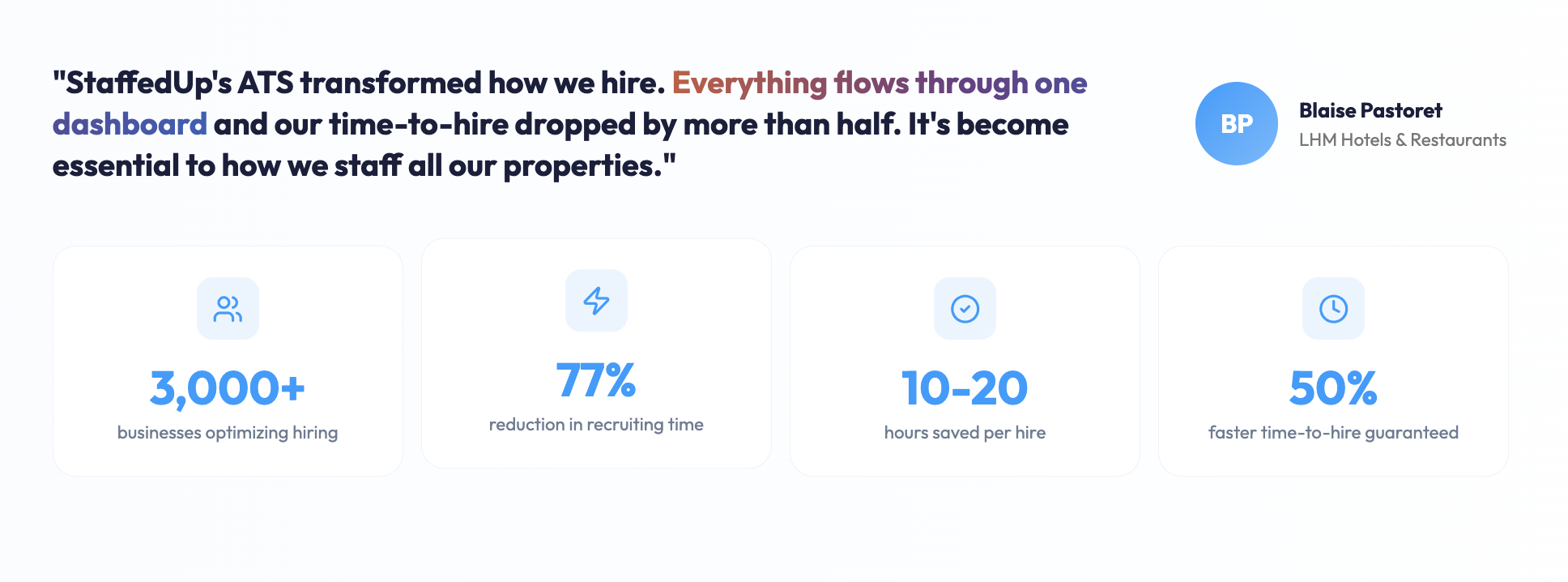
The clinical side of senior living has well-documented replacement-cost data; the dining side doesn’t. Here’s the math you can use. Agency or temp labor for a single unfilled dining-server shift typically runs $18–$28/hour versus a standard $14–$17 — a delta of roughly $30–$55 per shift at a four-hour minimum. A community carrying three open dining shifts a week that takes three extra days to fill each absorbs roughly nine shift-days of vacancy cost every week the pipeline isn’t working. Beyond that, replacing a bad hourly hire runs into the thousands of dollars once you count recruiting time, onboarding, and early-turnover replacement — build the case using your community’s actual rates; the directional argument holds. StaffedUp platform data shows 77% shorter time-to-hire, which turns a typical 14-day dining-server fill into roughly 3–4 days.
| Hiring Stage | Without ATS (Manual) | With Hospitality ATS (StaffedUp) |
|---|---|---|
| Post job across boards | 2–3 hours (manual on 3–4 boards) | Under 3 minutes (post once, auto-distributes) |
| First qualified applicant | 3–5 days | Within 24 hours (or you pay $0) |
| Application review | 2–4 hours sorting unqualified applicants | Qualified applicants only in inbox |
| Total time-to-first-interview | 5–9 days | 1–2 days |
Sean O. runs an Irish pub in Chicago. He spent $400/month on Indeed for three months and got zero hires; his first StaffedUp post cost $1, and he had a qualified applicant in 18 hours. The problem Sean had at his pub is identical to the one your dining director faces Monday morning: incumbent job-board spend produces noise; a platform built for that labor pool produces a candidate who actually wants the role.
Eight Questions to Ask Before You Sign
Bring these to any vendor conversation, not just ours: Does it distribute to the boards where dining candidates actually apply (Indeed, Google Jobs, ZipRecruiter, Monster), not just clinical networks? Can you post in under five minutes from your phone, with no demo or setup call? Can you set your own screening criteria without a support ticket? Does it filter mass-apply bots before they hit your inbox? What does the background-check integration cover — is a criminal-history and sex-offender pass-through built in, or an add-on? Is there a contract, or can you cancel easily? What does it truly cost per month and per first hire, with all fees included? And can the vendor show you named operators — real people, real communities, real roles — who solved exactly this problem?
StaffedUp for Senior Living Dining
Post once, and the job distributes automatically to every major board, including Monster via official partnership. Mass-apply and unqualified applications are screened out by the criteria you set — availability, commute radius, role-specific questions — and qualified applicants land in your inbox. No setup call, no desktop, no contract, and you can post from your phone in under three minutes. Across the platform, operators report 8x more applicants, 77% shorter time-to-hire, and 45% decreased turnover (StaffedUp’s own reporting, not an independent study). Danielle K. runs an independent bar in St. Louis: she posted Thursday night, had three qualified applicants by Friday morning, and hired for Saturday — the same timeline a dining director needs, from the same labor pool, with the same urgency. The honest scope, restated: if you’re filling dining servers, dietary aides, and line cooks, this platform is built for you; if you’re filling RNs and CNAs and need license verification at scale, talk to a healthcare ATS.
Post your first dining or F&B role for $1. Live in under three minutes from your phone — no setup call, no demo, no contract. If a qualified applicant — meeting your criteria, available for your hours, within your radius, with a completed application — isn’t in your inbox within 24 hours, you pay nothing and the charge reverses automatically. After the first post, it’s $29/month for unlimited active posts, cancel anytime in-app.
Frequently Asked Questions
What is the best hiring software for senior living communities?
There’s no single best platform for the whole building — the right answer depends on the role. For clinical staff (RNs, CNAs, LPNs) requiring license verification and credentialing, healthcare ATS platforms like Apploi or symplr are purpose-built and the right tool. For dining servers, dietary aides, and dishwashers, a hospitality-native platform like StaffedUp outperforms on speed, distribution, and availability-based screening. Many communities run both.
How do I hire dining staff for an assisted living community?
Post on boards where restaurant and hospitality candidates look — Indeed, Google Jobs, ZipRecruiter, and Monster at minimum. Make the application mobile-friendly, set screening criteria for availability and commute radius rather than clinical credentials, and respond within hours — a dining server who applied Tuesday morning is evaluating other offers by that afternoon. A hospitality-native ATS automates distribution and screening so only qualified applicants reach your inbox.
What’s the difference between a senior living ATS and a general hiring platform?
A healthcare ATS (like Apploi or symplr) handles license verification, credentialing, and compliance documentation for clinical staff. A hospitality-native ATS (like StaffedUp) is built for hourly roles: fast posting, multi-board distribution, mobile applications, and screening for availability and reliability. Senior living communities often need both — one for clinical staff, one for dining. Using a clinical ATS to fill dishwasher positions costs more and moves slower than you need.
What is the average turnover rate for dining staff in senior living?
A 2026 McKnight’s/Ziegler workforce survey reported dining staff in senior living carry roughly 40% annual turnover — comparable to CNAs and among the highest of any department, against an overall senior-living average near 35%. Dining consistently ranks among the higher-turnover departments even as sector-wide numbers improve modestly, because these roles compete directly with restaurants, hotels, and fast-casual chains for the same workers.
How long does it take to fill a dining server position in senior living?
Without a dedicated tool, 7–14 days is typical — manual posting, application review, scheduling back-and-forth, and interview-to-offer time. StaffedUp platform data shows 77% shorter time-to-hire, moving a 14-day process down to roughly 3–4 days, and the 24-hour guarantee means a qualified applicant is in your inbox the same day you post, or you pay nothing.
Can I try hospitality hiring software for senior living dining without a long-term contract?
Yes. StaffedUp’s first job post is $1 — no setup call, no demo, no contract. Post from your phone in under three minutes. If a qualified applicant isn’t in your inbox within 24 hours, you pay nothing — the charge reverses automatically. After that, it’s $29/month for unlimited active posts with easy in-app cancellation. It’s the lowest-risk way to see how a platform built for this labor pool compares to what you’re doing now.
Sources
- PHI, Direct Care Workers in the United States: Key Facts 2025 — 9.7 million total direct-care job openings, 2024–2034.
- McKnight’s Senior Living / Ziegler, 2026 State of the Senior Living Workforce — average turnover ~35%; dining staff ~40%.
- Hospital & Healthcare Compensation Service / NCAL / LeadingAge — Assisted Living Salary & Benefits Report (turnover by department).
- StaffedUp platform data: 8x more applicants, 77% shorter time-to-hire, 45% decreased turnover — internal reporting.

Hire Smarter, Faster
StaffedUp simplifies hiring for restaurant & hospitality operators. Post your first job for $1.