
Restaurant Recruitment Tools: What You Need at Every Stage
By Billy Giordano, Co-Founder, StaffedUp
Former restaurant operator. Built StaffedUp after watching a $400/month Indeed spend produce zero hires in three months — and losing a line cook before a Saturday rush with no backup plan.
Last updated: September 2026
Restaurant recruitment tools are the software a hiring manager uses to post jobs, reach applicants, track who applied, communicate fast enough to prevent ghosting, schedule interviews, and get a new hire through their first week. For most independent and small-chain restaurants, that’s 2–3 tools, not ten. The mistake most operators make is using only a job board, which gives you volume, not quality. The opposite mistake is adding ATS features built for corporate recruiters, not a three-person team running a Friday night rush. This guide covers what you need at each stage and what you can skip.
What Are Restaurant Recruitment Tools, Really?
In corporate HR, “recruitment tools” spans AI sourcing engines, video interview platforms, behavioral assessments, and branding dashboards — built for companies with dedicated HR departments, 30-day hiring cycles, and candidates who’ll wait through multiple rounds. That’s not your hiring cycle. Restaurant hiring moves in 48–72 hours or it doesn’t move at all: the candidate who applied Tuesday morning has three other offers by Wednesday. Every tool in your stack has to match that cadence, or it creates friction instead of help.

For a restaurant operator, recruitment tools cover five stages — attract applicants, capture and organize applications, screen and communicate fast enough to prevent ghosting, confirm and schedule interviews, and onboard the hire — supported by three layers: distribution, screening and communication, and scheduling and confirmation. Most independent restaurants run all three through one ATS; multi-location groups add onboarding and reporting on top. With accommodation and food services quitting at the highest rate of any industry (FRED puts annual hospitality turnover roughly in the 65–74% range), you’re not hiring once a year — you’re hiring continuously, and your tools determine whether that’s a manageable process or a weekly crisis.
Stage 1: Getting in Front of Enough Applicants
The sourcing stage is about reach — getting your posting in front of people looking for shifts right now. Hourly hospitality workers search Indeed (the volume leader), ZipRecruiter (algorithmic matching), Google for Jobs, Facebook Jobs, and hospitality-specific boards like Poached and Culinary Agents. What none of them solve alone is quality: a single Indeed post at a busy urban restaurant can generate 80–120 applications in 48 hours, most of them mass-apply bots or applicants who don’t meet your availability requirements. Volume without screening is a time tax — you’re sorting applications at 10pm instead of running your operation.
A distribution layer solves reach without multiplying your effort: post once, the platform pushes your listing to multiple boards at once, and your screening criteria apply consistently so unqualified applications never reach your inbox. StaffedUp platform data shows operators using multi-board distribution generate roughly 8x more applicants than single-board posting. Branded application pages and QR-code scan-to-apply let candidates apply from your website, a host-stand code, or a back-of-house poster in under three minutes on a phone — hourly applicants drop off fast when an application needs a desktop and a 20-minute form. The operators filling the industry’s hundreds of thousands of open roles fastest make it easiest to apply.
When a job board is enough: if you hire 1–4 people a year for low-turnover roles, posting directly to Indeed or ZipRecruiter is probably sufficient — sorting 50–80 applications every 6–12 months is annoying but survivable. If you’re replacing hourly staff more than 6–8 times a year and losing candidates to faster competitors, a distribution layer with screening is the answer, not a bigger job-board budget. The channel is not the strategy — a posting with no process attached gets you nothing, no matter which board it’s on.
Stage 2: Do Restaurants Actually Need an ATS?
An ATS is the inbox where every application lands, regardless of which board it came from. You set the criteria for “qualified” before the first application arrives — available for your posted hours, within commuting range, completed the full application, relevant experience — and the system surfaces candidates who meet them, instead of you sorting 80 applications after dinner service. What “qualified” means is your call: you define the criteria, the ATS applies them consistently so you’re reviewing 6 candidates instead of 80, and you still make the hire — screening tools don’t decide for you. Features that matter for restaurants: a mobile-friendly application, fast posting to multiple boards, automated candidate communication, and ranking by your criteria. Features that don’t: complex workflow builders, CRM-style pipeline stages, HRIS integrations, and diversity-analytics dashboards — built for corporate HR teams with hiring cycles measured in months.
Stage 3: Screening and Communication That Prevents Ghosting
Candidate loss happens in the 24–48 hours after application — the silence between “we received your application” and the next message. That’s not a candidate-behavior problem; it’s a response-time problem, and it’s fixable. The screening that matters for a restaurant is simple: does this person meet my shift requirements, are they within commuting range, and did they fill out a real application? It is not behavioral assessments or video-screening rounds for every line cook — those were built for $50,000 mis-hires, and for a $15/hour position they just drive drop-off. Set operator-defined criteria before the post goes live, automate a confirmation with the next step within 60 minutes, and send a one-click interview request in the first hour. Marisol V. at a seasonal bar and grill came in with 60 applications and walked out with 5 candidates who actually wanted to work — screening applied before the post went live, plus communication fast enough to hold attention. StaffedUp operators using consistent pre-set criteria see roughly 45% lower turnover.
Background checks are a separate matter — for alcohol service or certain food-handler permits, requirements vary by state, so check your state’s rules before making them a screening requirement. This is not legal advice.
Stage 4: Tools That Actually Prevent No-Shows
You screened a strong candidate and they replied — now you need to lock in an interview time, and that back-and-forth is where restaurants lose people they’ve already earned. The manual loop burns 1–3 days, and in that window a faster operator has already interviewed and made an offer. Scheduling tools let candidates book their own slot immediately after applying, with an automated confirmation and a day-of reminder. That single change moves show rates from the mid-40s to 70% or higher, because candidates who self-schedule are more committed than those pulled through a back-and-forth. For most restaurants, this should live inside your ATS, not a second subscription. Danielle K., an independent bar operator, posted Thursday night, had three qualified applicants by Friday morning, and hired for Saturday — post-to-hire in under 48 hours is what happens when distribution, screening, and scheduling work together. Competitive time-to-hire is 7 days or fewer; the industry average is around 20, and scheduling is where most of those extra days hide.

Stage 5: What Onboarding Software Can Actually Fix
Onboarding software does one thing well: it digitizes the paperwork stack — I-9, W-4, direct deposit, training acknowledgments, handbook sign-off — before the new hire walks in, eliminating the 45-minute first-shift paperwork session that eats training time. For multi-location operators it standardizes the experience across every GM. What it doesn’t do: teach someone your line, build cohesion, or make your culture stick — a new hire who shows up not knowing where to stand is a process problem, not a software one. When it’s worth buying: at 20+ employees still handling paperwork manually, the time savings justify the cost quickly; running a team of 8, a one-page PDF checklist emailed the night before gets you 80% of the way there. StaffedUp’s onboarding is included in the platform, not a separate purchase — a third tool means a third login and line item.
What You Don’t Need
Every tool roundup adds more tools; this section removes them. If you run a restaurant, bar, or hospitality operation with fewer than five locations, you almost certainly don’t need: AI sourcing engines (built to find passive software engineers — restaurant workers are already on Indeed and Poached, finding you); CRM and talent-pipeline management (useful at 200 hires a year, not for a tagged list of past applicants); pre-hire behavioral and cognitive assessments (designed for $50,000 mis-hires — for hourly roles they just drive drop-off, though they can help for GM or kitchen-manager roles); employer-branding platforms (for a single location, your brand is how you treat staff, what you pay, and whether your schedule is predictable); and standalone video-interview platforms (use one-way video selectively if your ATS includes it, but don’t buy a separate tool). None of these are bad tools — they’re the wrong tools for a two-to-three-person team running a 60-seat restaurant.
How to Build Your Stack by Business Size
The right stack depends on your hiring volume, team size, and turnover rate — not on what an enterprise HR vendor recommends.
| Operator Type | Hiring Volume | What You Need | Est. Monthly Cost |
|---|---|---|---|
| Independent (1 location, 10–25 staff) | 6–15 hires/yr | ATS with board distribution + automated communication | $29–$75 |
| Small chain (2–5 locations, 30–80 staff) | 20–50 hires/yr | ATS + multi-location posting + candidate scoring | $75–$200 |
| Multi-unit group (6+ locations, 100+ staff) | 50+ hires/yr | ATS + automation + reporting + onboarding + integrations | $200–$500+ |
Non-StaffedUp ranges are directional, based on publicly available information; costs vary by provider, features, and location count. StaffedUp: $1 for the first job post, $29/month after, unlimited active posts.
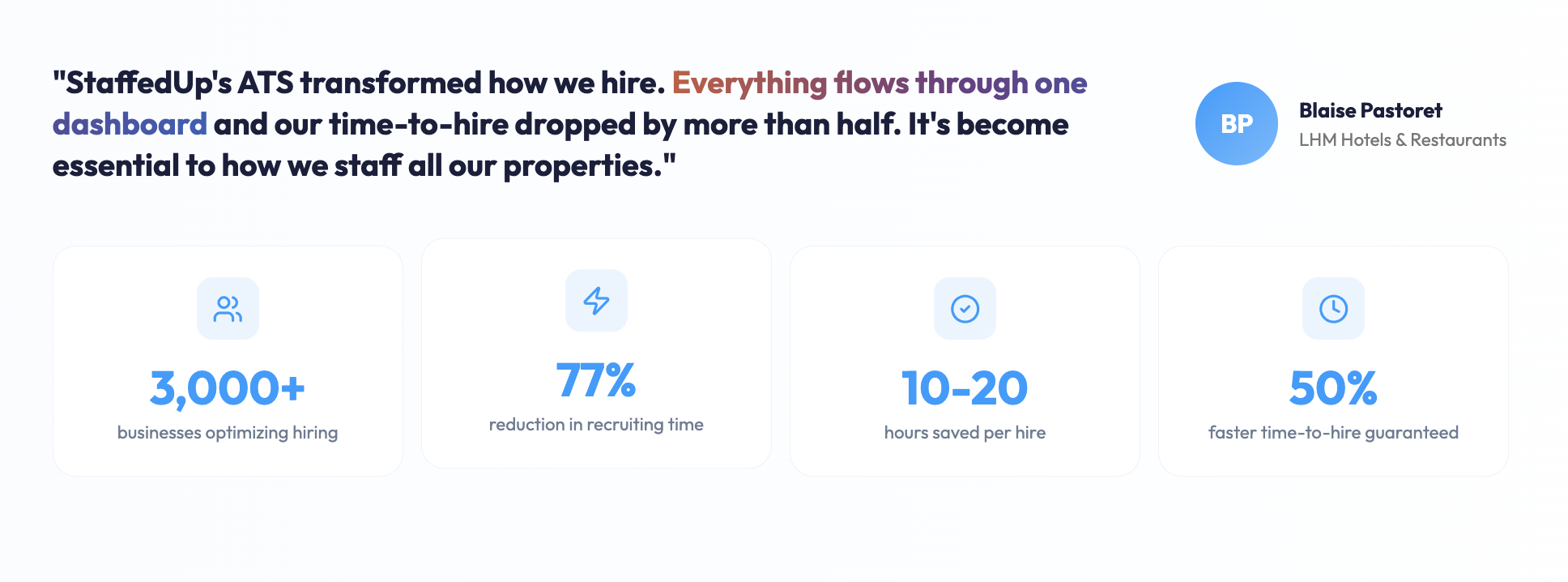
An independent operator needs an ATS that posts to multiple boards from a phone in under three minutes, applies screening criteria before applications arrive, and automates communication — StaffedUp at $29/month handles all three; if you’re already on 7shifts or HotSchedules, keep it. A small chain’s key variable is consistency: the same criteria across locations and one dashboard of hiring activity, where flat $29/month pricing with unlimited posts matters because you’re not paying per location. Multi-unit groups — where operators like Ryan French at MDP Restaurant Group (7 locations) run hiring — use the ATS as a control layer standardizing posting and screening across every property, adding onboarding, reporting, and integrations; the multi-location setup covers that tier. Across the platform, operators see 8x more applicants, 77% shorter time-to-hire, and 45% decreased turnover.
Build your stack starting at $1
Post your first job for $1. Distribution, screening, and scheduling in one platform, live in under three minutes from your phone — no demo, no setup call, no contract. If a qualified applicant — meeting your criteria, available for your hours, within your radius, with a completed application — isn’t in your inbox within 24 hours, you pay nothing and the charge reverses automatically. After the first post, it’s $29/month for unlimited active posts, cancel anytime in-app.
Frequently Asked Questions
What recruitment tools do restaurants actually need?
Most restaurants need three things: a way to distribute job posts to multiple boards at once, a screening layer that filters applications by your criteria before they reach your inbox, and automated communication that responds fast enough to prevent ghosting. For most single-location restaurants, one ATS handles all three. You don’t need a sourcing engine, a CRM, behavioral assessments, or a standalone video-interview platform — those were built for corporate HR teams whose hiring cycles and budgets don’t match restaurant operations.
What’s the difference between a job board and an ATS for restaurant hiring?
A job board is a marketplace — it shows your posting to applicants actively searching. An ATS manages everything after they apply: organizing applications, screening by your criteria, communicating, scheduling interviews, and tracking hires. Job boards give you volume; an ATS gives you control over that volume. For most restaurants hiring more than 6–8 people a year, you need both — ideally inside one platform.
How much does restaurant hiring software cost per month?
A basic ATS for a single location runs $29–$75/month. StaffedUp is $29/month with unlimited active posts after the $1 first post. Multi-location platforms range $75–$200/month depending on features and location count, and enterprise platforms with full automation and integrations run $200–$500 or more. Most independent restaurants and small chains don’t need the enterprise tier.
How do I stop candidates from ghosting before their first shift?
Ghosting happens in the silence gap — the 24–48 hours after application when the candidate hears nothing and accepts a faster offer. Three fixes: automate a confirmation within 60 minutes that includes the next step; use automated interview scheduling so candidates book immediately; and send a confirmation on booking, a reminder 24 hours before, and a reminder 2 hours before — with address, who to ask for, and what to bring. Most of this is automatable inside a basic ATS.
How do I try StaffedUp without a long commitment?
Your first job post is $1, and if a qualified applicant — someone who meets the availability, commute radius, and role requirements you set — isn’t in your inbox within 24 hours, you pay nothing and the charge reverses automatically. After that, it’s $29/month with unlimited active posts. No demo, no contract, no setup call, and you post from your phone in under three minutes. Cancellation is handled in-app. Start at staffedup.com/hire.
Sources
- U.S. Bureau of Labor Statistics, Job Openings and Labor Turnover Survey (JOLTS) — accommodation and food services 4.3% monthly quit rate, March 2026 (highest of any industry).
- Federal Reserve Bank of St. Louis (FRED), Quits: Accommodation and Food Services.
- National Restaurant Association, Restaurant Job Openings Economic Indicators (updates monthly).
- StaffedUp platform data: 8x more applicants, 77% shorter time-to-hire, 45% decreased turnover — internal aggregate across hospitality operators.

Hire Smarter, Faster
StaffedUp simplifies hiring for restaurant & hospitality operators. Post your first job for $1.