
Instawork Alternatives for Restaurant Operators: Gig Platforms, Job Boards, and ATS
By Billy Giordano, Co-Founder, StaffedUp
Former restaurant operator. Built StaffedUp after losing a line cook the night before a Saturday rush — and learning the hard way that a $400/month job board won’t save you when you need someone in 48 hours.
Last updated: October 2026
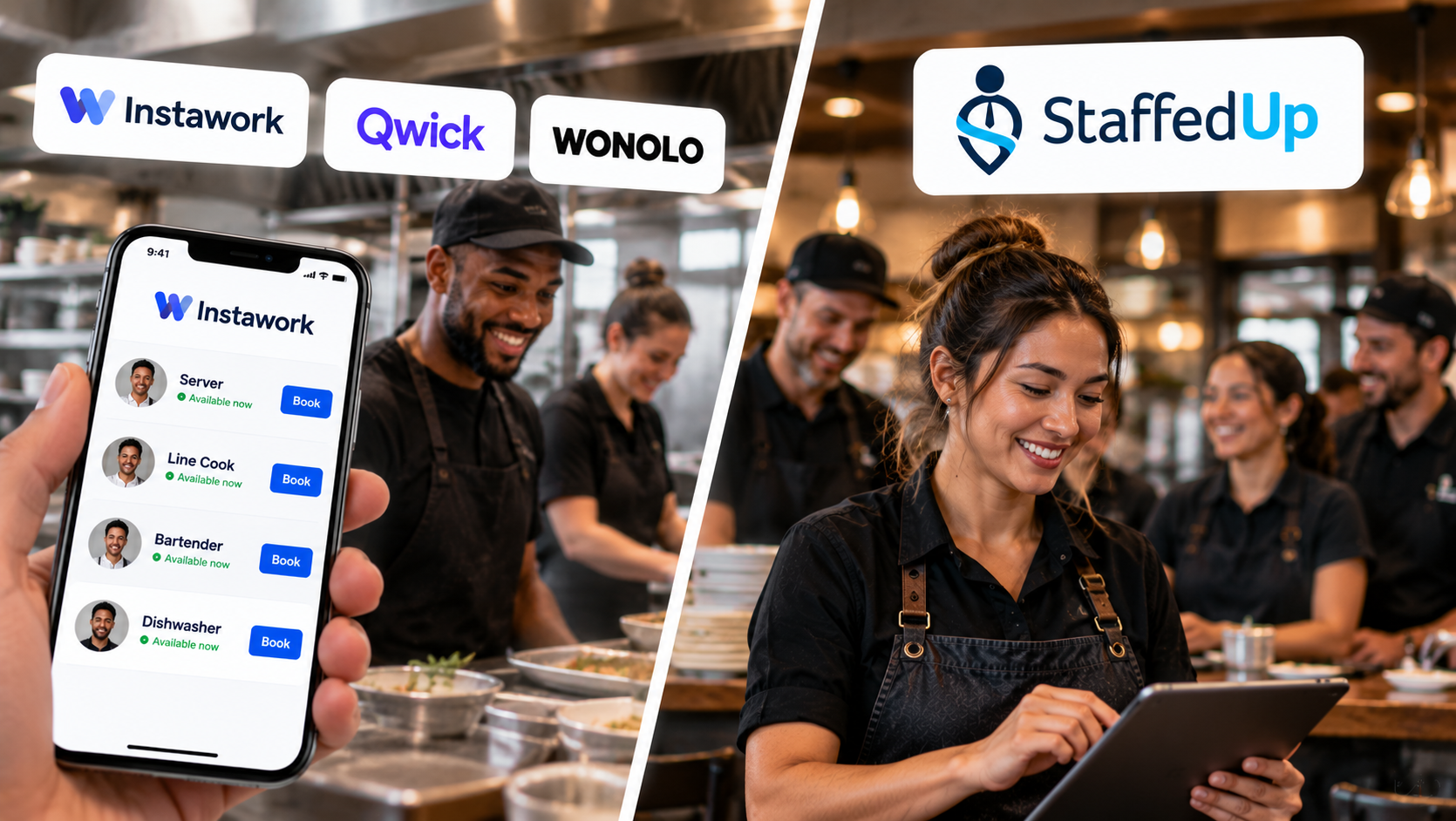
The best Instawork alternatives for restaurant operators aren’t interchangeable — they solve different problems. Gig platforms like Instawork, Qwick, and Wonolo are built for speed: post a shift, get a pre-vetted worker on your floor within hours. If your problem is “I need a body in a specific role by Saturday,” a gig platform is the right tool. But if your problem is “I keep losing people and I’m never building a stable team,” no gig platform solves it — you’ll pay a markup on every shift while the problem compounds. That’s the category question this post answers: which tool fits your actual staffing problem.
What “Instawork Alternatives” Actually Means — It Depends on Your Problem
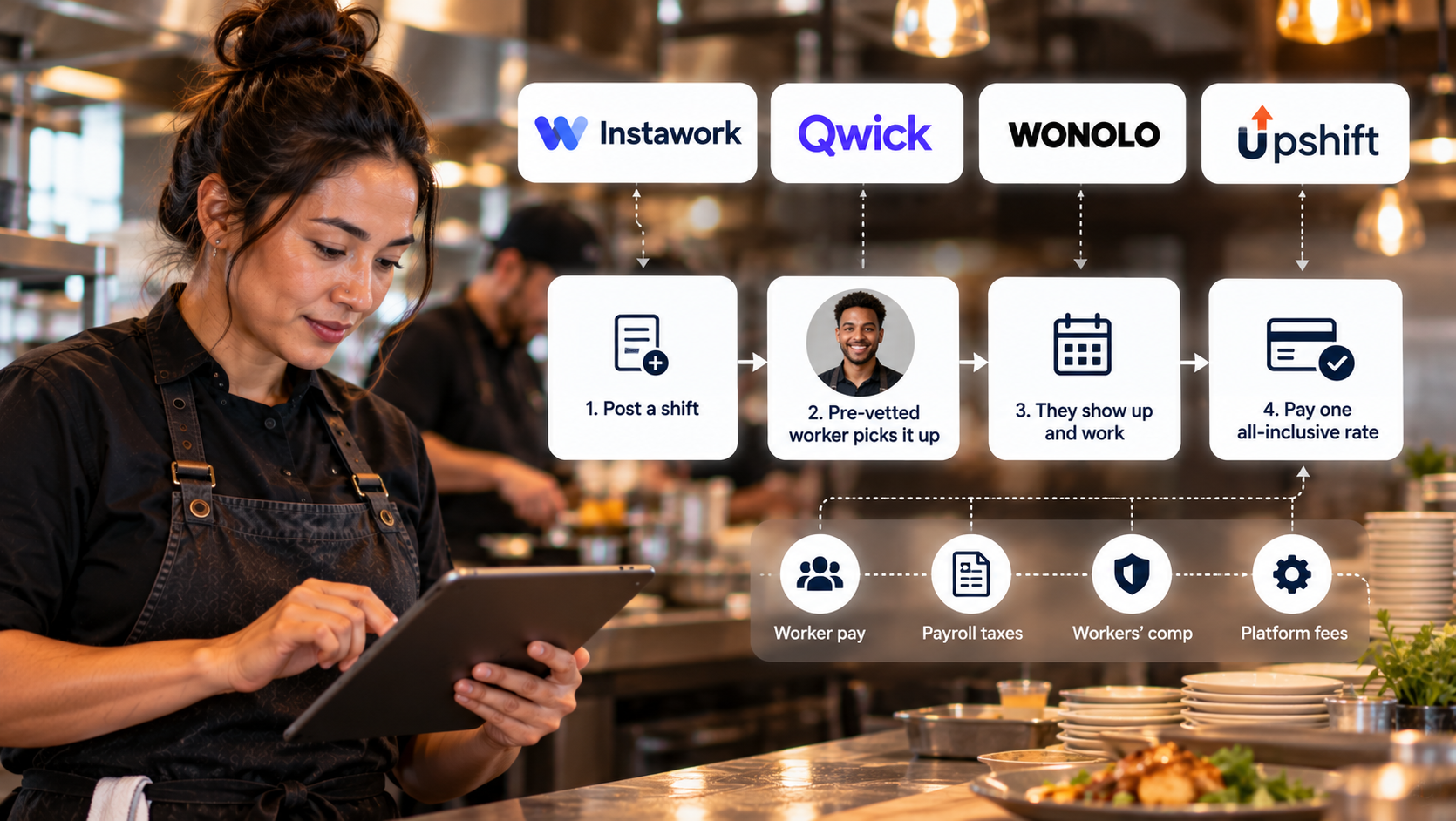
Search “Instawork alternatives” and most of what you’ll find is written for gig workers looking for apps to pick up shifts. This is written for operators. Three distinct tool types exist here, and they solve different problems. Gig staffing marketplaces (Instawork, Qwick, Wonolo, Upshift): post a shift, a pre-vetted worker accepts, you pay an all-inclusive hourly bill rate, and the worker is employed by or contracted to the platform — not you. You have a person on the floor within hours and own nothing except the shift coverage. General job boards (Indeed, ZipRecruiter, Snagajob): post a role, receive applications, screen and hire; the worker becomes your W-2 employee and the board was the distribution channel. ATS / hiring platforms (StaffedUp): post once and the job distributes to every major board, screening filters remove applicants who don’t meet your criteria before they reach your inbox, and you hire your own W-2 employee. These aren’t interchangeable, and choosing the wrong category is expensive in different ways.
How Gig Staffing Platforms Work — and What They Actually Cost
The gig model is simple on the surface: post a shift, a worker picks it up, pay one all-inclusive hourly bill rate — no subscription, no separate payroll — covering worker pay, taxes, workers’ comp, and platform fees. What it doesn’t make obvious is the markup embedded in the rate. Instawork doesn’t publish its markup; its Help Center says it “varies by shift type, shift volume, position type, location and other factors.” Operator-facing industry comparisons (shiftNOW, June 2026) report it at approximately 35% for Instawork and 40% for Qwick — third-party figures, so verify your actual bill rate directly. That markup covers real costs — workers’ comp, payroll taxes, vetting, liability — and the per-shift convenience has genuine value; the question is whether that cost structure fits your staffing pattern.
| Platform | Focus | Reported Markup | Direct-Hire Fee? |
|---|---|---|---|
| Instawork | Hospitality, warehouse, retail | ~35% (reported, not published) | Yes — OSA Section 4.7 |
| Qwick | Hospitality-only | ~40% (reported) | No (verify current terms) |
| Wonolo | Warehouse, light industrial, some hospitality | Not published | Verify current terms |
| Upshift | Hospitality, warehouse, retail | Not published | Verify current terms |
| StaffedUp | Restaurant/hospitality ATS — pipeline hiring | $29/mo flat | N/A — you own the hire |
One note on scope: Instawork operates in 400+ cities and serves warehouse, retail, and hospitality broadly — it’s not a hospitality-exclusive platform, which matters when you’re evaluating worker-pool depth for specialized BOH roles in your market.
The Markup Reality: the 12-Month Math on Gig Staffing vs. Your Own Roster
Here’s a scenario that plays out in a lot of independent restaurants. One server leaves; the operator tries a gig platform for the next few Fridays, then keeps using it because the immediate problem keeps getting solved. Six months later, they’re still covering the same role. Run the math. A server at $18/hour base, at a reported ~35% markup (verify your actual bill rate directly), is an all-inclusive charge near $24.30/hour — a 6-hour shift costs roughly $145.80 versus ~$108 in direct labor, so markup overhead is about $37.80 per shift. Cover that role four shifts a week and that’s ~$151/week — roughly $7,862 over 12 months for one role that should be a W-2 hire. StaffedUp for that same year is $1 for the first post, then $29/month — about $320, and you hire a W-2 server whose labor cost stays at $18/hour.
The honesty caveat: the all-in cost of an $18/hour W-2 server, with payroll taxes and workers’ comp, runs closer to $20–21/hour — still meaningfully below the all-inclusive bill rate at a reported 35% markup. The markup covers real costs, but the math breaks against gig dependency for recurring roles. And a second problem the numbers don’t capture: every gig shift resets the retention clock. A gig worker who covers your Friday is loyal to the platform, not to you — no reason to learn your regulars, your POS quirks, or your pace on a Saturday rush. Month 12 of gig dependency looks exactly like month 1, except you’ve spent considerably more.
Direct-Hire Fees: When You Find a Gig Worker You Want to Keep
This mechanic catches most operators off guard, because it only becomes relevant when something goes right. You use Instawork for a few months, one worker is consistently great, and you want to bring her on full-time — that’s the moment the direct-hire fee triggers. Instawork’s Online Service Agreement, Section 4.7 confirms a direct-hire fee applies when a business hires a worker who performed work through the platform within the previous 12 months — even if the worker later applies to you independently through a job board. Instawork’s Help Center confirms the fee exists but doesn’t publish a dollar figure; operator-facing comparisons (shiftNOW, June 2026) report $2,500 standard, reduced to $1,000 after 320+ hours with the same business. These are third-party figures — confirm current amounts and your account agreement directly. Converting a worker without the full fee means assigning enough shifts to hit the 320-hour threshold, which commits you to a multi-month relationship with one worker — a different proposition than flexible on-demand coverage. Neither fact is buried; neither is prominent in the marketing. (Instawork does have a separate product, Instawork Hiring, for full-time positions.)
When Gig Staffing Is the Right Answer (Honest)
We build an ATS, not a gig platform. When we say a gig platform is sometimes the right answer, that’s not a sales technique — it’s just true. Three scenarios where one genuinely wins: true emergency coverage (your three closers call in sick the morning of a private event and you need bodies in six hours — nothing in hiring software competes with “worker on your floor within hours”); one-off surge events (a grand opening, or a holiday party needing 8 bartenders for one Saturday and 2 the rest of the year — you’re covering a discrete event, not building a team); and genuinely episodic operating patterns (a beachfront bar that closes November through March and rebuilds every May has a different math problem than a year-round operation). If your problem fits any of those, use Instawork or Qwick. What changes the math is when the role is recurring — a line cook slot, a server working four nights a week, a shift lead. That’s not emergency coverage; it’s a hiring problem wearing shift-coverage clothing. The diagnostic: is this role on my schedule every week? → ATS. Have I used a gig platform for the same recurring role for more than six weeks? → you have a hiring problem, not a shift-coverage problem.

When an ATS Is the Right Answer — Why the Math Changes After Month 3
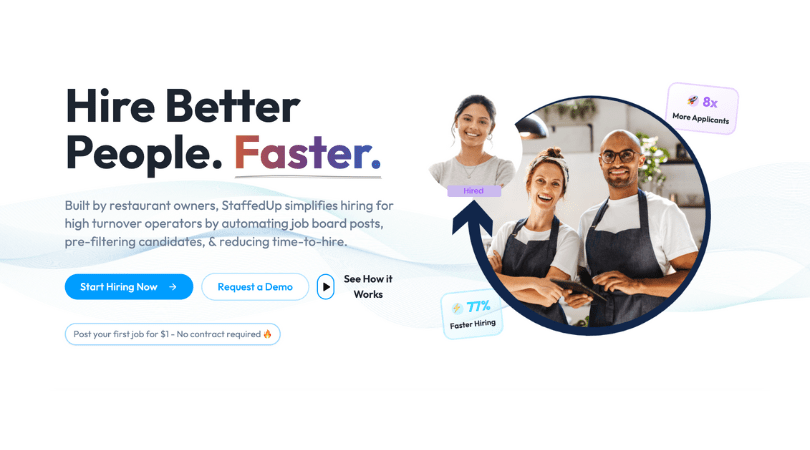
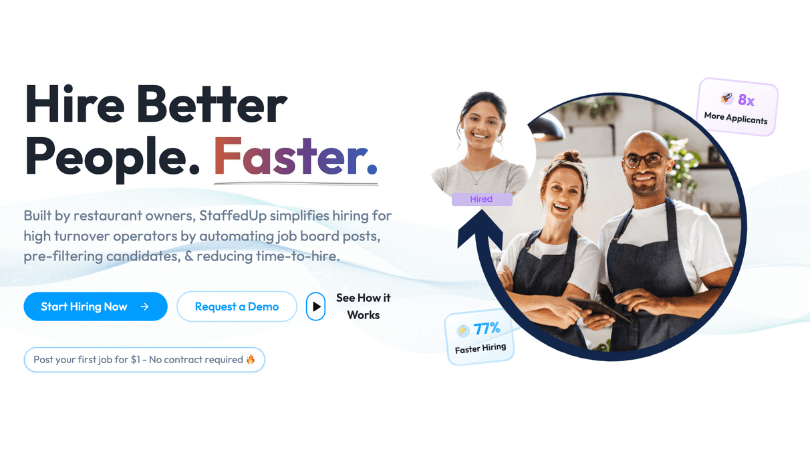
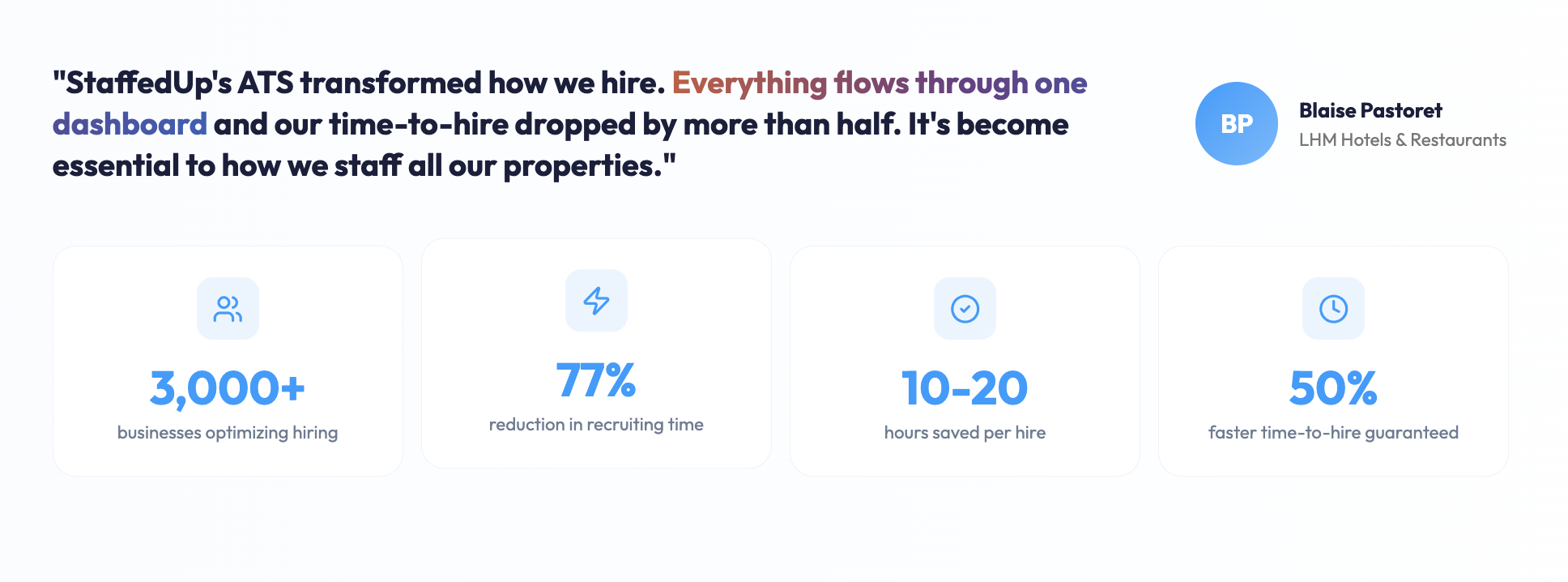
The problem an ATS solves isn’t “I need someone tonight.” It’s “I have a role that should exist permanently on my schedule, and I need a pipeline of qualified applicants so I’m never back in emergency mode.” The turnover context makes this structural: accommodation and food services posted a 4.3% quit rate in March 2026 (BLS JOLTS) — the highest of any tracked industry, nearly double the 2.2% private-sector average — and the National Restaurant Association’s data tracks the same pattern. An ATS doesn’t eliminate turnover; it compresses the time between turnover and rehire, and operator-defined screening affects whether the next hire lasts. Here’s what StaffedUp does: post once and the job distributes to every major board — Indeed, Google Jobs, Monster, and others — while operator-defined screening removes applicants who don’t meet your criteria before they reach your inbox. Platform data shows 8x more applicants, 77% shorter time-to-hire, and 45% decreased turnover. Danielle K., who runs an independent bar in St. Louis, posted Thursday night and had three qualified applicants by Friday morning — hired for Saturday. Sean O., who runs an Irish pub in Chicago, spent $400/month on Indeed for three months with zero hires, then had a qualified applicant 18 hours after his $1 StaffedUp post. Neither was gig coverage — both were operators building their own W-2 bench. That’s the month-3 inflection point: after three months of covering the same recurring role via gig staffing, an operator has typically spent enough in markup overhead to have funded months of ATS subscription and hired a W-2 employee. The markup clock keeps running; the ATS clock stops once the hire is made.
How to Choose Among Instawork Alternatives: The Decision Framework
| Gig Platform | Job Board | ATS (StaffedUp) | |
|---|---|---|---|
| Best for | Emergency shifts, surge, one-off coverage | Top-of-funnel applicant volume | Building your own W-2 pipeline |
| Cost model | Per-shift bill rate (~35–40% markup) | Pay-per-post or subscription | $29/mo flat; no per-applicant fee |
| Who owns the worker | Platform | You (after you hire) | You (after you hire) |
| Time to first worker | Hours | Days to weeks | Qualified applicant in 24 hours (guaranteed) |
| Direct-hire fee | Yes (Instawork, OSA 4.7) | No | No |
| Builds your team? | No — resets every shift | Only if you do the hiring work | Yes — your hire, your team, your culture |
Three diagnostic questions: Do I need someone on the floor within 12 hours? → gig platform. Do I have a recurring role to fill with my own employee? → ATS. Have I covered the same recurring role with gig workers for more than six weeks? → you have an ATS problem, not a shift-coverage problem. Larger multi-unit operators often use both — gig for true emergency surge, an ATS for ongoing pipeline. The mistake is using a gig platform as a substitute for a hiring strategy and discovering 12 months later you’re no closer to a stable team. For the retention side, see strategies that reduce restaurant turnover.
What StaffedUp Does — and What It Doesn’t
StaffedUp is an ATS built for restaurants and hospitality, by people who ran restaurants: post once, the job distributes to every major board, operator-defined screening removes unqualified and mass-apply applicants before they reach you, and you hire your own W-2 employee. “Qualified” means what you defined — your criteria, availability, radius, a completed application — not what an algorithm guessed might be close enough. Marisol V., who runs a seasonal bar and grill in Pensacola, went from 60 applications to 5 who actually wanted to work; her problem wasn’t volume, it was noise, and operator-defined screening cut through it. What StaffedUp is not: a gig platform. It doesn’t fill shifts, place workers, or handle payroll and workers’ comp for the people it helps you find. The worker you hire is your W-2 employee — that’s the whole point.
Post your first job for $1. If a qualified applicant — meeting your criteria, available for your hours, within your radius, with a completed application — isn’t in your inbox within 24 hours, you pay nothing and the charge reverses automatically. Under three minutes from your phone — no demo, no setup call, no contract. After the first post, it’s $29/month for unlimited active posts, cancel in-app.
Frequently Asked Questions
What are the best Instawork alternatives for restaurants?
It depends on your problem. For genuine emergency or one-off shift coverage, Qwick (hospitality-only) and Wonolo are the closest gig-platform alternatives. For building a permanent team, the alternative isn’t another gig app at all — it’s a restaurant ATS like StaffedUp that helps you hire your own W-2 employees at a flat $29/month with no per-shift markup and no direct-hire fee. Match the tool to whether you’re covering a shift or filling a role.
How much does Instawork cost for employers?
Instawork charges an all-inclusive hourly bill rate covering worker pay, taxes, workers’ comp, and platform fees, with a markup embedded. Instawork doesn’t publish the markup; operator-facing reporting cites roughly 35% (about 40% for Qwick). On an $18/hour server that’s an all-in charge near $24/hour — verify your actual bill rate directly, since it varies by shift type, volume, position, and location.
Does Instawork charge a fee to hire a gig worker permanently?
Yes. Instawork’s Online Service Agreement (Section 4.7) confirms a direct-hire fee applies when you hire a worker who performed work through the platform within the previous 12 months — even if they later apply to you independently. Instawork doesn’t publish the amount; third-party reporting names $2,500 standard, reduced to $1,000 after the worker completes 320+ hours with your business. Confirm current amounts and your account terms directly with Instawork.
Is a gig platform or an ATS better for restaurant hiring?
Neither is universally better — they solve different problems. A gig platform is better for true emergencies, one-off events, and unpredictable surge coverage, where you need a worker in hours. An ATS is better for recurring, ongoing roles where you’re building a stable W-2 team. The signal you’ve outgrown gig staffing: you’ve covered the same recurring role with gig workers for more than six weeks. That’s a hiring problem, not a shift-coverage problem.
When should I use Instawork instead of a hiring platform?
Use a gig platform when the need is genuinely temporary: emergency coverage (staff call out before an event), a one-off surge (a grand opening or single holiday party), or an episodic operating pattern (a seasonal venue that resets its roster every year). If the role is on your weekly schedule and you expect it to stay there, an ATS and a W-2 hire cost far less over 12 months.
How do I try StaffedUp as an alternative to gig staffing?
Post your first job for $1 at staffedup.com/hire. Your job distributes to every major board, and operator-defined screening filters the inbound so qualified applicants reach your inbox. If a qualified applicant isn’t there within 24 hours, you pay nothing — the charge reverses automatically. Under three minutes from your phone, no demo, no contract. After the first post, it’s $29/month for unlimited active posts.
Sources
- U.S. Bureau of Labor Statistics, Job Openings and Labor Turnover Survey (JOLTS) — accommodation and food services quit rate 4.3% (March 2026), highest of any industry.
- National Restaurant Association, Restaurant Job Openings Economic Indicators.
- Instawork, Online Service Agreement, Section 4.7 (direct-hire fee); Instawork business pricing and permanent-hire Help Center articles. Markup and fee dollar figures are third-party reported (shiftNOW, June 2026) — verify directly.
- StaffedUp platform data: 8x more applicants, 77% shorter time-to-hire, 45% decreased turnover — internal aggregate.

Hire Smarter, Faster
StaffedUp simplifies hiring for restaurant & hospitality operators. Post your first job for $1.