
Hiring Software for Hourly Employees: What It Does and What It Costs
By Billy Giordano, Co-Founder, StaffedUp
Former restaurant operator. Built StaffedUp after losing a line cook two hours before a Saturday rush — and finding out that $400/month on Indeed for three months produced exactly zero hires.
Last updated: August 2026
Hiring software for hourly employees posts your jobs across multiple boards simultaneously, screens applicants against criteria you set, and surfaces qualified candidates in one place — fast enough to compete in a market where your Friday applicant has accepted someone else’s offer by Saturday morning. It is not the same as a traditional ATS, which was built for white-collar hiring cycles running 30–90 days. Hourly hiring software is built for shift-based speed: applications under three minutes on a phone, screening that runs while your team is on the floor, and candidates in your inbox instead of buried in email threads.
Is Hourly Hiring Software Different From a Regular ATS?
An applicant tracking system was built for corporate HR teams running salaried searches over weeks or months. Hiring software for hourly employees is built for something structurally different: high-volume, shift-based roles where your applicant is applying to five other places while you read their submission. Four differences matter in practice.
Speed architecture. A standard ATS assumes 2–8 week cycles and email threads. Hourly software is built around same-day response windows and screening that runs while you’re on the floor.
Volume plus quality filtering. A standard ATS surfaces every applicant and expects someone to screen them. Hourly software applies your criteria at intake — availability, commute radius, role requirements, completed application — so only qualified applicants reach your view.
Multi-board distribution. A standard ATS posts to one or two boards. Hourly software distributes a single posting across all major boards simultaneously — Indeed, Google Jobs, Facebook, Monster, and the platform’s own network.
Operator-accessible design. A standard ATS needs an HR department. Hourly software is designed to be posted by a GM between lunch and dinner service, from a phone, without a setup call, demo, or contract.

Some traditional ATS products have bolted on hourly features over time. The question worth asking: is frontline hiring the core use case or an afterthought? The answer usually shows up in the UX.
Why Hourly Restaurant Hiring Breaks Standard Recruiting Tools
The National Restaurant Association’s 2026 State of the Restaurant Industry found 47% of operators report job openings that are difficult to fill, and nearly three-quarters plan to hire this year while expecting difficulty finding experienced managers and chefs. That’s not an abstract number. That’s the prep cook position that’s been open six weeks.
BLS JOLTS data shows the accommodation and food services quit rate at 4.3% in March 2026 — the highest of any industry and roughly double the private-sector average. Hiring isn’t a one-time event in this business. It’s infrastructure, and turnover compounds your recruiting costs year over year.
Standard recruiting tools weren’t built for this cadence. They assume you have days to respond, a recruiter managing the inbox, and candidates who wait. None of that holds in restaurants: your Wednesday applicant may have an offer from two blocks over by Thursday noon, while generic boards flood you with bots, out-of-market applicants, and partial submits. The first employer to respond wins — not the best one, the fastest one.
I know this from experience. I lost a line cook two hours before a Saturday rush. “URGENTLY HIRING” on Facebook got nothing. $400 a month on Indeed for three months got nothing. Software doesn’t create workers who don’t exist — it compresses the time between your posting and the ones who do exist, before someone else gets them.
How Hiring Software for Hourly Employees Works on a Restaurant Floor
Generic feature lists don’t tell you much. Here’s what the capabilities mean in practice.
1. Posts once, distributes everywhere. One posting flows to all major job boards simultaneously. No logging into four dashboards — a line cook post takes three minutes from your phone and is live across the network before your next table turns.
2. Screens out unqualified applicants before they reach you. You define “qualified”: available for the shifts you posted, within radius, questions answered, application completed — no partial submits. Marisol V., who runs a seasonal bar and grill in Pensacola, went from 60 applications down to 5 that actually wanted to work, because the screening ran on her criteria, not on volume.
3. Keeps the application short enough that real applicants finish it. Under three minutes, on a phone. Your applicants are between shifts or applying at 11pm after a close — 20-minute laptop applications lose real candidates before they ever reach you.
4. Moves fast enough to beat the offer window. Qualified applicants get flagged the moment they finish applying — not three days later at the bottom of an email pile. The window to reach an hourly applicant is measured in hours.
5. Consolidates everything in one dashboard. Every applicant from every board in one view — status, messages, screening, interviews. No more toggling between Indeed, Facebook DMs, and a spreadsheet at midnight.
Restaurant-specific extras worth checking for: BOH vs. FOH screening criteria, QR scan-to-apply for window signs and to-go bags, one-way video interviews, and digital onboarding that fires the moment an offer is accepted.
What Hourly Hiring Software Actually Costs
Nobody on the search results page for this topic publishes a number before the demo. Here’s the honest breakdown by tier.
| Tier | Who It’s For | Typical Monthly Cost | Honest Limitation |
|---|---|---|---|
| Free / basic boards | 0–5 hires/year, 1 location | $0 | Manual screening; applicants scattered across email and comments |
| SMB hourly hiring software | 5–100 hires/year, 1–5 locations | $25–$40 | Not built for enterprise HRIS integration |
| Mid-market / multi-unit | 100–500 hires/year, 5–25 locations | $50–$150 per location | Pricing varies widely; get actual quotes |
| Enterprise / franchise | 500+ hires/year, 25+ locations | $500–$8,000+ (custom) | Implementation fees can reach five figures; not for independents |
StaffedUp pricing, stated plainly: $1 for your first job post, $29/month after. Unlimited active postings. No contract, no setup call, no demo. Post from your phone in under three minutes.
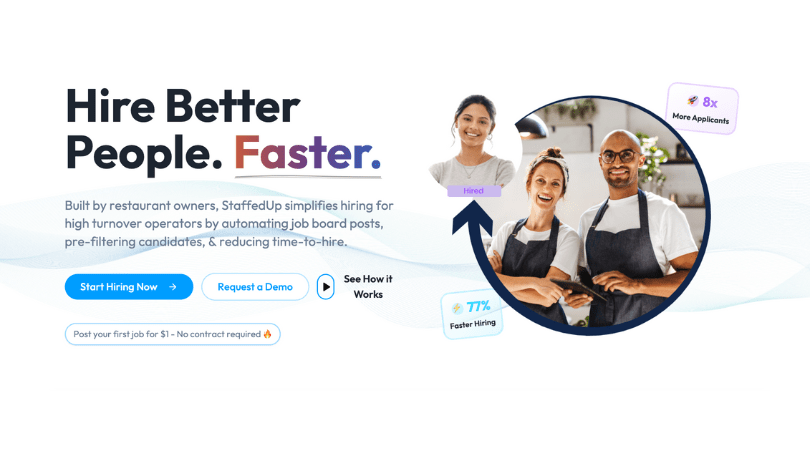
The ROI math. Industry research estimates a bad hire costs $2,305 per hourly employee in recruiting, onboarding, and training someone who doesn’t work out — at $29/month, preventing one bad hire covers the software for most of a year. The unfilled-shift math is faster: one short-staffed Friday dinner at a 60-cover restaurant can cost $540–$810 in turned-away or degraded covers, plus overtime for the crew scrambling to cover. And StaffedUp platform data shows 77% shorter time-to-hire — a three-week line cook search becomes roughly five days, which is weeks of overtime and manager floor time you don’t spend.
Across StaffedUp operator accounts we see the numbers below. These are platform data points, not industry averages — and they’re the numbers we’d want to see before committing to any hourly hiring software.
Post your first job for $1. If a qualified applicant — someone who meets your criteria, is available for your shifts, is within your radius, and has completed the application — isn’t in your inbox within 24 hours, you pay nothing. The charge reverses automatically.
The Ghosting Problem — Why Restaurant Applicants Disappear
SHRM’s 2025 Talent Trends research found 41% of organizations with recruitment difficulties reported increased candidate ghosting — and in hourly hiring it’s structural, not personal. Applications are low-friction, so applicants cast wide nets. Competing offers land same-day. And an applicant who submitted Monday and hasn’t heard from you by Wednesday has no reason to prioritize your interview.

What software does about it, mechanically: instant flagging of qualified applicants, automated same-day acknowledgment, interview scheduling in the same conversation, and reminders between booking and showing up. Danielle K., who runs an independent bar in St. Louis, posted Thursday night, had three qualified applicants by Friday morning, and hired for Saturday. Speed plus screening is what keeps applicants from going quiet — here’s a deeper look at why applicant ghosting happens and how to reduce it.
How to Evaluate Hourly Hiring Software: An Operator’s Checklist
| Feature | Why It Matters for Restaurants |
|---|---|
| Mobile posting, under 3 minutes | GMs post between service periods, not from a desk |
| Multi-board distribution in one post | Manual duplication wastes 30–60 minutes per opening |
| Operator-defined screening | You define “qualified” — availability, radius, certifications |
| Centralized applicant dashboard | Every board’s applicants in one view, not scattered threads |
| Automated engagement | Same-day acknowledgment beats the competing offer window |
| Interview scheduling built in | Kills the back-and-forth; cuts no-shows |
| Short mobile application | Long applications lose real candidates |
| No contract, transparent pricing | If it doesn’t work, you’re out — no annual lock-in |
Running multiple locations? Add three: a multi-location dashboard, location-level permissions, and time-to-hire analytics across the operation.
One feature not worth optimizing for at independent scale: AI video assessment scoring. Rules on automated hiring assessments vary by jurisdiction — New York City’s Local Law 144 is one example — so check your state and local requirements before implementing any automated assessment tool.
When Do You Actually Need Hourly Hiring Software?
Software may not be worth it for your operation right now. Here’s the honest read on which side of the line you’re on.
Sean O., who runs an Irish pub and grill in Chicago, spent $400 a month on Indeed for three months and got zero hires. That’s not a story about Indeed being a bad product — it’s the wrong tool for the context. His $1 StaffedUp post put a qualified applicant in his inbox in 18 hours. The difference wasn’t spend. It was filtering and speed.
Frequently Asked Questions
What’s the difference between hourly hiring software and a traditional ATS?
A traditional ATS was designed for white-collar hiring cycles of 2–8 weeks, recruiter-managed workflows, and single-board posting. Hiring software for hourly employees is built for shift-based speed: mobile applications under three minutes, multi-board distribution in one post, automated screening, and qualified applicants surfaced in hours — not days.
How much does hiring software for hourly employees cost per month?
For small-to-medium restaurant operators, purpose-built hourly hiring software typically runs $25–$40 per location per month. StaffedUp is $29/month with unlimited active job postings after a $1 first post — no contract, no demo required. Enterprise tools run $500–$8,000+/month and are a different category entirely.
What features matter most for restaurant and hospitality hiring?
The non-negotiables: mobile posting in under three minutes; multi-board distribution in a single post; operator-defined screening for availability, radius, and role requirements; automated engagement fast enough to beat competing offers; and one dashboard consolidating every source. Multi-unit operators should add location-level dashboards and analytics.
How does hiring software reduce interview no-shows in restaurants?
No-shows happen because the window to reach an hourly applicant is measured in hours and manual processes are too slow. Software flags qualified applicants the moment they finish applying, sends acknowledgment immediately, books the interview in the same conversation, and sends reminders — closing the gap where disengagement sets in.
Is hiring software worth it for a single-location restaurant?
It depends on volume and process. Posting fewer than 10–15 jobs a year with free boards producing qualified applicants? You may not need it yet. Spending 3–4+ hours weekly on hiring admin, running two-week-plus time-to-hire, or absorbing a recent bad hire or no-show? The $29/month math shifts quickly.
How quickly can I hire using StaffedUp, and how do I get started?
StaffedUp platform data shows 77% shorter time-to-hire. Post your first job for $1 in under three minutes from your phone. If a qualified applicant isn’t in your inbox within 24 hours, you pay nothing — the charge reverses automatically. Then it’s $29/month, unlimited active postings, no contract.
Sources
- U.S. Bureau of Labor Statistics — Job Openings and Labor Turnover Survey (JOLTS), Quits: Accommodation and Food Services, March 2026 (via FRED, series JTS7200QUR)
- National Restaurant Association — 2026 State of the Restaurant Industry (February 2026)
- SHRM — 2025 Talent Trends Report (background reference for candidate-ghosting trend)
- StaffedUp platform data — 8x more applicants, 77% shorter time-to-hire, 45% decreased turnover (operator account aggregate; self-disclosed)

Hire Smarter, Faster
StaffedUp simplifies hiring for restaurant & hospitality operators. Post your first job for $1.