High-Turnover Hiring Software: What Restaurants Actually Need
By Billy Giordano, Co-Founder, StaffedUp
Former restaurant operator. Built StaffedUp after losing a line cook before a Saturday rush — “URGENTLY HIRING” on Facebook got zero replies, and $400/month on Indeed produced nothing for three months. That failure is what this platform is built on.
Last updated: August 2026
High-turnover hiring software is built for businesses that fill the same roles repeatedly — restaurants, bars, hotels, and hourly operations where annual turnover commonly exceeds 75%. Unlike standard ATS platforms designed for corporate recruiting, the right tool does three things: it compresses the response window from days to hours before applicants take other offers, screens for fit and availability rather than just volume, and automates onboarding so new hires don’t quit in the first 90 days. The question isn’t whether you need hourly hiring software — it’s whether the one you’re looking at was built for your environment.
Why High-Turnover Hiring Is a Different Problem — Not Just a Bigger One
Most ATS platforms were built around corporate assumptions: a resume as the primary document, a recruiter who checks a queue every morning, a multi-round interview measured in weeks, a new hire who starts with an HR packet. None hold in a restaurant kitchen. Restaurants run among the highest turnover of any industry — commonly cited around 75% annually, quick-service higher still. Black Box Intelligence’s 2025 research puts limited-service hourly turnover at 110% (Q3 2025) and full-service at 92%. If you run a QSR, you’re statistically replacing your entire crew more than once a year — an operating reality to manage with the right process, not a crisis to solve in six weeks.
The BOH/FOH split matters, and most hiring software ignores it. BOH candidates often work two gigs at once and evaluate offers fast because they need their schedule by Friday; FOH candidates are more likely to ghost at the interview stage. Software that treats all applicants as identical misses both. And the “more hiring” trap makes it worse: fill roles at volume without fit screening and you accelerate turnover — your best performers cover for churn, burn out, and leave. High-turnover hiring isn’t a bigger version of normal hiring; it’s structurally different. For the retention side, see our breakdown on how to reduce restaurant employee turnover.

Why Restaurant Operators Lose Candidates Before the Interview
Here’s what actually happens. A line cook applies at 2pm on their break — and applies to three others in the same 10 minutes, same phone. You see it at 9pm when service winds down and plan to respond the next afternoon. By then, two other employers have texted, and the cook has taken a shift. I lived this: the “URGENTLY HIRING” Facebook post that got zero replies — not because no one needed work, but because by the time we responded, everyone available had committed elsewhere.
Applicants in hourly hiring decide in hours, not days. The right software addresses the window mechanically: a qualified applicant surfaces in your inbox — filtered, not buried — an automated acknowledgment goes out immediately, and you respond from your phone in the same hour you’re managing everything else. Sean O., who runs an Irish pub and grill in Chicago, spent three months at $400/month on Indeed and hired no one; his first StaffedUp post cost $1 and had a qualified applicant within 18 hours. For more on drop-off and no-shows, see our post on preventing ghosting in hospitality hiring.
Speed Without Fit Is Just Faster Turnover
Every operator has made the desperate hire — a Saturday rush, no one else available, so you hired the person you knew wasn’t right. That hire lasted three weeks and the cycle restarted. That’s not a character flaw; it’s what happens when your process produces volume without fit screening. Fit in a restaurant context isn’t abstract: availability that matches your posted hours, a location radius the person can actually reach, and a completed application — not the mass-apply bots that click “apply” on hundreds of listings without reading one. Those signals predict whether someone shows up on Day 1.
The connection to turnover is direct. Operators who define “qualified” using their own criteria — hours, radius, role requirements — and let screening surface only matching applicants see 45% decreased turnover across StaffedUp postings. That’s a screening story, not just a speed one. Marisol V., who runs a seasonal bar and grill, cut 60 applications down to 5 that actually fit — and those 5 showed up. One compliance note: screening is operator-defined and operator-reviewed — you set the criteria; the platform filters consistently against them. Employment screening rules vary by state; check your jurisdiction’s requirements, particularly around availability and location filters.
| Criterion | Why It Matters for Restaurants | Generic ATS? |
|---|---|---|
| Availability vs. posted hours | Mismatched availability = scheduling conflict on Day 1 | Rarely filters on it |
| Distance / commute radius | Long commute = first bad-weather day becomes a no-call | Almost never |
| Completed application | Completion signals real interest; bots don’t finish forms | No — ingests all |
| Role-specific criteria | Kitchen experience is verifiable; resume formatting isn’t | Manual review |
| Automated pre-screen response | Response speed predicts engagement; non-responders no-show | Rarely built in |
The Onboarding Gap — Where New Hires Go to Quit in Days 1–90
Filling the role isn’t the finish line — it’s the start of the highest-risk 90 days. A 2022 HourWork study of 8,000+ restaurants found only 54% of hourly QSR employees reached 90 days before quitting. For every 10 you hire, roughly 4 or 5 are gone before they’re fully productive — and you’ve paid the recruiting, screening, and training cost on all 10. The same research found QSR workers are five times more likely to quit over management miscommunications in the first 90 days than after.
Software has a narrow, specific job here. Paperwork not completed before Day 1 means the employee arrives unprepared — or doesn’t arrive, and scheduling confusion in the first week is a quit trigger. Digital onboarding that completes paperwork before the first shift, sends reminders so the new hire doesn’t go cold, and confirms scheduling clearly is a mechanical fix to a mechanical failure. What it can’t do is fix a broken culture — it fills the empty role faster, so knowing which problem you’re solving matters before you spend anything.
What Generic ATS Tools Get Wrong About Restaurant Hiring
Standard ATS platforms were designed for a recruiter managing 12 pipelines, reviewing formatted resumes, acting the next morning. Restaurant operators aren’t recruiters — they have 15 minutes on Sunday night to sort 40 applications, half from people who never read the job description. Where generic tools break in a restaurant context:
- Long application forms. Mobile applicants abandon these before submitting. Over 5 minutes on a phone and you’re losing candidates before they finish.
- Multi-day response workflows. Built for a recruiter who actions items the next morning — not a Saturday prep shift where you learn your lead cook quit Thursday.
- Resume-first screening. Filters out experienced cooks who don’t keep a formatted resume. Restaurant hiring runs on references and availability, not document design.
- No mobile posting. When someone quits after dinner service, you can’t wait for morning and a desktop.
- Enterprise pricing and setup. Some systems quote five figures at entry with multi-month implementation — a corporate HR tool sold to operators, not the other way around.
To be fair, corporate ATS platforms do what they’re built for well — hiring a VP of Operations on a 90-day timeline, an enterprise system has its place. Hiring a line cook who applied 40 minutes ago and is deciding between you and the place across the street, it doesn’t. StaffedUp posts from a phone in under 3 minutes — no setup call, no demo, no contract. To understand how it works, see how the StaffedUp ATS works.

The Real Cost Math
Industry estimates put the hard cost of replacing one hourly restaurant employee well over $2,000 — Black Box Intelligence’s 2025 research puts it at $2,706 (recruiting, screening, training, lost productivity). For a 50-person restaurant at 80% annual turnover, that’s 40 replacements a year — roughly $108,000, before revenue lost to uncovered shifts.The ROI math is short: at $1 for a first post and $29/month after, one prevented bad hire pays for the platform for years. Danielle K., who runs an independent bar, posted on a Thursday night and had three qualified applicants by Friday morning — hired in time for Saturday. The software versus one uncovered Saturday isn’t a close comparison.
What High-Turnover Hiring Software Must Actually Do
A framework to apply to any vendor — including StaffedUp — holding every platform to the same standard.
| Question | Testing For | StaffedUp | Your Vendor |
|---|---|---|---|
| Post from a phone in under 5 min, no setup call? | Mobile-first for operators in service | Yes — under 3 min | |
| Distributes to boards applicants actually use? | Reach into major job networks | Yes | |
| Screens for your criteria before you see an applicant? | Fit screening, not just volume | Yes — operator-defined | |
| Qualified applicant in 24 hours, with a risk-reversal? | Accountability, not just promises | Yes — or the charge reverses | |
| Schedule interviews and follow up without an HR person? | Built for operators, not teams | Yes — built in | |
| Onboarding paperwork done before Day 1, automatically? | Closing the hired-to-first-shift gap | Yes — included |
If a vendor can’t answer yes to at least four of six, they’re not built for your operation. Ask in writing so the answers are on record.
When High-Turnover Hiring Software Won’t Fix Your Problem
Two problems look identical from the outside — both show up as an empty shift on Saturday. Software solves one and not the other.
Software solves this: you’re losing applicants before they walk in. Your pipeline is slow, your response time too long, posted roles sit open for two weeks while you check applications between services. That’s a process problem — the right software compresses the response window and keeps you in the decision window before candidates go elsewhere.
Software doesn’t solve this: your best people are leaving because the culture is broken. The night manager yells, schedules change with 12 hours’ notice, pay is below market and hasn’t moved in two years. Software fills the empty role faster; it does not fix why the role became empty.

The diagnostic is simple: are you losing people before or after their first two weeks? Before — pipeline speed and screening are your lever. After — retention, culture, and compensation are where the investment belongs. Both matter; the order matters more. If you’re losing applicants before they walk in, that’s what StaffedUp fixes. If you’re losing great people after they start, that’s a different conversation — and we’ll tell you so.
Test it against your next open shift
Post your first job for $1. If a qualified applicant isn’t in your inbox within 24 hours, you pay $0 — the charge reverses automatically. After that it’s $29/month: unlimited active posts, no contract, no setup call, cancel in-app any time. Post from your phone in under 3 minutes.
Frequently Asked Questions
What is high-turnover hiring software?
An applicant tracking system built for businesses that fill the same hourly roles repeatedly — restaurants, bars, and hotels where annual turnover commonly exceeds 75%. Unlike standard ATS platforms, it’s built for mobile applicants, fast response windows, and screening for availability and fit rather than resume review — designed for operators, not corporate recruiting teams.
What features matter most in hiring software for high-turnover industries?
Five: mobile job posting in under 5 minutes, automatic distribution to major job boards, screening that filters for your criteria before you see an application, interview scheduling without a dedicated recruiter, and onboarding automation that completes paperwork before Day 1. If a platform requires a setup call before your first post, it wasn’t built for your environment.
How much does it cost to replace a restaurant employee?
Industry estimates put the hard cost well over $2,000 per hourly employee; Black Box Intelligence’s 2025 research puts it at $2,706. A restaurant with 50 employees and 80% annual turnover faces roughly $108,000 in annual replacement costs before lost-shift revenue.
How does hiring software reduce candidate ghosting and no-shows?
The primary mechanism is speed. Candidates in hourly hiring decide in hours, not days. Software that surfaces qualified applicants immediately, triggers automated acknowledgment, and enables same-day scheduling keeps you in the response window before the candidate accepts another offer. Drop-off accelerates sharply when employers don’t respond within the first day.
Does hiring software help with 90-day retention, or just filling the pipeline?
Both, if it includes onboarding automation. A 2022 HourWork study found only 54% of hourly QSR employees reached 90 days before quitting. Software that automates paperwork, sends first-day reminders, and confirms scheduling before a new hire’s first shift closes the highest-risk window. What it doesn’t fix: culture problems that drive turnover after the first month.
How do I try high-turnover hiring software without a long contract?
Post your first job for $1 at staffedup.com/hire. If you don’t have a qualified applicant in your inbox within 24 hours, you pay $0 — the charge reverses automatically. After that it’s $29/month with unlimited active posts, no contract, no setup call, and easy cancellation in-app. “Qualified” means what you define: your criteria, availability, and radius.
Sources
- U.S. Bureau of Labor Statistics, Job Openings and Labor Turnover Survey (JOLTS).
- Black Box Intelligence, State of the Restaurant Workforce — Employee Turnover (2025): hourly replacement cost $2,706; limited-service hourly turnover 110% (Q3 2025), full-service 92%.
- HourWork QSR retention report (2022), via Restaurant Dive / HR Dive: 54% of hourly QSR employees reached 90 days before quitting.
- National Restaurant Association, Restaurant Economic Indicators: restaurant.org.
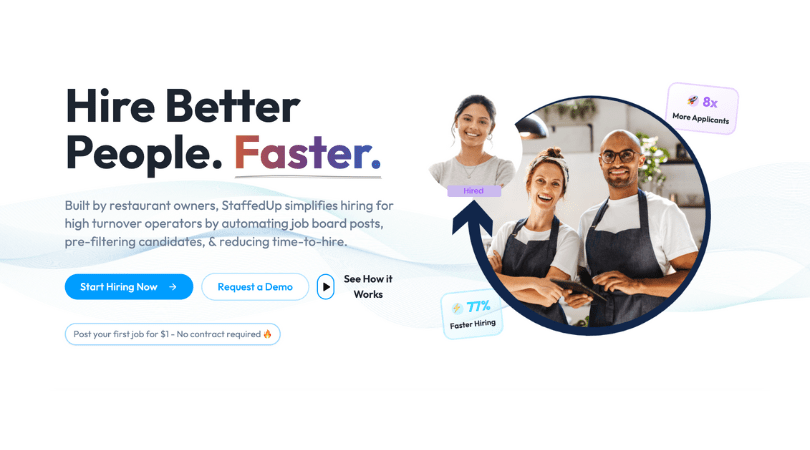
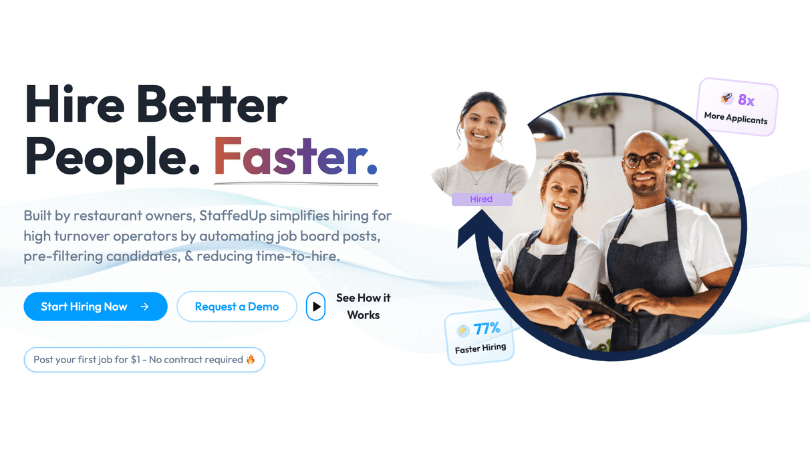
- StaffedUp platform data: 8x more applicants, 77% shorter time-to-hire, 45% decreased turnover (internal aggregate).

Hire Smarter, Faster
StaffedUp simplifies hiring for restaurant & hospitality operators. Post your first job for $1.