
Child Care Hiring Software: When a Vacancy Is a Risk
By Billy Giordano, Co-Founder, StaffedUp
Former restaurant operator. Built StaffedUp after living through the cost of a bad hire and a slow pipeline — watching a single unfilled role destroy a week of operations. Child care directors face the same math with higher stakes.
Last updated: September 2026
Child care hiring software is an applicant tracking system built around the compliance realities that make childcare staffing different from every other hourly hiring problem: mandatory background checks before day one, child-to-staff ratios that turn an unfilled classroom into a licensing event, and workforce turnover well above the median U.S. occupation. A generic job-board post doesn’t account for any of that. This post breaks down what the software actually needs to do, what the federal data says about why the problem is structural, and how to evaluate your options honestly.
Why Child Care Hiring Is a Compliance Problem, Not Just an HR Problem
Most job-board advice treats a vacant role as a productivity inconvenience. In a licensed child care center, it’s a regulatory event. State child-to-staff ratio requirements are a continuous obligation: if your classroom opens at 7am with correct coverage and a teacher calls out at 10am, you’re out of compliance mid-session, with children still in your care. The consequence isn’t a strongly worded letter — it’s a citation, a corrective action plan, and, depending on response time, a required enrollment reduction. And enrollment reduction is where the math turns painful: if you can’t maintain ratio, you can’t serve all enrolled children, which means fewer tuition dollars before you’ve even posted the role. The National Head Start Association’s 2023 workforce survey found that at the peak of the staffing crisis, 14% of Head Start classrooms were closed, with staff vacancies as the primary driver — real classrooms, real families turned away.

Ratio requirements vary by state and age group — the number governing your infant room differs from your preschool classroom. Check your state licensing office for current ratios; nothing here is compliance advice. Every day a seat goes unfilled is a day you’re managing a licensing exposure, not just a scheduling gap.
| Time Unfilled | Operational Consequence | Financial Impact |
|---|---|---|
| Day 1–3 | Remaining staff absorb coverage; burnout risk begins | Overtime or temp-agency cost |
| Week 1–2 | Ratio pressure mounts; conditional hires need constant cleared-staff supervision | Supervision cost + overtime/temp |
| Week 3–4 | State ratio threshold may force enrollment reduction | Lost tuition per removed child, per week |
| Month 2+ | Enrollment reduction becomes official; waitlisted families may disenroll permanently | Compounding revenue loss + re-enrollment cost |
The Background Check Timeline Is Your Pipeline’s Longest Bottleneck
Federal law requires background check requests to be submitted before a staff member’s first day. That’s not a best practice — it’s a requirement under the Child Care and Development Block Grant Act, implemented through 45 CFR 98.43, and it applies to all staff in licensed programs. Per Childcare.gov’s guidance, a complete check includes an FBI fingerprint check (Next Generation Identification), a National Sex Offender Registry search, and state criminal, sex-offender, and child-abuse/neglect registry checks for each state the applicant lived in over the past five years. Private-database components often return in one to three business days; the state fingerprint and criminal repository process is the long tail — states have up to 45 days under 45 CFR 98.43(e)(1), and actual turnaround runs from two to six weeks depending on backlog.
| Check Component | Typical Turnaround | Rule Reference |
|---|---|---|
| Sex-offender registry (national + state) | Same day – 2 business days | 45 CFR 98.43(b) |
| Child abuse & neglect registry | 1–5 business days | 45 CFR 98.43(b) |
| County criminal history | 1–3 business days | 45 CFR 98.43(b) |
| State criminal repository | 5–20 business days | 45 CFR 98.43(e)(1) |
| FBI fingerprint check | 2–6 weeks (varies by backlog) | 45 CFR 98.43(b) |
| Full clearance | Up to 45 days (federal max) | 45 CFR 98.43(e)(1) |
Timelines vary significantly by state and fingerprint backlog. Verify current timelines with your state licensing office. Not legal advice.
The takeaway for your pipeline: because full clearance can take weeks, the only lever you control is how fast you source and screen qualified candidates in the first place. The earlier a cleared-eligible applicant is in your inbox, the earlier the clock starts.
Childcare Turnover Is Continuous — Your Hiring Has to Be Too
There is no off-season for childcare hiring. The Federal Reserve Bank of Cleveland (January 2024) found childcare turnover ran roughly 65% above the median U.S. occupation in 2022, and that about half of departing workers leave the sector entirely — not for a competing center, but for good. The BLS projects about 160,200 openings a year through 2034, every one driven by replacement need, against a projected 3% decline in total childcare employment. The openings exist because the turnover never stops.
Part of the cause is structural and no software fixes it: median pay sits at $15.41/hr (BLS, May 2024), in the bottom tier of all tracked wages. If you’re losing teachers to higher-paying retail or food service, faster recruiting won’t solve the root cause. What faster, broader recruiting does solve is catching available candidates before a competing center does. And here’s the mechanism that matters most: I saw it constantly in restaurant hiring — sixty applications would come in and five actually wanted the job; the other fifty-five were mass-apply noise. You don’t need more volume. You need the five who meet your criteria surfaced before your inbox buries them. Custom screening questions — availability, ECE background, willingness to complete a background check — eliminate the fifty-five before they reach your dashboard. The fix is treating your pipeline as infrastructure, not a faucet: keep a branded careers page live year-round and a platform distributing to Indeed, Facebook, and Google Jobs continuously, so when a seat opens you have a working pipeline, not a dead posting page.
What Child Care Hiring Software Actually Needs to Do
Here’s the category confusion that wastes directors’ time: most comparison pages for “child care hiring software” are actually comparing childcare management platforms — billing, attendance, parent communication, enrollment CRM. Brightwheel, Procare, Playground. Those are useful tools; they are not hiring tools. A director who needs a lead teacher in five days doesn’t need better parent messaging — they need applicant volume, fast screening, and a scheduled interview before a competing center calls the same candidate. A hiring-specific tool needs to do five things: distribute one post to every board (Indeed, Google Jobs, Facebook, and the broader network — childcare is a local labor market); run a mobile-first application under three minutes (hourly candidates don’t keep résumés on a desktop, and completion rates collapse past a few mobile screens); filter with custom screening questions for availability, ECE background, and background-check willingness before applications reach your inbox; fit a director’s workflow, reviewable in under ten minutes between sessions with no HR department; and track background-check status, showing where each candidate sits in the clearance pipeline — the feature gap most general ATS tools miss.

Honest fit: for a single-center independent director managing 20–60 children with no dedicated HR staff, a general hourly-hiring ATS with broad distribution and screening is usually the right tool — lower cost, faster setup, less complexity. For a multi-site organization with CCDF subsidy tracking and licensing-data integrations, a purpose-built childcare HR platform may be worth the added cost. Evaluate on your actual center size and staff capacity, not a software company’s demo — and check the ACF background-check FAQ and your state licensing office for your specific obligations.
How StaffedUp Fits
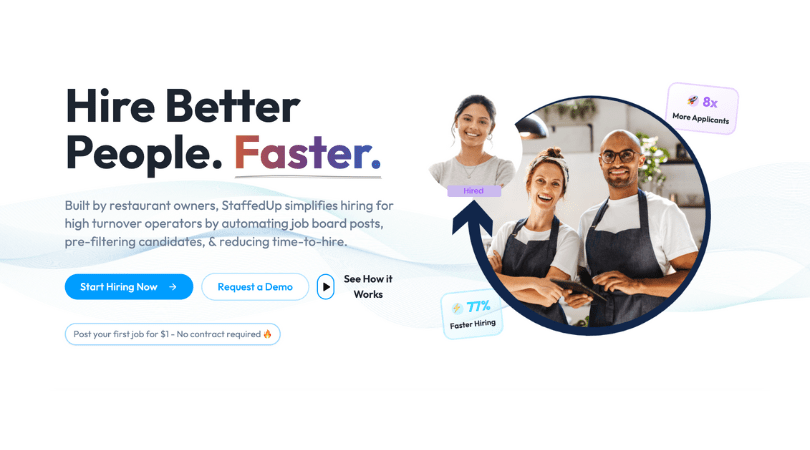
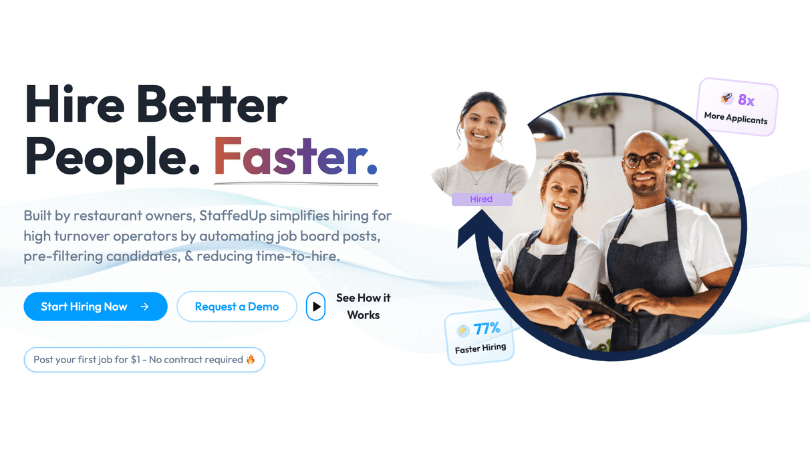
Open your phone, fill in the role, hours, location, and screening questions — under three minutes, no desktop, no setup call, no demo. Your posting goes live simultaneously to Indeed, Facebook, Google Jobs, and the broader network, and the screening questions you set filter out candidates who don’t meet your criteria before they reach your dashboard. One feature worth calling out for childcare: QR-code scan-to-apply — print it for your break room, drop-off entry, or a community board, and candidates apply without hunting for a posting online, reaching the local community where your hires actually live. Across StaffedUp operators, that adds up to 8x more applicants, 77% shorter time-to-hire, and 45% decreased turnover. I built it because I posted “URGENTLY HIRING” on Facebook and got zero replies, then spent $400 a month on a major job board and got nothing qualified — the problem in a restaurant kitchen and a childcare center feels identical from the inside: you’re one person short and every hour matters.
Post your first job for $1. It goes live to Indeed, Facebook, Google Jobs, and the broader network within minutes. If a qualified applicant — meeting your criteria, available for your hours, within your radius, with a completed application — isn’t in your inbox within 24 hours, the month is free and the charge reverses automatically. Under three minutes from your phone, no contract, cancel anytime in-app. After the first post, it’s $29/month for unlimited active posts.
Frequently Asked Questions
What is child care hiring software and how is it different from a general ATS?
Child care hiring software is an applicant tracking system built around childcare’s specific compliance constraints: mandatory background checks before day one, child-to-staff ratios that make every open role a licensing risk, and structural turnover that demands always-on recruiting. Generic ATS tools are built for office hiring workflows and don’t map to a childcare director’s actual operating environment or regulatory obligations.
How do background check requirements affect child care hiring timelines?
Federal law requires background check requests before a staff member’s first day, with states allowed up to 45 days to complete the full process under 45 CFR 98.43. New hires can begin work conditionally under constant supervision by a cleared staff member, but that supervision carries a real staffing cost. Budget two to six weeks for full clearance in your pipeline planning — timelines vary significantly by state, so verify with your state licensing office and review the Childcare.gov guidance.
What happens to my program if an open staff role isn’t filled fast enough?
If you can’t maintain required child-to-staff ratios, you may be required to reduce enrollment — turning away enrolled children and losing tuition revenue before the position is filled. National Head Start Association workforce surveys document ongoing classroom closures tied directly to staff vacancies. Ratio requirements vary by state and age group; check your state licensing office.
How do I keep my candidate pipeline full between openings?
Keep a branded careers page live year-round and use a platform that keeps posts distributing to Indeed, Google Jobs, and Facebook continuously — not just when you’re actively hiring. Respond to applicants even when a position is filled, and flag qualified candidates for follow-up. A director who only posts when someone gives notice is already weeks behind before the first application arrives.
What should I look for when comparing child care hiring software?
Prioritize a mobile-first application under three minutes, multi-board distribution from one post, custom screening questions for childcare-specific filters, background-check stage tracking, built-in interview scheduling, and no long-term contract. Hiring childcare workers fast starts with removing every friction point between a candidate and a completed application — don’t pay for enterprise features your center doesn’t need.
How do I post my first job on StaffedUp and what does it cost?
Your first job post is $1. Post from your phone in under three minutes — no desktop, no setup call, no demo — and your listing distributes to Indeed, Facebook, Google Jobs, and the broader network. A qualified applicant in your inbox within 24 hours or the month is free, charge reversed automatically. After the first post: $29/month, unlimited active posts, cancel anytime in-app. Start at staffedup.com/hire.

Sources
- U.S. Bureau of Labor Statistics, Occupational Outlook Handbook: Childcare Workers — $15.41/hr median (May 2024), 3% employment decline 2024–34, ~160,200 annual openings (all replacement-driven).
- Federal Reserve Bank of Cleveland, Childcare and Education Workforce report (January 2024) — turnover ~65% above the median occupation (2022).
- eCFR, 45 CFR 98.43 — criminal background check components, 45-day maximum, supervised provisional employment.
- Childcare.gov, Staff Background Checks; ACF Office of Child Care, background-check FAQ.
- National Head Start Association, 2023 workforce survey — 14% of Head Start classrooms closed at the peak of the staffing crisis.
- StaffedUp platform data: 8x more applicants, 77% shorter time-to-hire, 45% decreased turnover — internal aggregate across hourly and frontline roles.

Hire Smarter, Faster
StaffedUp simplifies hiring for restaurant & hospitality operators. Post your first job for $1.