
Busser Job Description: Two Ready-to-Copy Templates (Fine Dining & Casual)
By Billy Giordano, Co-Founder, StaffedUp
Former restaurant operator. Built StaffedUp after losing a line cook before a Saturday rush and spending $400/month on Indeed for three months without a single hire. We’ve seen thousands of restaurant job descriptions go through our platform — here’s what actually works for bussers.
Last updated: August 2026
A busser job description needs to do two things: attract applicants who can actually do the work and filter out the ones who can’t before they waste your time. Government wage data puts the mean hourly wage near $15.74/hour, higher where bussers share a tip pool — so posting $10–$12/hour in most markets will get you ghosted. Below are two ready-to-copy templates (one casual full-service, one fine dining), pay guidance with tip-out math, a busser-vs.-food-runner decision guide, and interview tips from operators who’ve filled this role.
What Does a Busser Actually Do?
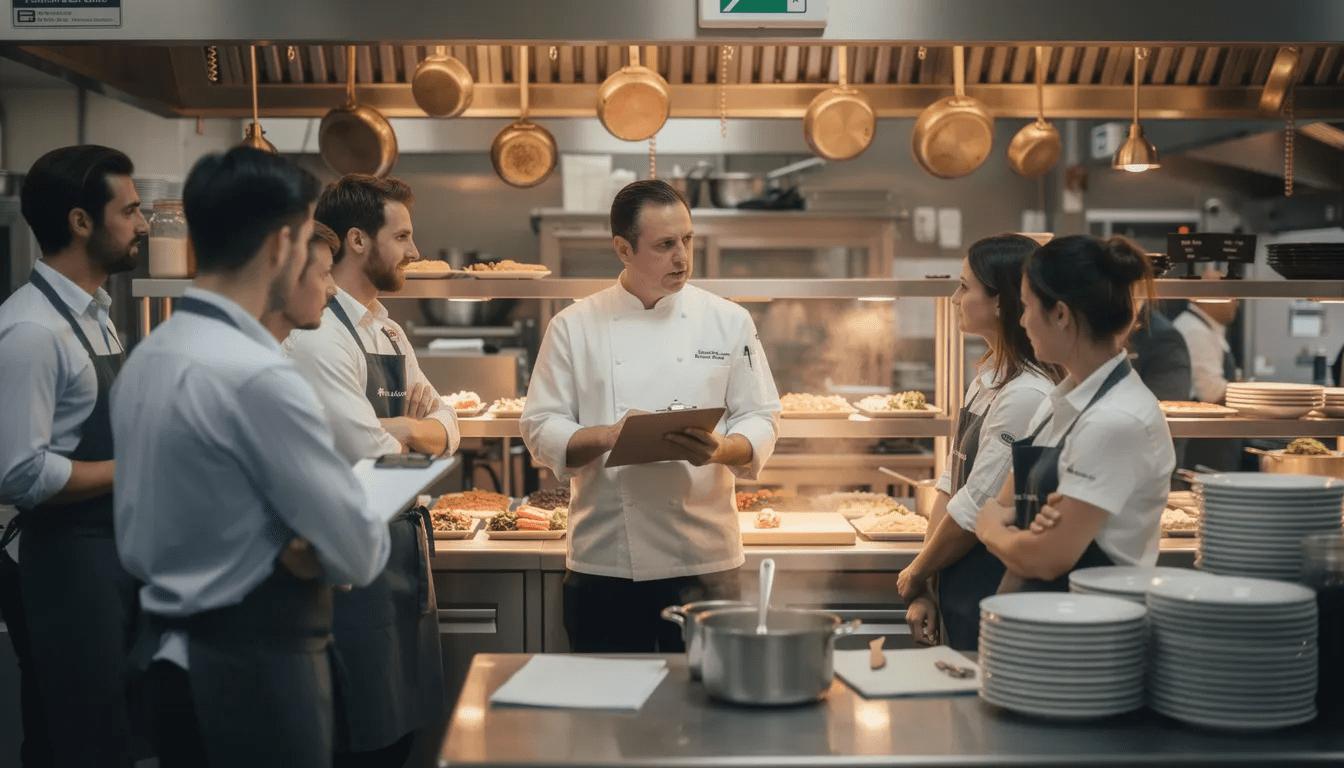
The one-sentence version: a busser makes the server’s job physically possible during a full house. On the floor, that means clearing and resetting tables between covers (fast in casual, precise in fine dining — crumb-scrape, linen swap, glassware alignment); refilling water without being asked; stocking service stations; pre-bussing during service to keep server hands free; running dirty dishes safely; and handling pre-shift setup and post-close breakdown.
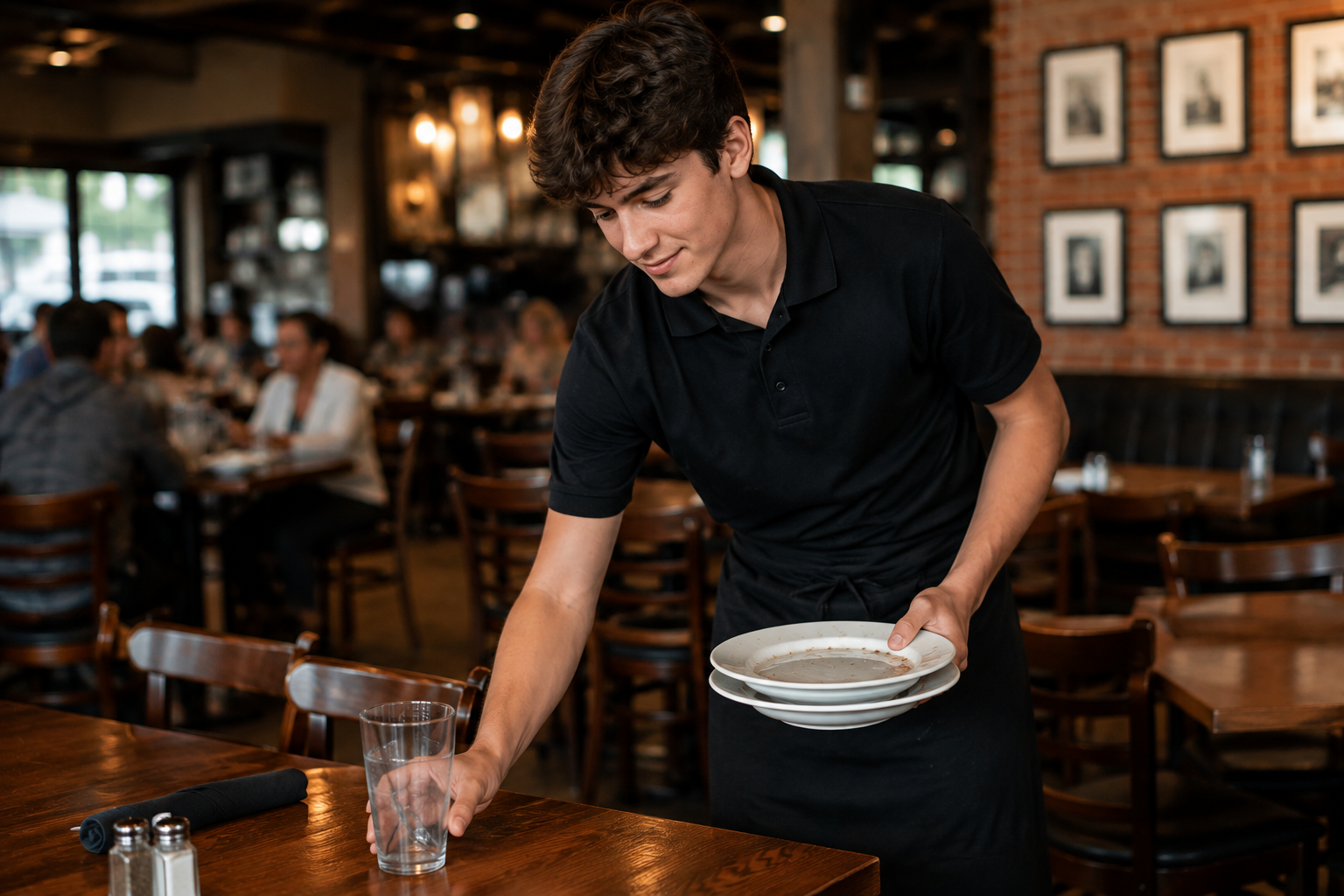
The fine dining distinction matters: there, tableside presence is a skilled act — silent, precise, timed to the guest. A fast, friendly casual busser is a great casual hire who may not belong in a white-tablecloth room. That’s a different job, not a character flaw. In counter-service or fast-casual, many operations don’t run a dedicated busser at all. One thing worth writing down: busser is the most common entry point into front-of-house work, and bussers who show initiative move to runner, then server. Operators who say that plainly in the posting attract more motivated applicants and see better 90-day retention.
Busser Job Description Templates — Copy, Paste, Customize
Complete, fill-in-the-blank templates. Swap the bracketed fields for your specifics, and keep the detail — that specificity is what makes applicants self-select correctly before they apply.
Template A: Casual Full-Service
BUSSER — [RESTAURANT NAME]
[City, State] | [Full-Time / Part-Time]
Pay: $[X.XX]/hour + tip pool (approx. $[Y]–$[Z] per shift)

ABOUT US
[Restaurant Name] is a [cuisine] restaurant in [neighborhood] known for
[1–2 sentences on atmosphere, volume, or concept]. We run [X] covers on a
peak dinner service and need a busser who can keep up.

WHAT YOU'LL DO
- Clear and reset tables between covers — fast, complete, every time
- Pre-bus during service to keep server hands free
- Refill water and remove finished dishes without waiting to be asked
- Stock and maintain service stations (napkins, silverware, glassware)
- Carry trays of dirty dishes to the dish pit safely
- Assist with pre-shift setup and post-close breakdown
WHAT WE'RE LOOKING FOR
- Available evenings and weekends, including Fri/Sat and holidays (required)
- Able to stand a full shift and carry a loaded tray (up to [X] lbs)
- Team-first attitude; this role works alongside servers, not apart
- Restaurant experience preferred, not required — we train for speed

SCHEDULE
[Be specific: e.g., "Fri–Sun dinner required; weekday shifts available"]

COMPENSATION
- Base: $[X.XX]/hour + tip pool ($[Y]–$[Z] per shift)
- [Meals, discounts, other benefits]

TO APPLY
[Application link or walk-in instructions]
[Restaurant Name] is an equal opportunity employer.
Template B: Fine Dining
BUSSER — [RESTAURANT NAME]
[City, State] | [Full-Time / Part-Time]
Pay: $[X.XX]/hour + tip pool (approx. $[Y]–$[Z] per shift)

ABOUT US
[Restaurant Name] is a fine dining restaurant in [city] offering
[e.g., "a 60-cover tasting menu focused on seasonal American cuisine and
precise, unhurried service"]. Our dining room team holds a high standard —
quiet, attentive, detail-oriented. We expect the same from every role.

WHAT YOU'LL DO
- Execute a complete formal reset between covers: crumb-scrape, linen swap,
  glassware alignment, napkin fold, centerpiece placement
- Maintain a silent, attentive tableside presence — guests shouldn't notice
  you; they should notice the table is already reset
- Refill water and clear finished courses without disrupting conversation
- Stock and maintain all service stations throughout service
- Assist servers with pre-bussing during multi-course service
- Complete pre-shift mise en place and post-close breakdown to house standard

WHAT WE'RE LOOKING FOR
- Attention to detail — reset quality is non-negotiable
- Calm and composed; our pace is deliberate, not rushed
- Discreet, professional demeanor in the dining room
- Availability for [evenings/nights/weekends]
- Prior experience preferred; fine dining familiarity a plus, not required

SCHEDULE
[e.g., "Tuesday–Saturday dinner service required"]

COMPENSATION
- Base: $[X.XX]/hour + tip pool ($[Y]–$[Z] per shift)
- [Additional benefits]

TO APPLY
[Application instructions]
[Restaurant Name] is an equal opportunity employer.
Across postings on our platform, a busser job description that includes the concept, a cover-count context, and a specific availability requirement consistently produces more qualified applicants than a generic three-sentence post. Want one customized to your concept and schedule? The free job description generator takes about two minutes, no signup required.
How Much Does a Busser Make in 2026?
| Source | Data Point |
|---|---|
| BLS OEWS (SOC 35-9011), mean | $15.74/hour |
| BLS OEWS (SOC 35-9011), median | $14.99/hour |
BLS OEWS covers Dining Room and Cafeteria Attendants and Bartender Helpers — the official classification for the busser role. Verify the latest annual release for your market.
Location moves this number more than anything: urban coastal markets run well above the national average, rural markets below it, and hotel and fine dining rooms with strong tip pools often land at the top. The National Restaurant Association’s job-openings data tracks how labor-market tightness shifts these numbers — worth checking before you set a rate in a new market.
The tip-out math most postings omit. If your servers average $120 in tips on a Friday dinner and you run a 10% busser tip-out, that’s $12 per server per shift on top of base — up to ~$48 on a four-server floor. Say so in the posting: “Base pay: $[X]/hour + tip pool (approximately $[Y]–$[Z] per shift).” Tip-pool shares to bussers in the 5–15% range are consistent with full-service industry norms.
Tip credit varies by state. Some states let employers pay tipped employees a lower base (the federal tip credit allows a base as low as $2.13/hour); others require full minimum wage regardless of tips. This isn’t legal advice — the DOL Wage and Hour Division’s tip regulations are a reliable starting point, but rules vary by state and change; confirm with your state labor department or an attorney. And don’t post a low base against a $14–$16 prevailing wage — you’ll attract applicants with no attachment to your concept, or none at all.
Fine Dining vs. Casual Full-Service — Which Template Fits?
A fine dining busser and a casual busser share a title and almost nothing else.
| Factor | Casual Full-Service | Fine Dining |
|---|---|---|
| Primary skill | Speed of reset, volume | Precision, quiet presence |
| Cover count | 80–200+ /service | 40–80 /service, slower |
| Experience required? | No — train for speed | Preferred — shortens ramp |
| Key JD language | “Fast-paced,” “team player” | “Detail,” “formal,” “discreet” |
| Trial shift tests | Speed and stamina | Protocol and composure |
Two questions answer which template to use: is your primary constraint speed of table turn or quality of tableside experience, and does this person work directly alongside your servers or more independently? In a counter-service or fast-casual concept below 40 covers, the role often disappears — posting for it creates a labor cost you didn’t budget and a hire who runs out of work by 7pm.
Busser vs. Food Runner — Which Role Do You Actually Need?
A busser works backward — clearing each cover, resetting for the next guest. A food runner works forward — moving food from the kitchen to the correct table, fast and accurate. The overlap is real, but the constraint each solves is different.
| If your primary constraint is… | You need… |
|---|---|
| Table-turn speed (clearing bottleneck) | Busser |
| Food delivery accuracy and speed | Food runner |
| Both | One of each, or a hybrid |
| Under 40 covers, fast casual | Neither — server/self-bus |
As a rough guide, at 60–80 covers one busser typically supports a four-server floor through peak; at 100+, most operators run one busser per section plus a dedicated runner. If you’re unsure which to post first, post the busser role — it’s the easier, lower-cost hire with more available applicants, and a busser who proves themselves is a natural runner candidate in 60–90 days. For the full breakdown, see the restaurant food runner job description.
5 Hiring Tips From Operators Who’ve Done This
1. Lead with availability, not experience. The most common reason a busser posting fails is attracting applicants who can’t work the hours you need. Put “must be available evenings and weekends” in the first paragraph — applicants who can’t meet it remove themselves. It’s one of the most reliable ways to reduce ghosting before it costs you a shift.
2. Run a 10-minute phone screen. Three questions — availability for [days/hours], any physically demanding full-shift-standing experience, and can they start within [X] days — eliminate 30–40% of scheduled interviews. The no-shows cost you nothing; the ones who pass are a different quality of applicant.
3. Consider a paid trial shift. A two-hour paid trial during actual service — not a fake “observation” — is the most accurate screen you have: speed, stamina, and how they handle a three-table backlog. Note that laws on compensating trial shifts vary by state; confirm before making paid trials policy.
4. Set the reset standard before you post. The number-one server complaint about new bussers is inconsistent reset quality. A busser hired to a clear standard knows what “done” looks like before touching a table — write it into the job description or a first-day checklist. People stay in roles where expectations are clear, which helps reduce early turnover.
5. Use scenario questions. Ask every candidate what they’d do if three tables needed clearing at once (prioritization); if a server asks something the manager hasn’t assigned (team orientation); if a guest speaks to them instead of their server (service instinct). A résumé can’t answer these — thirty seconds with the right questions can.


Fill the role this week
Post your first busser job for $1. Under 3 minutes from a phone — no demo, no contract, no setup call. Qualified applicants who meet your criteria land in your inbox; if none within 24 hours, you pay nothing and the charge reverses.
Frequently Asked Questions
What does a busser do in a restaurant?
A busser clears dirty dishes, glasses, and linen between covers, resets each table to service-ready standard, stocks service stations, refills water, and assists servers with pre-bussing during service. In fine dining the role includes precise tableside reset sequences — crumb-scraping, formal linen fold, glassware alignment. In high-volume casual service, the priority is speed of reset. Busser is the most common entry point into front-of-house work; motivated bussers typically advance to runner or server within 3–12 months.
How much does a busser make per hour in 2026?
The BLS OEWS survey puts the mean hourly wage at $15.74, with a median of $14.99, for SOC 35-9011 (Dining Room and Cafeteria Attendants and Bartender Helpers) — and the figure has risen every year since 2021. Actual pay varies by market, concept, and tip-pool participation. In high-volume restaurants with an active tip pool, total compensation can run $3–$8/hour above the posted base. BLS updates annually, so verify the latest release for your market.
Do bussers get tips, and how does tip-out work?
It depends on the restaurant’s tip-pool policy and state law. Many full-service restaurants include bussers in a tip pool, typically 5–15% of the server’s total tips per shift. Where servers average $120/night, a 10% busser tip-out adds $12 per server per shift — on a four-server floor, $40–$50 per evening on top of base. Put the structure and an estimated per-shift range in your description; applicants will ask, and transparency drives application completion. Tip credit laws vary by state; the DOL’s tip regulations are a reliable starting point.
What’s the difference between a busser and a food runner?
A busser’s primary function is backward — clearing and resetting tables after each cover. A food runner’s is forward — delivering food from the kitchen to the correct table accurately and quickly. Both support servers and overlap during a rush. If table-turn speed is the bottleneck, hire a busser; if food delivery is the issue, hire a runner. Many full-service restaurants above 80 covers run both. See the food runner role explained in full.
How do I try StaffedUp to hire a busser?
Post your first busser job for $1 at staffedup.com/hire — from a phone, under 3 minutes, no setup call, no demo, no contract. Your posting distributes across major job boards, and unqualified applicants are screened out before they reach your inbox. If you don’t have a qualified applicant within 24 hours, you pay nothing — the charge reverses automatically. After the first post, it’s $29/month with unlimited active postings and easy in-app cancellation.
You’ve got the template — now fill the role
Post your first busser job for $1. Qualified applicants who meet your criteria land in your inbox — mass-apply submissions screened out first. No qualified applicant within 24 hours, you pay nothing.
Sources
- U.S. Bureau of Labor Statistics — Occupational Employment and Wage Statistics (OEWS), SOC 35-9011, Dining Room and Cafeteria Attendants and Bartender Helpers (mean $15.74/hr, median $14.99/hr; May 2023 release, the most recent complete figures confirmed for this occupation — BLS updates annually).
- National Restaurant Association — Restaurant Job Openings, Economic Indicators (hospitality labor-market context).
- U.S. Department of Labor, Wage and Hour Division — Tip Regulations (federal tip credit, tip pools, tipped minimum wage).
- StaffedUp platform data — internal observations from thousands of restaurant job postings (applicant volume, qualified-applicant rates, time-to-hire).

Hire Smarter, Faster
StaffedUp simplifies hiring for restaurant & hospitality operators. Post your first job for $1.