
7shifts Hiring vs. a Dedicated ATS: The Honest Comparison
By Billy Giordano, Co-Founder, StaffedUp
Former restaurant operator. Built StaffedUp after posting “URGENTLY HIRING” on Facebook during a Saturday rush and getting zero replies — then spending $400/month on Indeed for three months and making zero hires.
Last updated: October 2026
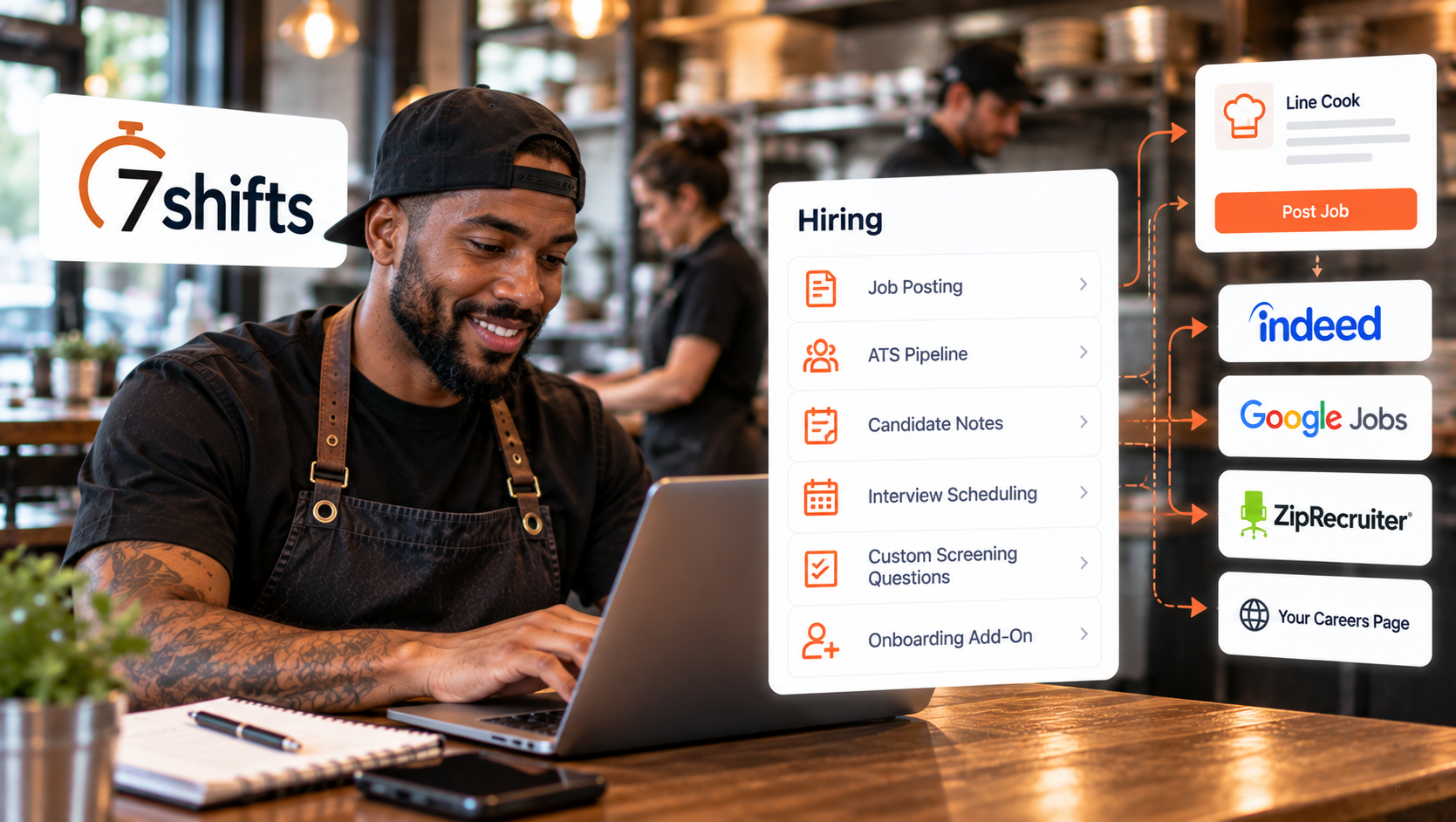
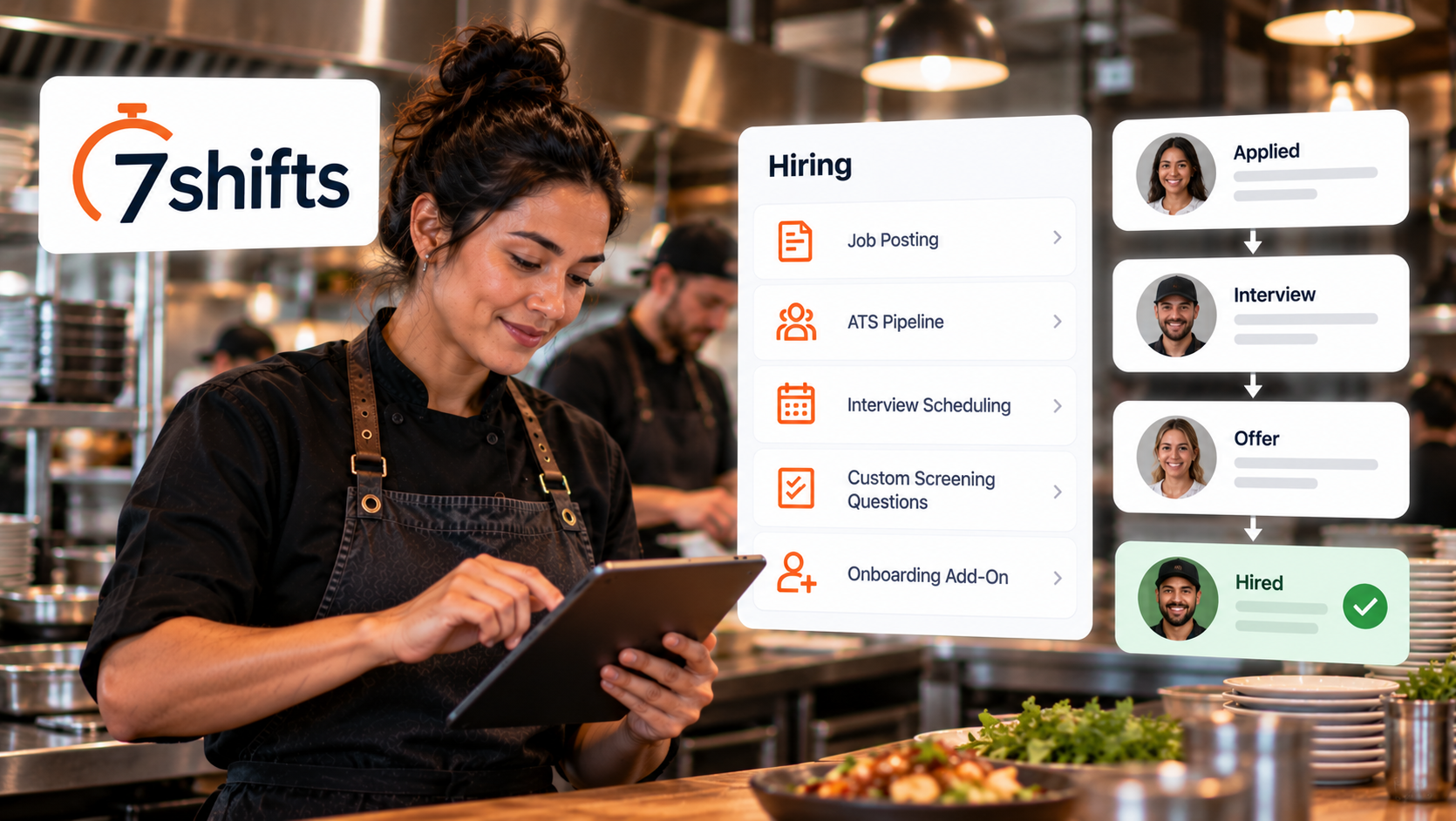
Here’s the short answer: 7shifts includes a real, functional hiring module — job posting, an ATS pipeline, candidate notes, interview scheduling, custom screening questions, and an onboarding add-on at $2.99 per package. It works well if you already live in 7shifts for scheduling and hire infrequently at one location. The honest ceiling: 7shifts was architected as a scheduling platform, not a hiring platform, so it lacks broad job-board syndication, text-to-apply, AI screening, and automated follow-up. For operators posting 5+ roles a month, running multiple locations, or losing applicants over a weekend, a dedicated ATS is worth running alongside it.

What 7shifts Hiring Actually Includes (Verified, September 2026)
Before naming what 7shifts hiring can’t do, name what it does. Per the 7shifts knowledge base and product page: a job-posting builder (create a posting in minutes, specify role, location, and job type); an ATS candidate pipeline (all applications in one view — contact info, experience, availability, screening responses, plus notes, flags, and status tracking); custom screening questions (text, yes/no, date, number, and currency formats to filter applicants before you pick up the phone); email alert notifications (configurable per role — though by default only the posting creator gets alerts, routing to all Admins if they’re off); native interview scheduling; and a $2.99-per-package onboarding add-on (W-4, W-9, I-9, direct deposit; mobile completion; US only). The standout is the new-hire-to-schedule handoff: approve a hire and you assign location, department, and role in the same step, so they’re on the schedule from day one. The post distributes to external job boards, though 7shifts doesn’t publish a specific list of partners — the KB language is “external job boards” without naming them.
| Capability | 7shifts Hiring | Notes |
|---|---|---|
| Job-posting builder | ✅ | Minutes to create; customizable |
| ATS candidate pipeline | ✅ | Notes, flags, status tracking |
| Custom screening questions | ✅ | Multiple format options |
| Interview scheduling | ✅ | Native, within platform |
| Automated SMS/text follow-up | ❌ | Email only |
| Text-to-apply | ❌ | Not available |
| AI screening / scoring | ❌ | Not available |
| Broad multi-board syndication | ❌ | Network not published |
| Digital onboarding | ✅ | Add-on, $2.99/package, US only |
Scheduling-Native vs. Hiring-Native: Why the Architecture Matters
This framework explains the feature checklist better than any item-by-item breakdown. 7shifts was built from the scheduling layer out. Its core data model is the shift — who’s working, when, at what labor cost, against what sales projection — and hiring was added to serve that model: get a new hire onto the schedule faster. The module is designed to close the gap between “open role” and “first shift,” not to optimize candidate-pipeline conversion. A dedicated ATS is built from the candidate pipeline out. Its core model is the application — who applied, when, what they said, how they screened, where they dropped off — with scheduling integration as the bridge, not the engine. It’s designed to move applicants from interested to qualified to hired, fast and at volume, without a manager manually chasing every lead. Why that matters for restaurants: BLS JOLTS shows accommodation and food services posted a 4.3% quit rate in March 2026 — roughly double the private-sector average — with annual turnover at 65.5% in 2025. Most restaurants hire continuously, not occasionally. A scheduling-native tool is built for occasional use; a hiring-native ATS is built for continuous use. The failure mode operators feel but can’t name: you check 7shifts at 9am Monday, see a solid applicant who submitted Friday night, send an email — and they already started somewhere else Saturday. That’s not user error, it’s the architecture. The system sent an email, not a text; it didn’t auto-respond; it didn’t move them through a pipeline while you were in the weeds on Saturday service. For context on why restaurant turnover makes hiring continuous, that’s covered separately. None of this is a flaw in 7shifts — it’s a product-scope decision. If your hiring volume is low and your urgency manageable, that scope is right for you.
Where 7shifts Hiring Works Well
This is the section most competitor pages won’t write because it costs them a sale. You’re already on 7shifts and don’t want a second tool. If your scheduling, time-tracking, labor costs, and team communication all live in 7shifts, adding a separate hiring platform means two logins, two data sets, and a manual handoff on every hire — for low-volume hiring, that friction probably isn’t worth eliminating. You’re a single location posting fewer than 2–3 roles a month. Filling a server position once a quarter and a BOH role twice a year, 7shifts hiring gets it done: job up in minutes, pipeline visible, email on apply, move to hired, on the schedule — no reason to pay for more. The new-hire-to-schedule handoff is the best part of the module. Approve a hire, assign location/department/role in one step, and they’re in scheduling from day one — no re-entry, no manual bridge. A dedicated ATS needs a data integration to match that, and today that’s often still a manual step. 7shifts wins this one cleanly. If you run one restaurant, live in 7shifts every day, and hire two people a year, a second tool adds complexity you don’t need.
Where 7shifts Hiring Runs Out
No text-to-apply. Candidates can’t apply by texting a number — they navigate to a job-post link. Reasonable at low volume; a meaningful friction point against operators offering one-tap apply. No AI screening or automated scoring. Applications land in the pipeline and a manager reviews them by hand — fine at low volume, but during a seasonal surge that’s hours of work before you’ve talked to a single qualified person. Email-only communication, no automated follow-up. Changing a candidate’s status triggers nothing back to the candidate; at 10pm Friday when a strong applicant submits, the pipeline is silent until someone opens the app Monday. That’s the applicant-ghosting problem at its most preventable. Unpublished job-board syndication. 7shifts distributes to external boards but doesn’t name its partners — verify the current network directly before assuming coverage. Onboarding is a paid add-on, $2.99 per package, US only — the detail operators discover after assuming it was bundled. Notification routing gap. Only the posting creator gets new-applicant alerts by default; if that manager is off Saturday, the application waits. Sean O., who runs an Irish pub in Chicago, spent $400/month on Indeed for three months and made zero hires — the core problem wasn’t just the board, it was a passive workflow where a candidate applied, landed in a pipeline, and the ball was in his court to chase. That’s the same gap you hit when hiring volume exceeds what a manager can realistically chase alone.
Decision Framework: Keep 7shifts Hiring, or Add a Dedicated ATS?
| Situation | 7shifts Hiring Is Enough | Add a Dedicated ATS |
|---|---|---|
| Locations | Single location | 2+ locations |
| Monthly open roles | 1–3 | 5+ |
| Hiring urgency | Days to a week is fine | Qualified applicants in 24–48 hours |
| Applicant volume | Low; manual review manageable | High; need automated screening |
| Weekend responsiveness | Checking Monday is okay | Losing applicants by Monday |
| Onboarding volume | Rare (few per year) | Frequent; $2.99/package accumulates |
The weekend test. If you’ve opened your inbox Monday, seen a strong applicant who submitted Friday night, sent a message — and learned they started somewhere else Saturday — you’ve hit the ceiling. Among the operators we work with, that’s the most common trigger for adding a dedicated ATS. The multi-location trigger. Running 2+ locations makes hiring effectively continuous; a manager working a basic pipeline across properties isn’t sustainable at volume. The seasonal scenario. Bringing on 15–20 people in six weeks every summer, a basic pipeline tracker isn’t built for it — you need automated screening, broad distribution, and fast communication. Marisol V., who runs a seasonal bar and grill, went from 60 applications down to 5 who actually wanted to work — exactly the screening problem where a dedicated ATS earns its cost.
The “Keep Both” Stack: 7shifts + a Hiring ATS in Practice
This is what many multi-location groups already run: 7shifts for scheduling, a dedicated ATS for hiring. The ATS handles sourcing, screening, and selection; once you’ve made a hire, that person’s name, role, contact, and availability move into 7shifts for scheduling — currently a manual step (add the hire in 7shifts, assign location and department, set shift access). Verify current integration status with your ATS provider before assuming automation. Running two systems means two records per employee, so keep role, availability, and contact info consistent across both, and assign one person — the manager or ops lead — to own the handoff explicitly. The payoff: you keep 7shifts’ genuinely strong scheduling and labor tools while getting the distribution, screening, and automated candidate communication a scheduling-native module wasn’t built to provide. That’s how StaffedUp fits — a dedicated hiring layer that posts your role to Indeed, Google Jobs, ZipRecruiter, and more simultaneously, screens applicants against the criteria you set before they reach your inbox, and keeps candidates warm with automated follow-up. First post is $1, then $29/month for unlimited active posts; a qualified applicant lands in your inbox within 24 hours or you pay nothing, charge reversed automatically. No demo, no contract, under three minutes from your phone, cancel in-app. How the StaffedUp ATS works covers the mechanics.
Post your first job for $1. It distributes to Indeed, Google Jobs, ZipRecruiter, and more — simultaneously — with screening that filters applicants before they reach your inbox, alongside the 7shifts scheduling you already run. If a qualified applicant isn’t in your inbox within 24 hours, you pay nothing and the charge reverses automatically. Under three minutes from your phone — no demo, no setup call, no contract. After the first post, it’s $29/month for unlimited active posts.
Frequently Asked Questions
Does 7shifts have a built-in hiring or applicant tracking system?
Yes. 7shifts includes a hiring module with a job-posting builder, an ATS candidate pipeline, custom screening questions, email alerts, and native interview scheduling, plus a paid onboarding add-on ($2.99/package). It’s a legitimate, functional tool — architected as an extension of 7shifts’ scheduling platform, so it’s built for lower-volume, single-location hiring rather than high-volume or multi-location recruiting. Hiring availability depends on your plan tier; confirm with 7shifts.
Does 7shifts post jobs to Indeed and other external job boards?
7shifts distributes postings to external job boards but doesn’t publish a specific list of partners — its knowledge base refers to “external job boards” without naming them. If distribution breadth matters to your strategy, contact 7shifts directly to verify the current network before assuming coverage. A dedicated ATS typically distributes to a named, broad set (Indeed, Google Jobs, ZipRecruiter, Monster, and more) from a single post.
How much does 7shifts hiring and onboarding cost?
The hiring module’s availability depends on your 7shifts plan tier — verify current inclusions directly with 7shifts. The onboarding add-on is listed at $2.99 per onboarding package sent, available to US customers (confirm geographic availability). For operators sending many onboarding packages, that per-package cost accumulates; factor it into any volume comparison.
What does 7shifts hiring not do that a dedicated ATS does?
7shifts hiring lacks text-to-apply, AI-powered screening or candidate scoring, automated candidate follow-up sequences, and broad published job-board syndication. It’s email-only for candidate communication, and changing a candidate’s status doesn’t trigger any automated message back to them. A dedicated ATS adds multi-board distribution, automated pre-screening against your criteria, and automated text/email follow-up that keeps candidates engaged over a weekend.
Should I replace 7shifts, or run it alongside a hiring platform?
Run it alongside — don’t replace it. 7shifts’ scheduling, labor forecasting, and team-communication tools are genuinely strong, and its new-hire-to-schedule handoff is excellent. The “keep both” stack — 7shifts for scheduling, a dedicated ATS for hiring — is common among multi-location groups. The only caveat is the handoff: assign one person to keep employee records consistent across both systems, since the integration is often still a manual step.
How do I try a dedicated ATS alongside 7shifts without a commitment?
Post your first job on StaffedUp for $1 at staffedup.com/hire. It distributes to Indeed, Google Jobs, ZipRecruiter, and more, with screening that filters applicants before your inbox — and you keep 7shifts for scheduling. If a qualified applicant isn’t in your inbox within 24 hours, you pay nothing; the charge reverses automatically. No demo, no setup call, no contract, under three minutes from your phone. After the first post, it’s $29/month for unlimited active posts.
Sources
- 7shifts, Hiring (Knowledge Base) and the 7shifts hiring-software product page — hiring module features, screening questions, notification routing, new-hire-to-schedule handoff; onboarding add-on $2.99/package (US only).
- U.S. Bureau of Labor Statistics, JOLTS — accommodation and food services quit rate 4.3% (March 2026); annual turnover 65.5% (2025).
- National Restaurant Association, Restaurant Job Openings Economic Indicators.
- StaffedUp platform data: 8x more applicants, 77% shorter time-to-hire, 45% decreased turnover — internal aggregate.

Hire Smarter, Faster
StaffedUp simplifies hiring for restaurant & hospitality operators. Post your first job for $1.