

Kitchen Manager Job Description: Free Template for Restaurant Operators
By Billy Giordano, Co-Founder, StaffedUp
Former restaurant operator. Built StaffedUp after losing a line cook before a Saturday rush — and learning the hard way that a vague job description is the first reason serious candidates don’t apply.
Last updated: August 2026
A kitchen manager oversees back-of-house operations — managing kitchen staff, controlling food and labor costs, enforcing food safety standards, and ensuring consistent execution from prep through service. Use this kitchen manager job description template and salary guide to hire the right person, set the right expectations, and stop losing qualified applicants to a vague JD. The role differs from a sous chef (culinary execution) and a general manager (whole-restaurant P&L): most kitchen managers are salaried, receive no tips, and are accountable for specific cost targets.
What Is a Kitchen Manager?
The kitchen manager runs the BOH as a business operation — not the creative food authority, not the whole-restaurant owner. The KM owns the numbers: food cost, labor cost, inventory, scheduling, compliance, and execution consistency, shift after shift. When your head chef calls in sick on a Saturday, the KM adjusts the prep list, calls in a cover, and keeps tickets from backing up. When your health inspection score drops, the KM is accountable.

In most full-service and fast-casual concepts the KM reports to the GM or owner; in larger multi-unit groups, to a Director of Operations or Executive Chef. The BLS Occupational Outlook Handbook classifies the role under Food Service Managers. In single-location independents and many QSR concepts, kitchen manager, BOH supervisor, and executive chef fold into one person or split by volume. If you’re unsure which role you need, the comparison table below handles that. For the GM-level role at full FOH+BOH scope, see the restaurant general manager job description.
Kitchen Manager Job Description Template [Copy-Ready]
Copy this block, customize the bracketed fields for your concept, and you’re ready to post tonight.
JOB TITLE: Kitchen Manager
REPORTS TO: [General Manager / Owner / Director of Operations]
LOCATION: [Restaurant Name], [City, State]
EMPLOYMENT TYPE: Full-Time | Salaried
COMPENSATION: $[XX,000]–$[XX,000]/year + benefits

ABOUT US
[2–3 sentences on your concept, kitchen culture, and what makes your BOH
worth leading. Be specific — generic "fast-paced environment" filters nobody.
Tell them the food, the volume, the kind of team.]

THE ROLE
We're looking for an experienced Kitchen Manager to own back-of-house
operations at [Restaurant Name]. This is a leadership and operations role —
not just a cooking role. You'll own food cost, labor scheduling, team
development, and execution consistency from open to close.

WHAT YOU'LL OWN
• Daily BOH operations: prep, line, expo, and close
• Kitchen staff scheduling, training, and performance management
• Food cost and inventory control — ordering, waste tracking, vendors
• Food safety and sanitation compliance (health dept + internal audits)
• BOH labor cost within [X]% of revenue target
• Cross-communication with FOH on timing, 86s, and accommodations

WHAT WE'RE LOOKING FOR
Required:
• 3+ years BOH restaurant experience, incl. 1+ year supervisory
• ServSafe Manager Certification (or state-equivalent — check your state)
• Demonstrated track record of food cost control
• Available for [schedule, incl. nights, weekends, holidays]

Preferred:
• Experience with [your POS] and [your inventory platform]
• Experience managing a BOH team of [X] or more
• Bilingual [languages relevant to your market]

WHY WORK WITH US
[2–3 sentences: compensation, growth path, kitchen culture, perks. If you
promote from within, say it. If you close two days a week, say it. Specifics
attract candidates who want this job, not every job.]

HOW TO APPLY
[Application link or instructions]
ServSafe note: ServSafe Manager Certification is the industry standard for this role, and many states or localities require a certified food protection manager on-site — the mandate, exam format, and reciprocity rules vary by jurisdiction. Confirm your state’s requirements before finalizing your JD.
Post it tonight
Post your kitchen manager job for $1. If a qualified applicant isn’t in your inbox within 24 hours, you pay nothing for the month — the charge reverses automatically. Under 3 minutes from a phone, no demo, no contract, cancel in-app.
Core Duties and Responsibilities
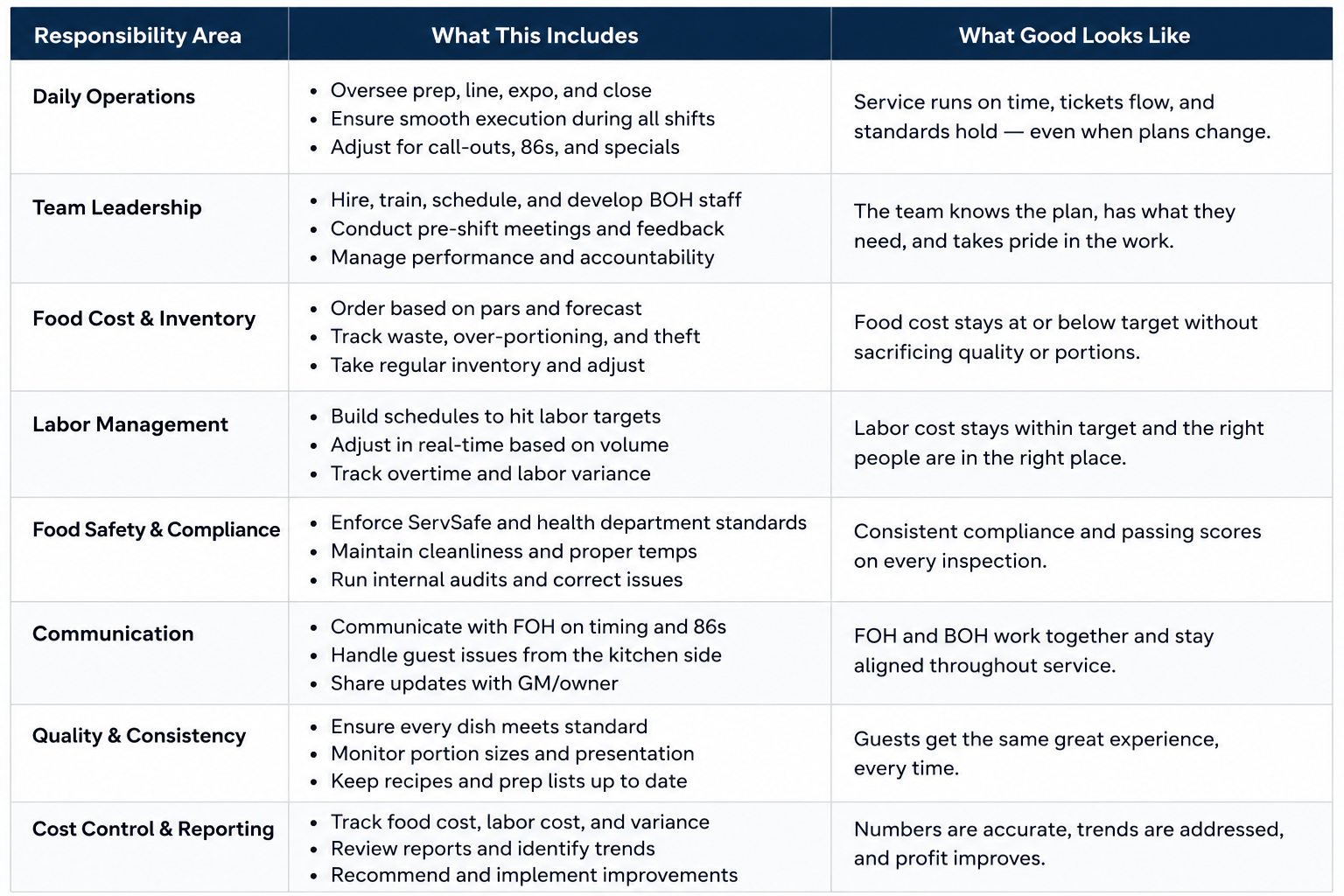
The template gives you the bones. Here’s what each area looks like on the floor, for operators customizing the JD or evaluating candidates against specifics.
Operations: opens or closes the kitchen (temp checks, equipment walkthroughs, prep sign-off); runs or oversees the line and manages ticket pacing; adjusts prep and staffing when callouts hit; communicates 86s and specials to FOH. People: hires, onboards, and schedules BOH staff against projected volume; runs performance check-ins and corrective action; develops line and prep cooks — the best KMs are the reason your BOH team sticks around. Financials: places weekly orders, flags invoice discrepancies, tracks actual food cost against target, and runs labor schedule-vs-actual. Compliance: leads health-inspection prep and internal audits, maintains equipment logs, and enforces FIFO, labeling, and temperature discipline. The KM is the person who turns “we’re 86’d on salmon” into a plan.
Kitchen Manager KPIs: What This Role Is Accountable For
Before you post, write down the three numbers you’ll use to evaluate this person at 30, 60, and 90 days. A KM who doesn’t know their targets can’t own them.
| KPI | Typical Target | What It Tells You |
|---|---|---|
| Food Cost % | 28–35% of food revenue | Ordering and waste control |
| BOH Labor Cost % | 28–35% of total revenue | Scheduling to need, not habit |
| Health Inspection Score | 90+ (or A-grade) | Sanitation standards are real |
| BOH Turnover Rate | Below 75% annualized | Developing people vs. burning them |
| Ticket Time (service) | Concept-specific baseline | Execution consistency |
These are industry rules of thumb — directional starting points, not guaranteed targets. A fine-dining concept runs a different food-cost structure than a QSR, and a lunch-heavy fast-casual runs a different ticket-time benchmark than a 60-cover dinner house. Calibrate every number to your own P&L, and pair the turnover KPI with a real plan to reduce BOH turnover before you put it in a review. For sector labor context, the National Restaurant Association tracks the trends.
Kitchen Manager vs. Sous Chef vs. General Manager: Which Do You Need?
| Kitchen Manager | Sous Chef | General Manager | |
|---|---|---|---|
| Primary focus | BOH ops + cost control | Culinary execution | Whole-restaurant P&L |
| Owns the menu? | No | Yes (under exec chef) | Approves |
| Owns food cost? | Yes | Partially | Yes (overall) |
| On the line? | As needed | Most services | Rarely |
| Post if… | You need BOH ops owned | You need culinary firepower | You need one person running everything |
By concept size: QSR or fast-casual under $2M — KM and GM are often the same person; add a dedicated KM when you need someone whose entire job is the BOH. Full-service, 50–150 covers — the classic KM hire (the template above). Full-service 150+ or multi-concept — you may need both a KM (operations) and a sous chef (culinary) under an executive chef. Promoting from within after losing a chef — be explicit about whether you’re hiring a KM or a sous chef; conflating them is how you hire wrong twice.
Kitchen Manager Salary by Concept Type (2026)
A single national average is useless when you’re setting a budget, so here’s the data with sources named. The BLS median for Food Service Managers (the category that includes kitchen managers) is $65,310 (May 2024); Salary.com benchmarks the kitchen-manager-specific average around $55,500 (2026). Most operators can expect to pay in the $48,000–$75,000 range depending on concept and market.
| Concept Type | Typical KM Salary |
|---|---|
| QSR / Fast Food | $38,000–$52,000 |
| Fast Casual | $45,000–$60,000 |
| Full Service (casual) | $52,000–$68,000 |
| Full Service (upscale / fine dining) | $60,000–$80,000+ |
| Multi-unit / group | $65,000–$85,000+ |
Ranges by concept reflect industry estimates — validate against current postings in your market before setting an offer. Two things to keep in mind: kitchen managers receive no tips, so base salary is the full compensation picture outside benefits and bonus — a gap that matters when you benchmark against a sous chef who earned tip income on the line. And in high-cost-of-living markets, expect to pay 15–25% above these ranges.
Qualifications: What Real Operators Screen For
Most kitchen managers didn’t go to culinary school — they came up through the line: prep, line cook, lead, sous chef, KM. Your qualifications section should reflect what predicts success in this role, not what looks good on a job board. Two signals your section is off:
If your JD requires a culinary degree, you’re filtering out most of the people who can do this job. A candidate who spent three years as a lead line cook managing a BOH team of eight and hitting 31% food cost consistently is a stronger operations hire than most culinary-school graduates — and doesn’t have the credential. If your JD doesn’t mention ServSafe, you’re not filtering enough. A certified food protection manager is a real screen; a culinary degree is performative for this role. The great KM who came up through the line looks different on paper — know what you’re actually hiring for before you screen them out.
On legal requirements: employment law, wage rules, and food-handler certification mandates vary by state and sometimes county. This isn’t legal advice — consult your state’s labor department or a local employment attorney for jurisdiction-specific requirements.
How to Post a Kitchen Manager Job Description and Get Qualified Applicants
A good JD is only as useful as the platform you post it on and the filters you use. Three things that work for KM postings: Put the salary range in the posting — candidates who won’t work for your budget ghost faster when they see it, and “$DOE” signals you either don’t know your market or won’t commit. Specify availability explicitly — “must be available Friday and Saturday evenings, including holidays” is a free filter. Add one targeted application question — “What food cost percentage were you responsible for at your last role?” eliminates every applicant who didn’t read the JD; a serious candidate answers in 15 seconds, someone mass-applying to 40 postings cannot.
Marisol V., who runs a seasonal bar and grill, used operator-defined screening criteria to bring her applicant pool from 60 submissions down to 5 that matched both her experience bar and availability requirements. That’s what a specific JD plus the right filters gets you. StaffedUp lets you set those criteria upfront so applications that don’t meet your availability, radius, and qualification requirements don’t reach your inbox — see how the screening works. One more note: BOH management candidates ghost at higher rates than FOH, and the vague posting is part of why — a specific JD attracts candidates who opted in knowing exactly what the role requires.
Frequently Asked Questions
What does a kitchen manager do day-to-day?
A kitchen manager runs back-of-house operations from open to close: setting prep, managing the line during service, adjusting for callouts, tracking waste, and placing orders. Administrative work — food cost reporting, vendor calls, next week’s schedule — typically happens before covers start. On any shift, they check food quality and temps, review labor against projected volume, and communicate 86s to the FOH.
What’s the difference between a kitchen manager and a sous chef?
A kitchen manager focuses on operations and cost control — scheduling, inventory, compliance, and BOH staff management. A sous chef focuses on culinary execution — cooking, leading the line, and developing dishes under an executive chef. In smaller restaurants, one person often carries both. When separating them, post for a KM if your pain point is cost and consistency; post for a sous chef if it’s culinary quality.
How much should I pay a kitchen manager in 2026?
Most operators pay in the $48,000–$75,000 range depending on concept and market. Fast-casual KMs typically fall in the $45,000–$60,000 range; full-service and upscale-casual $52,000–$75,000; fine dining and multi-unit roles can reach $80,000 or more. The BLS median for the broader Food Service Managers category is $65,310 (May 2024). Kitchen managers receive no tips, so base salary is the full compensation picture — and national averages shift significantly by region, so check current postings in your market.
What certifications does a kitchen manager need?
ServSafe Manager Certification is the industry standard. Many states and localities require a certified food protection manager on-site — the specific mandate, exam requirements, and renewal schedule vary by jurisdiction, so confirm your state’s requirements before finalizing your JD. No culinary degree is typically required or expected; most operators prioritize BOH line experience and a demonstrated track record in cost control over academic credentials.
How do I post a kitchen manager job and get qualified applicants?
Start with a specific JD — include the salary range, required availability, and one screening question tied to the role (food cost experience is the right one for a KM). StaffedUp distributes your posting across major job boards with one submission and filters out mass-apply and unqualified applications before they reach your inbox. First job post is $1; no qualified applicant within 24 hours, you pay nothing for the month, automatically, and you can cancel in-app. Post at staffedup.com/hire.
Ready to post this job tonight?
Copy the template, fill in your salary range and availability, and post it in under 3 minutes — no setup call, no demo, no contract, cancel in-app. Post your first kitchen manager job for $1. No qualified applicant in your inbox within 24 hours of going live? You pay nothing for the month — automatically.
Sources
- U.S. Bureau of Labor Statistics — Occupational Outlook Handbook: Food Service Managers (role classification, 2024–34 outlook).
- U.S. Bureau of Labor Statistics — Occupational Employment and Wage Statistics, Food Service Managers (SOC 11-9051): median $65,310, May 2024.
- Salary.com — Kitchen Manager salary benchmark (kitchen-manager-specific average ~$55,500, 2026).
- National Restaurant Association — State of the Restaurant Industry (sector labor context; KPI figures are industry rules of thumb, not firm NRA targets).
- U.S. Department of Labor, Wage and Hour Division — State Labor Offices (jurisdiction-specific requirements).
- StaffedUp platform data — internal observations from thousands of restaurant job postings.

Hire Smarter, Faster
StaffedUp simplifies hiring for restaurant & hospitality operators. Post your first job for $1.