
High Volume Hiring Software for Restaurants: What Enterprise Tools Get Wrong
By Billy Giordano, Co-Founder, StaffedUp
Former restaurant operator. Built StaffedUp after an “URGENTLY HIRING” Facebook post failed before a Saturday rush and $400/month on Indeed for three months produced zero hires. That’s why this platform exists.
Last updated: August 2026
What is high volume hiring software?
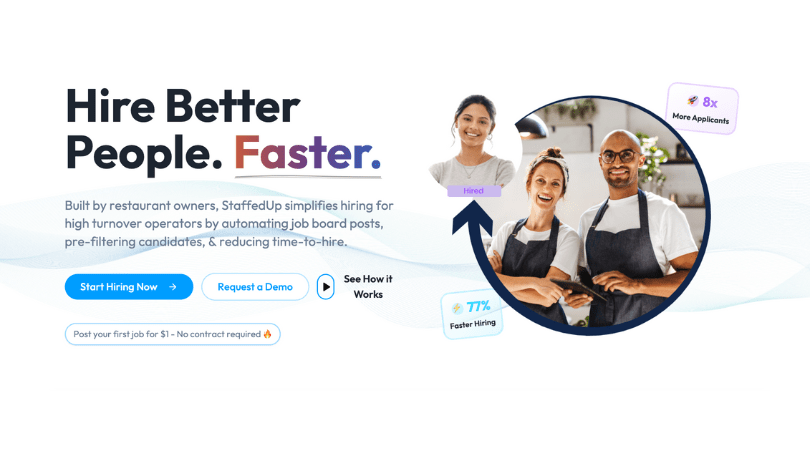
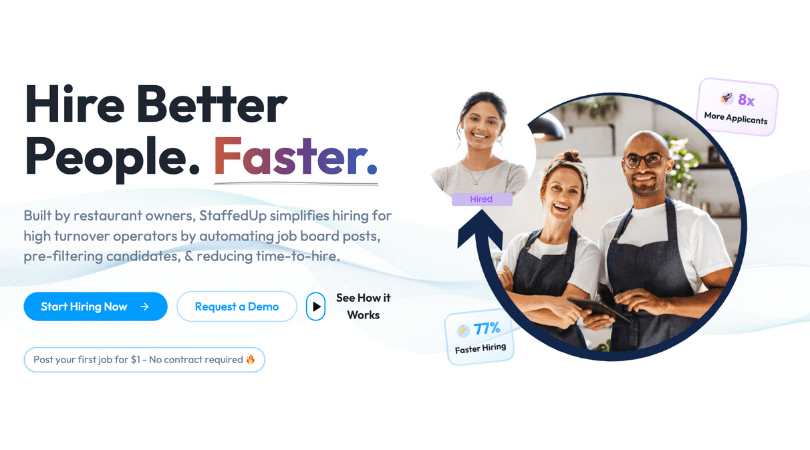
High volume hiring software is a recruiting platform built to generate and manage large numbers of applicants at once, screening and routing them so only qualified people reach the hiring manager. For restaurants, that means posting once across multiple boards, filtering out unqualified and mass-apply submissions automatically, and getting a real shortlist fast. Unlike a standard ATS built for slow corporate cycles, it’s designed for speed and volume from day one. StaffedUp users see 8x more applicants and 77% shorter time-to-hire versus single-board posting. (StaffedUp platform data.)
What “High Volume” Actually Means for a Restaurant
There are two modes of high-volume hiring that share almost nothing except the word “volume.” Enterprise mode is Workday, iCIMS, Fountain, and Paradox: 500 roles a quarter, a recruiting team, a full HCM stack. Restaurant mode is you — a GM who runs the floor, 18 hires needed before a new location opens in three weeks, no HR department. Same keyword, completely different problem.
Standard ATS tools are built for one role drawing a few dozen applicants over a month. Restaurant hiring is the inverse — multiple roles open at once, dozens of daily applicants per posting, candidates applying to three other jobs at the same time. BLS JOLTS data shows the accommodation and food services quit rate hit 4.3% in March 2026, the highest of any sector and nearly double the private-sector average. Volume isn’t a one-time staffing problem here; it’s structural.

The market also just got more complicated: Workday completed its acquisition of Paradox on October 1, 2025, and SmartRecruiters moved inside SAP in September 2025. Evaluating either now means evaluating an enterprise HCM suite, not a standalone hiring tool. If you run 1–15 locations and need to hire now, most “high volume hiring software” content online isn’t written for you — this one is. For the full category picture, the complete guide to applicant tracking systems for restaurants covers the landscape.
The Volume Triggers: New Locations and Seasonal Ramps
Here’s the scenario: you’re opening a fourth location and need a full FOH and BOH — 18 people minimum — before the doors open in three weeks, with a GM who has maybe 14 hours a week for hiring. That’s what “high volume” means for an operator: a three-week staffing sprint, not a quarterly pipeline. A seasonal ramp or a sudden collapse — two line cooks quit the same week and you’re at 60% capacity — creates the same pressure. Traditional posting fails these moments on lead time: individual posts, manual screening, and the lag before a qualified applicant appears can run three or more weeks.
Danielle K., an independent bar owner in St. Louis, posted Thursday night on StaffedUp and had three qualified applicants by Friday morning — one hired for Saturday, a 36-hour result during a volume sprint. The National Restaurant Association’s 2026 State of the Industry report projects 15.8 million industry jobs in 2026 with nearly three-quarters of operators planning to hire, so the problem is industry-wide. If seasonal ramp is your trigger, the guide to recruiting seasonal restaurant employees goes deeper.
How the Volume Funnel Works
Post once and the job distributes across the full network simultaneously — that reach, on a platform hospitality candidates already use, is where the 8x figure comes from.
| Stage | What Happens | Typical Timeline |
|---|---|---|
| Job posted | Goes live, distributed to full board network | Under 3 minutes |
| Applicant flow | Applications come in across all boards | Hours 1–48 |
| Auto-screening | Unqualified / mass-apply submissions filtered by your criteria | Continuous |
| Qualified inbox | Only candidates meeting your criteria land | By hour 24 |
| Interview scheduling | One-click scheduling, optional video stage | Day 2–4 |
| Full roster (sprint) | Pre-open or seasonal team filled | Day 10–21 |
Screening filters against operator-defined criteria — available for the posted hours, within radius, completed application, meets the role. SmartMatch scoring ranks each qualified candidate against those criteria, so you see a prioritized shortlist, not a raw inbox of 200 names. It’s criteria-based and operator-controlled: you define “qualified,” and the hiring decision stays with you. Employment law on automated screening tools varies by state — the EEOC’s guidance on selection procedures is the federal reference; check your state’s rules first.
One friction point enterprise tools miss is implementation speed: Paradox and Fountain deploy over weeks with a success team, while StaffedUp is live from a phone in under three minutes — no demo, no setup call, no contract. See how StaffedUp’s ATS works. Across operator accounts, that funnel produces:
Five Features That Actually Matter for Restaurant Volume Hiring
1. Multi-Board Job Distribution
Post once, reach the boards where hourly candidates actually look. A line cook applying between shifts is on their phone on a general job board — not a company career portal. Reach at the top of the funnel is what produces volume; without it, you depend on whichever board your candidate happened to check.
2. Automated Candidate Screening (Criteria-Based)
The volume problem isn’t too few applicants — it’s too many unqualified ones. Marisol V., who runs a seasonal bar and grill in Pensacola, took 60 applications down to 5 that actually wanted the posted hours. That 60-to-5 ratio is the norm without screening; filtering against your criteria inverts it.
3. Mobile-First Application Experience
Hospitality candidates apply on phones. An application that runs more than a few minutes — or requires creating an account — loses them before they finish. Under-3-minute mobile application isn’t a convenience feature; it’s an operational constraint that decides whether a candidate between shifts completes it at all.
4. Multi-Location Dashboard
Multi-location hiring breaks down without a unified view. One dashboard lets per-location managers post and review candidates without looping in ownership on every decision, and candidates can be shared between locations to fill gaps faster. See the StaffedUp multi-unit and enterprise hiring page.

5. Interview Scheduling and One-Way Video
Scheduling back-and-forth is where candidates ghost — three to five messages to confirm a time gives them room to accept another offer. One-click scheduling collapses that exchange, and one-way video lets you review candidates asynchronously; those who complete a video question have self-selected for interest.
Cost Math: What Operators Pay vs. Enterprise Pricing
StaffedUp pricing is straightforward: $1 for your first job post, then $29/month with unlimited active posts, no contract, cancel in-app. The enterprise alternatives — Fountain, Paradox (now Workday), SmartRecruiters (now SAP), Greenhouse — all list “contact us,” typically starting in the thousands per month plus implementation fees, and both acquisitions now mean an enterprise HCM evaluation rather than a standalone purchase. Verify pricing directly before committing.
The more relevant comparison isn’t StaffedUp vs. Fountain — it’s platform cost vs. the cost of unfilled roles. Bad hires and turnover run into the thousands of dollars per role, and every pre-opening service you run short-handed is compromised revenue plus crew burnout. Three weeks of unfilled pre-open roles makes $29/month a rounding error against weeks of overtime, temp fees, or an agency retainer at 20–30% of first-year salary. See StaffedUp’s hiring software pricing page.
| Platform | Built For | Pricing Model | Entry Cost |
|---|---|---|---|
| StaffedUp | 1–2,000+ location restaurants and hospitality | $1 first post → $29/mo unlimited | $1 to start |
| Fountain | Enterprise frontline (UPS, Amazon DSP, Sweetgreen) | Contact sales | Enterprise |
| Paradox (Workday) | Workday HCM customers; QSR chains | Contact Workday | Enterprise stack |
| SmartRecruiters (SAP) | SAP SuccessFactors enterprise | Contact SAP | Enterprise stack |
| Greenhouse | Corporate recruiting teams | Contact sales | Enterprise |
Pricing is indicative. Verify directly with each vendor — enterprise pricing is not published and changes.
Test it against your own roles
Post your first job for $1. If a qualified applicant isn’t in your inbox within 24 hours, you pay nothing — the charge reverses automatically.
Reducing No-Shows and Ghosting at Volume
In high-volume hourly hiring, ghosting is the default, not the exception: a candidate who applied Monday has applied to four other places by Wednesday, and the first employer to respond and schedule wins. Speed-to-contact is the biggest lever — automated screening surfaces qualified candidates within hours, which is much of the 77% shorter time-to-hire in StaffedUp platform data. Sean O., who runs an Irish pub and grill in Chicago, spent $400/month on Indeed for three months and got zero hires; his first StaffedUp post cost $1 and produced a qualified applicant in 18 hours. The habits that hold that gain are in the checklist below, and the ghosting in hospitality hiring guide covers how to close the gaps at each stage.
When You Don’t Need High-Volume Hiring Software
Volume software isn’t right for every situation. One open role, a full team, no ramp event? A well-written post on a couple of boards is all you need. Here’s the honest read on which side you’re on.
The honest sizing rule: Fountain is built for the likes of UPS, Amazon DSP, and Sweetgreen, and Paradox now needs existing Workday HCM or a full migration — enterprise commitments that don’t fit a four-location group. For 1–50 location operators, purpose-built hourly hiring software matches the pricing, timeline, and feature set. Not sure where you fall? The $1 first post is the empirical test — a qualified applicant in 24 hours, or you owe nothing.
3-Week Restaurant Staffing Sprint Checklist
For new location openings and seasonal ramps.
Week 1: Reach
- Confirm the opening date and build a headcount target by role (FOH, BOH, bar, management)
- Post all roles simultaneously — one post to the full board network
- Set operator-defined screening criteria (availability, distance, role experience)
- Respond to first qualified applicants within 24 hours; book first interviews for Day 3–5 (off-peak)
Week 2: Screen and Hire
- Complete first-wave interviews; extend first offers by Day 7
- Identify gaps; re-post or adjust criteria if volume is low
- Run reference checks for key hires; send onboarding documents right after offer acceptance
- Confirm second-wave interviews; text-confirm the evening before
Week 3: Confirm and Onboard
- Full pre-open roster confirmed by Day 20, onboarding documents returned
- Pre-open training schedule built and communicated to the full team
- Keep posts running through Day 90 — turnover is highest in the first three months

Frequently Asked Questions
What is high volume hiring software and how is it different from a standard ATS?
It distributes jobs across multiple boards at once, screens applicants automatically, and routes only qualified candidates to you. A standard ATS handles one role drawing manageable applicants over weeks. Volume tools are built for the inverse: multiple roles, fast applicant flow, same-day screening.
What’s the best high volume hiring software for restaurants and hospitality?
For 1–50 location operators, purpose-built hourly hiring software matches the operational pace and pricing: post once, screen automatically, hire fast, no enterprise stack. For 500-location chains already on Workday or SAP, Paradox or SmartRecruiters may fit — but both now require a full enterprise HCM evaluation after their 2025 acquisitions.
How do I hire 20+ people at once for a new restaurant location?
Post all roles simultaneously to the full board network on Day 1, and use automated screening instead of reviewing hundreds of applications by hand. Schedule five to ten interviews a day in off-peak windows, with first offers by Day 7, second-wave hires by Day 14, and the full roster locked by Day 20.
What features reduce interview no-shows in high-volume hourly hiring?
Speed-to-contact is the primary lever — candidates who haven’t heard from you within 48 hours are already interviewing elsewhere. Automated screening lets you contact qualified candidates the same day, one-click scheduling removes the exchange where candidates drop off, one-way video filters passive applicants, and a text the evening before catches the rest.
How do I try StaffedUp — and what does it cost to get started?
Your first job post is $1, then $29/month with unlimited active posts and no contract. Post from your phone in under three minutes — no demo, no setup call. If a qualified applicant isn’t in your inbox within 24 hours, you pay nothing and the charge reverses automatically. Start at staffedup.com/hire.
Try it before you trust it
If you’re in a hiring sprint right now — new location, seasonal ramp, or a critical role gap — the fastest test is posting the job. Post your first job for $1. If a qualified applicant isn’t in your inbox within 24 hours, you pay nothing — the charge reverses automatically. No contract, no demo, no setup.
Sources
- Bureau of Labor Statistics — JOLTS, accommodation and food services quit rate, March 2026.
- National Restaurant Association — 2026 State of the Restaurant Industry Report.
- Workday Newsroom — Workday Completes Acquisition of Paradox, October 1, 2025.
- SAP News Center — SAP Completes Acquisition of SmartRecruiters, September 11, 2025.
- EEOC — Q&A on the Uniform Guidelines on Employee Selection Procedures.
- StaffedUp platform data — 8x more applicants, 77% shorter time-to-hire, 45% decreased turnover (internal aggregate).

Hire Smarter, Faster
StaffedUp simplifies hiring for restaurant & hospitality operators. Post your first job for $1.