
Running a restaurant means managing dozens of moving parts at once—from the kitchen line to the front door. Without clear rules, even the best teams can fall into confusion, conflict, or compliance issues that hurt your business.
A code of conduct for restaurant employees is your foundation for consistent behavior, legal protection, and a positive work environment that keeps guests coming back. The company plays a crucial role in setting the culture, guiding employee conduct, and ensuring accountability within the restaurant. This complete guide walks you through every key section you need, from professional appearance standards to anti harassment policies and emergency response protocols.
Whether you’re drafting your first restaurant employee handbook or updating an existing document, you’ll find practical examples and actionable standards that work for real-world restaurant operations.
What Is a Restaurant Employee Code of Conduct?
A code of conduct is a written set of behavior rules that applies to all front-of-house and back-of-house staff. It sets clear expectations for how employees should act, communicate, and make decisions during every shift.
This code applies to servers, bartenders, hosts, bussers, line cooks, dishwashers, supervisors, and managers working in the restaurant. Everyone from the newest hire to the general manager follows the same core values and standards.
How it differs from other documents:
- A mission statement describes your restaurant’s purpose and brand vision
- An employee handbook covers policies like scheduling, benefits, and leave requests
- A code of conduct focuses on daily actions, decisions, and behavior
The code covers behavior toward guests, coworkers, suppliers, and the public—including online interactions on social media where your restaurant’s reputation is at stake.
Key benefits of a strong code:
- Consistency: Everyone operates from the same page, reducing confusion during busy shifts
- Safety: Clear food safety practices and workplace safety rules protect staff and guests
- Legal protection: Documented standards help defend against harassment claims and labor law disputes
- Better guest experience: Professional conduct ensure service quality stays high

Employee Handbook and Policies
A restaurant employee handbook is a cornerstone of effective management and team cohesion. This document goes beyond basic rules—it provides employees with a clear understanding of the company’s mission statement, core values, and code of conduct. Key sections of the employee handbook should include the restaurant’s history, workplace policies, procedures for overtime pay, and guidelines for disciplinary measures.
By outlining these essential topics, the employee handbook ensures that all restaurant employees are on the same page regarding expectations and responsibilities. It also helps promote a positive work environment by clarifying procedures and reducing misunderstandings. When employees know what is expected of them and how to access support, customer satisfaction improves and turnover rates decrease. A well-structured handbook is not just a set of rules—it’s a tool for building a strong, unified team that upholds the restaurant’s standards and values.
Core Principles of Conduct
Every effective restaurant code rests on a handful of core principles that guide decision-making when the rulebook doesn’t cover a specific situation. These principles should reflect your restaurant’s mission and the highest ethical standards you expect from your team.
Foundational principles to include:
- Respect: Treat all guests, coworkers, and vendors with courtesy and dignity—even during the Friday dinner rush when tempers run hot
- Integrity: Be honest in all interactions; never falsify clock-in times, manipulate tips, or misrepresent menu ingredients to guests
- Safety: Follow all safety protocols without shortcuts, whether handling hot oil or mopping wet floors
- Accountability: Own your mistakes, report problems immediately, and accept feedback without defensiveness
- Hospitality: Create great service by anticipating guest needs and solving problems before they escalate
- Compliance: Follow all national, state, and city labor laws, health administration regulations, and local regulations that apply to your restaurant’s location
These principles apply at all times while on duty, on restaurant property, at off-site catering gigs, and when representing the restaurant at festivals or community events.
Violations of these principles will guide disciplinary measures described later in this article. When an incident occurs, managers should ask: “Which core principle did this behavior violate?” That framework keeps discipline consistent and fair.
Professional Behavior and Appearance
Professional behavior and appearance matter for three reasons: sanitation, brand image, and guest trust. Guests make judgments about food quality based on how your staff looks and acts. A sloppy appearance or rude interaction can tank an online review faster than a slow ticket time.
Punctuality expectations:
Employees should arrive at least 10–15 minutes before scheduled shifts. This allows time to clock in, review notes, check the floor or kitchen setup, and be fully ready at the official start time. Habitual lateness disrupts business operations and shifts the burden onto coworkers.
Uniform and dress code standards:
| Item | Requirement |
| Footwear | Black non-slip shoes, closed-toe |
| Shirts | Clean, pressed, with restaurant logo visible |
| Aprons | Fresh apron each shift, no visible stains |
| Hair | Tied back if longer than shoulder length; hair restraints in kitchen |
| Jewelry | Minimal—small earrings only, no dangling pieces near food |
Grooming habits:
- Daily hygiene including showering and using deodorant
- No strong perfume or cologne (can interfere with food aromas)
- Nails trimmed short and clean
- Any open cuts on hands must be covered with waterproof bandages and gloves
Professional communication:
- Use polite phrases with guests (“My pleasure,” “Absolutely,” “I’ll find out for you”)
- Avoid profanity in guest areas—even when you think no one is listening
- Resolve conflicts calmly; step away if needed rather than arguing in front of customers
Phone use restrictions:
Personal phones must be stored away during shifts—in lockers, cubbies, or pockets where they’re not visible. Phones should never appear on guest tables, service stations, or the kitchen line. Exceptions apply only for genuine emergencies, and staff should notify a manager before stepping away.
Examples of acceptable vs. unacceptable behavior:
| Acceptable | Unacceptable |
| Arriving early to review the 86 list | Rushing in after the shift starts |
| Politely asking a coworker to cover a table | Snapping at a coworker during rush |
| Tucking phone in locker before clocking in | Checking texts while at the host stand |
Interactions With Guests and Customers
Guest interactions directly affect online reviews, repeat business, and tip income. Every touchpoint—from the greeting to the check drop—shapes how customers perceive your restaurant.
Greeting standards:
- Acknowledge guests within 60 seconds of entering, even if just with eye contact and a nod
- Use a friendly, genuine tone—not a robotic script
- If the host stand is busy, nearby staff should step in with a quick “Welcome in, someone will be right with you”
Customer service standards for service quality:
- Take orders accurately by writing them down or entering them immediately
- Repeat orders back to confirm (“So that’s the salmon, medium, with the house salad?”)
- Check in within 2–3 minutes after food delivery to ensure everything is correct
- Refill drinks proactively without being asked
Handling complaints:
When a guest is unhappy, follow this sequence:
- Listen fully without interrupting
- Apologize sincerely (“I’m sorry that happened”)
- Avoid blaming the kitchen, a coworker, or anyone else
- Immediately involve a supervisor if the guest is upset or mentions health concerns
- Document the complaint after the shift for management review
Refusing service:
Sometimes you must decline service—to intoxicated guests or disruptive individuals. Always:
- Use clear, respectful language
- Involve a manager before cutting off alcohol service
- Follow local laws regarding alcohol refusal
- Never physically confront or argue with the guest
Staff should never argue with guests, discuss tips, or share internal disputes in front of customers. Save those conversations for the back of house or after the shift ends.
Respectful Workplace and Anti‑Harassment Rules
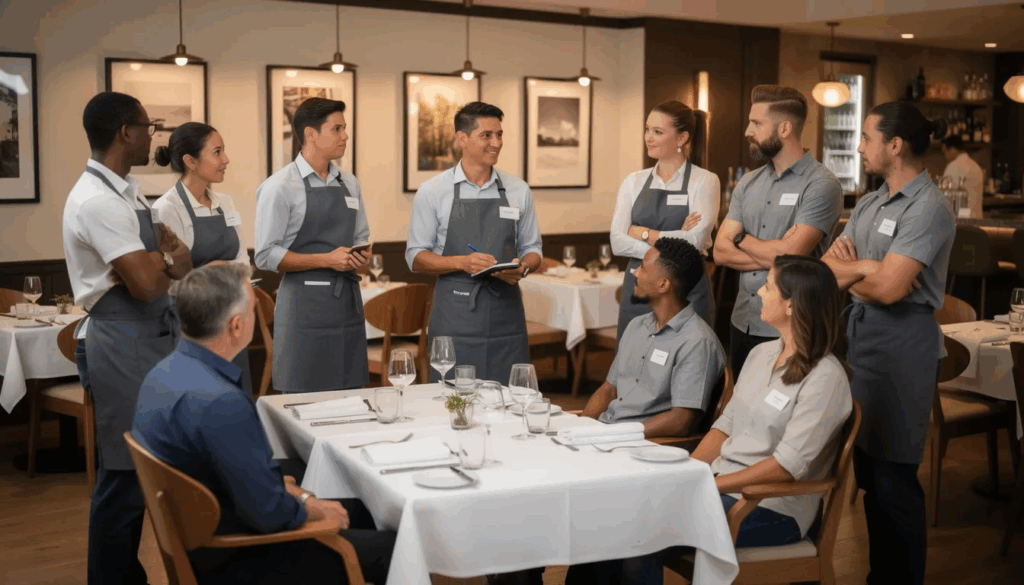
This restaurant is committed to a safe, harassment‑free environment for all employees and guests. Everyone deserves to work without fear of mistreatment, regardless of their role or hours worked.
Harassment and discrimination defined:
Harassment includes any unwanted conduct that creates a hostile, intimidating, or offensive environment. In restaurant settings, examples include:
- Crude or sexual jokes in the kitchen or walk-in
- Unwanted touching, shoulder rubs, or “playful” shoving
- Slurs or derogatory comments about race, gender, religion, national origin, or sexual orientation
- Repeated unwelcome advances despite clear rejection
- Displaying offensive images on phones or in staff areas
Harassment, discrimination, bullying, and retaliation are strictly prohibited—regardless of position, seniority, or tip status. A manager harassing a dishwasher is just as serious as any other scenario.
Who this applies to:
This code applies to interactions among employees, with guests, vendors, delivery drivers, and third‑party staff like cleaning crews. Misconduct outside the building that affects workplace relationships may also be subject to review.
Relationships and conflicts of interest:
Romantic or sexual relationships between managers and staff they supervise must be disclosed immediately. These relationships may be restricted or require reassignment to avoid conflicts of interest in scheduling, discipline, and performance reviews.
Reporting requirements:
All staff must immediately report harassment they experience, see, or hear about. Use the reporting channels detailed later in this document. You don’t need proof—just a good-faith belief that something is wrong.
Equal Opportunity and Fair Treatment
Employment decisions at this restaurant are based on performance, skills, and business needs—not on protected characteristics. We hire, promote, train, and discipline based on how well someone does the job.
Protected characteristics include:
- Race and color
- National origin
- Religion
- Sex
- Sexual orientation
- Gender identity
- Age
- Disability
- Genetic information
- Other categories protected by local laws
Fair treatment expectations:
- Schedules are distributed based on availability, seniority, and business needs—not favoritism
- Promotions and training opportunities go to qualified candidates through a transparent process
- Discipline follows documented procedures with consistent standards
Managers should document performance feedback and disciplinary steps to support fair and transparent treatment. If an employee feels they’ve been treated unfairly, they can raise concerns without fear of punishment using the reporting channels described below.
Safety, Hygiene, and Food Handling Standards
Safety and sanitation are non‑negotiable. They protect guests from illness, employees from injury, and the restaurant’s license from revocation. This section outlines the safety measures and food safety practices every team member must follow.
Personal hygiene rules:
- Frequent hand washing is required—after handling raw meat, touching cash, using the phone, sneezing, or using the restroom
- Proper glove use: change gloves between tasks, never reuse gloves, and wash hands before putting on new gloves
- Clean uniforms every shift; do not reuse stained or soiled clothing
- Report any symptoms like vomiting, diarrhea, or fever immediately—you cannot handle food or work on site while symptomatic
Food safety basics:
| Practice | Standard |
| Cold storage | Refrigerators at 40°F or below; freezers at 0°F or below |
| Hot holding | Keep hot foods at 140°F or above |
| Labeling | All prep items labeled with preparation date and discard date |
| Cross-contamination | Separate cutting boards and utensils for raw and ready-to-eat foods |
Equipment safety:
- Handle knives safely—cut away from your body, store in designated blocks or magnetic strips
- Keep walkways dry; clean spills immediately
- Use protective gear (oven mitts, heat-resistant gloves) when handling hot pans
- Lock out faulty equipment and tag it “Do Not Use” until repaired
Reporting requirements:
Employees must immediately report accidents, near‑misses, and unsafe conditions to a supervisor. Record incidents according to the restaurant’s procedure, including date, time, and description of what happened.
We adhere to local health department regulations, current food safety guidelines, and conduct regular internal checks like weekly temperature logs for refrigerators and freezers.
Emergency and Incident Response
Every restaurant needs clear steps for fires, power outages, severe weather, or medical emergencies. When seconds count, confusion can cost lives.
Basic expectations:
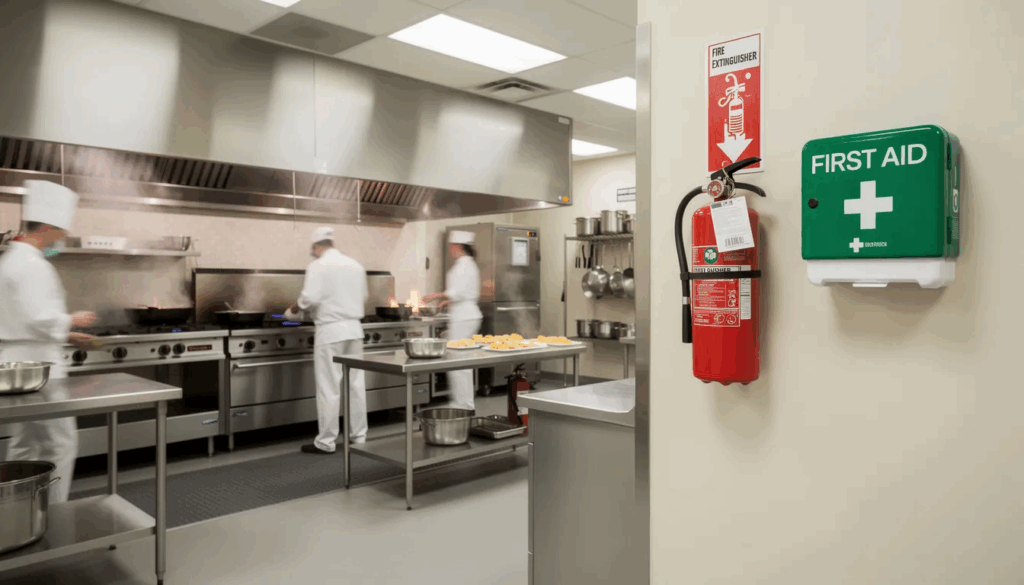
- Know where fire extinguishers and first aid kits are located
- Understand evacuation routes and assembly points (posted near the time clock and in the kitchen)
- Participate in fire drills and emergency training during onboarding
Medical emergencies:
If a guest has a severe allergic reaction or choking incident:
- Call emergency services immediately (911)
- Notify the manager on duty
- If trained, administer first aid or the Heimlich maneuver
- Clear the area to give responders access
- Document the incident after the situation stabilizes
Violence or threats:
When facing violence, threats, or severely intoxicated individuals:
- Prioritize your safety and the safety of guests
- Do not attempt to physically restrain anyone
- Call authorities when needed
- Move other guests away from the situation if possible
This section refers to the separate, detailed emergency plan posted in staff areas. Review it during onboarding and again annually.
Use of Restaurant Property, Technology, and Social Media
Restaurant property—from POS systems to branded uniforms—must be used responsibly and only for business purposes. Misuse puts the company’s interests at risk and can result in discipline.
Assigned equipment:
Cash drawers, POS logins, keys, and access cards are assigned to individuals. You are responsible for their proper use and security. Never share your login credentials or leave cash drawers unlocked.
Theft and misuse:
The following are grounds for disciplinary action up to termination:
- Theft of cash, food, equipment, or guest property
- Intentional damage to restaurant property
- Taking food home without manager approval
- Giving free drinks or food to friends without authorization
- Manipulating sales or tip records
Technology rules:
- Do not install unauthorized software on POS terminals
- Never share passwords with coworkers
- Do not use guest Wi‑Fi for downloading illegal content or streaming during shifts
- Report any suspicious activity or system errors immediately
Social media guidelines:
What you post online reflects on the restaurant. Follow these rules:
| Acceptable | Unacceptable |
| Sharing public menu photos with permission | Posting photos of guest checks or credit card receipts |
| Positive posts about team events | Insulting guests by name or appearance |
| Linking to the restaurant’s website | Criticizing coworkers or managers publicly |
| Posting behind-the-scenes images showing health or safety concerns |
Never post confidential information, negative comments about the business, or anything that could embarrass the restaurant. When in doubt, ask a manager before posting anything that references the restaurant by name, logo, or location.
Confidentiality and Data Protection
Protecting sensitive business information and guest privacy is part of your job. Breaches can result in disciplinary action and potential legal consequences.
What counts as confidential:
- Recipes and proprietary preparation methods
- Supplier pricing and vendor contracts
- Wage information and financial data
- Customer contact lists and reservation databases
- Unpublished promotions or menu changes
Guest data handling:
- Payment details must be processed according to PCI compliance standards
- Reservation notes and complaint records stay internal
- Never discuss guest information with anyone outside the restaurant
Employee information:
Staff must not discuss other employees’ schedules, pay rates (except as permitted by labor laws), overtime pay arrangements, or disciplinary actions with guests or unauthorized coworkers.
Violations of confidentiality can range from a written warning to immediate termination, depending on severity. Local laws may also impose penalties for data breaches.
New Employee Onboarding
Welcoming new hires with a structured onboarding process is crucial for setting them up for success in the restaurant industry. Effective onboarding begins with a thorough review of the restaurant employee handbook, ensuring that new employees understand the restaurant’s policies, procedures, and core values from day one. Training should also cover essential food safety practices, customer service standards, and workplace safety protocols.
By providing clear expectations and comprehensive training, new hires can quickly adapt to the restaurant’s environment and start delivering great service to customers. This approach not only supports food safety and workplace safety but also helps new employees feel confident and valued. A well-designed onboarding program reduces confusion, boosts job satisfaction, and increases employee retention, creating a stronger, more reliable team dedicated to excellent food and service.
Complete Guide to Restaurant Operations
A complete guide to restaurant operations is vital for ensuring that every aspect of the business runs efficiently and in compliance with all relevant laws and regulations. This guide should address business operations, the restaurant code, and local regulations, as well as outline safety measures and the handling of confidential information. It’s also important to include guidance on labor laws to protect both the restaurant owners and employees.
By maintaining a comprehensive operations guide, restaurant owners and managers can foster a positive work environment, uphold service quality, and enhance customer satisfaction. Clear documentation of procedures and safety measures helps prevent issues before they arise, while compliance with local regulations and labor laws reduces the risk of costly fines or legal challenges. Ultimately, a well-structured guide supports the restaurant’s mission and ensures that every team member understands their role in delivering safe, high-quality service.
Clear Communication and Expectations
Clear communication and well-defined expectations are the backbone of a successful restaurant. Establishing a restaurant code of conduct is essential for promoting ethical behavior, respect, and inclusivity among all employees. The code should address important topics such as harassment, discrimination, and retaliation, ensuring that every team member feels safe, valued, and empowered to speak up.
By setting clear expectations and encouraging open communication, restaurant owners and managers create a positive work environment where employees can thrive. This not only improves morale and teamwork but also leads to higher customer satisfaction and a stronger reputation for the business. A thoughtfully crafted code of conduct protects the company’s interests, reduces the risk of legal issues, and fosters a culture of respect and integrity that benefits everyone—employees, customers, and the restaurant as a whole.
Reporting Violations, Discipline, and Continuous Training
Speaking up about violations maintains a safe and ethical restaurant. Every employee plays a role in upholding the standards in this document outlines.
Reporting channels:
You have multiple options for reporting concerns:
- Direct report: Tell your shift supervisor or manager immediately
- Owner or HR contact: If the concern involves your direct supervisor, escalate to the owner or designated HR contact
- Anonymous reporting: Some restaurants offer an ethics hotline or anonymous submission form—ask about availability during onboarding
Retaliation against anyone who reports a concern in good faith is strictly prohibited. Retaliation is itself a serious violation that can result in termination of the retaliating party.
Discipline process:
Typical progression for violations:
- Verbal warning (documented)
- Written warning
- Suspension
- Termination
Severe misconduct—theft, violence, harassment, or gross safety violations—may result in immediate dismissal without progressive steps.
All disciplinary steps should be documented with dates, times, and a brief description of the incident. This protects both the restaurant and the employee by ensuring consistency and fairness.
In some companies, an audit committee may oversee workplace practices, review risks, and ensure regular discussion with management as part of the company’s governance framework.
Ongoing training:
A code of conduct only works if employees understand and remember it. Schedule regular training refreshers:
- Food safety and hand washing procedures (quarterly)
- Anti harassment and respectful workplace (annually)
- Responsible alcohol service (as required by local regulations)
- Emergency response procedures (semi-annually)
New hires should complete training during their first week, with a signed acknowledgment form kept in their employment records.
Final note:
Review this code yearly. If you’re unsure about any policy, ask your manager before acting. Your questions help us improve our workplace policies and keep everyone on the same page.

Key Takeaways
- A restaurant code of conduct sets clear expectations for behavior, safety, and customer satisfaction
- Core principles like respect, integrity, safety, and accountability guide daily decisions
- Professional appearance and punctuality directly impact guest trust and service quality
- Anti harassment rules protect everyone and require immediate reporting
- Food safety and emergency response protocols are non-negotiable legal requirements
- Social media and confidentiality rules protect the restaurant’s reputation and guest privacy
- Consistent discipline and ongoing training make the code effective
A strong code of conduct keeps your team aligned, your guests safe, and your restaurant protected from legal and reputational risks. For example, Burger King faced significant fines in 2024 due to franchise violations of wage and child labor laws, illustrating the importance of strict compliance. Restaurant owners who invest in clear documentation and regular training see fewer incidents, better reviews, and lower turnover.
Start by reviewing your current restaurant employee handbook template against the sections outlined here. Identify gaps, update outdated policies to reflect current local laws, and share the final document with every team member. Schedule a yearly review and require signed acknowledgment forms to ensure everyone understands the rules.
Your code of conduct isn’t just a document—it’s the foundation of your restaurant’s culture.