
Fitness Hiring Software: What It Does and How to Use It
By Billy Giordano, Co-Founder, StaffedUp
Former restaurant operator. Built StaffedUp after losing a line cook before a Saturday rush — the same “I need someone by this weekend” urgency fitness operators face every time a trainer walks out the door.
Last updated: September 2026
Fitness hiring software is an applicant tracking system (ATS) built to help gym owners, studio operators, and fitness franchise managers source, screen, and onboard hourly and certified employees. It is not gym management software — that handles memberships, billing, class scheduling, and check-ins; it doesn’t help you find a qualified personal trainer. Fitness hiring software does one thing: it gets qualified applicants into your pipeline faster, screens out candidates who aren’t certified or available for your hours, and cuts the back-and-forth that causes candidates to ghost before the interview.
What Is Fitness Hiring Software — and What It Isn’t
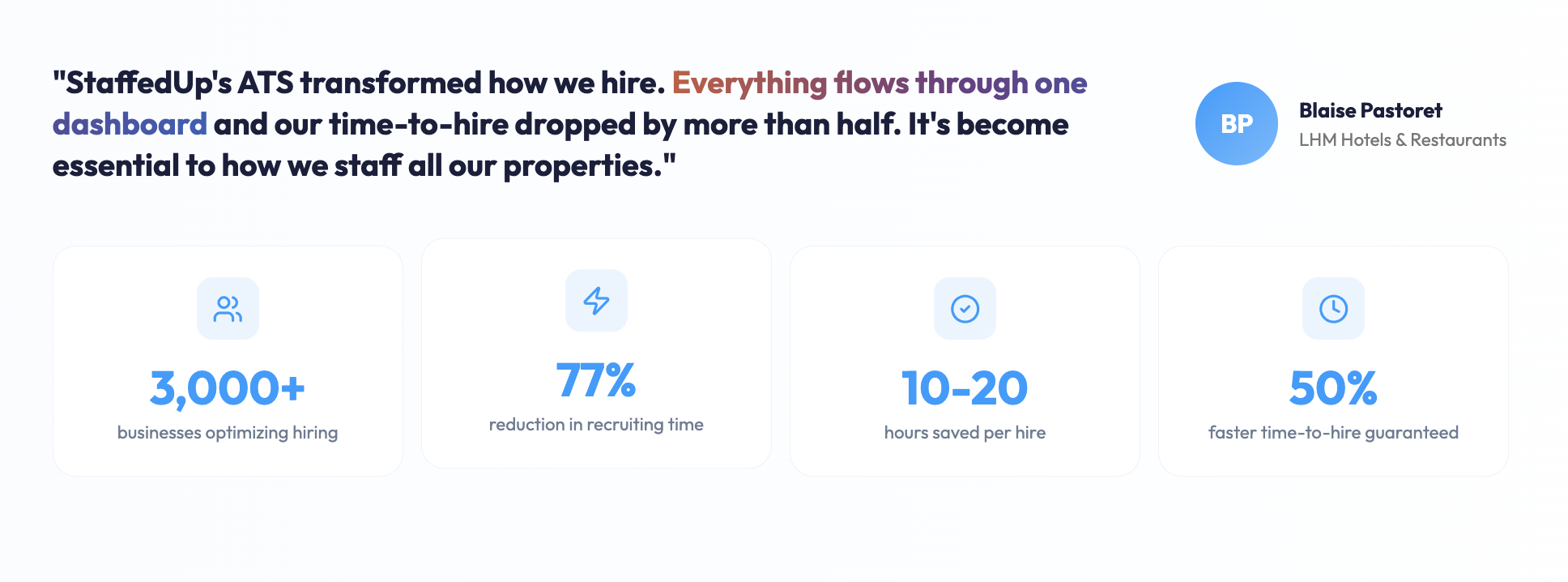
It’s an ATS purpose-built for the roles gym and studio operators actually hire: personal trainers, group fitness and yoga instructors, cycling coaches, front desk staff, and studio managers. You post once, the platform distributes to major job boards, your operator-defined criteria filter out mass-apply bots, and qualified candidates land in your inbox — on StaffedUp, in under three minutes from a phone. Across the platform, operators see 8x more applicants, 77% shorter time-to-hire, and 45% decreased turnover compared to unassisted job-board posting.
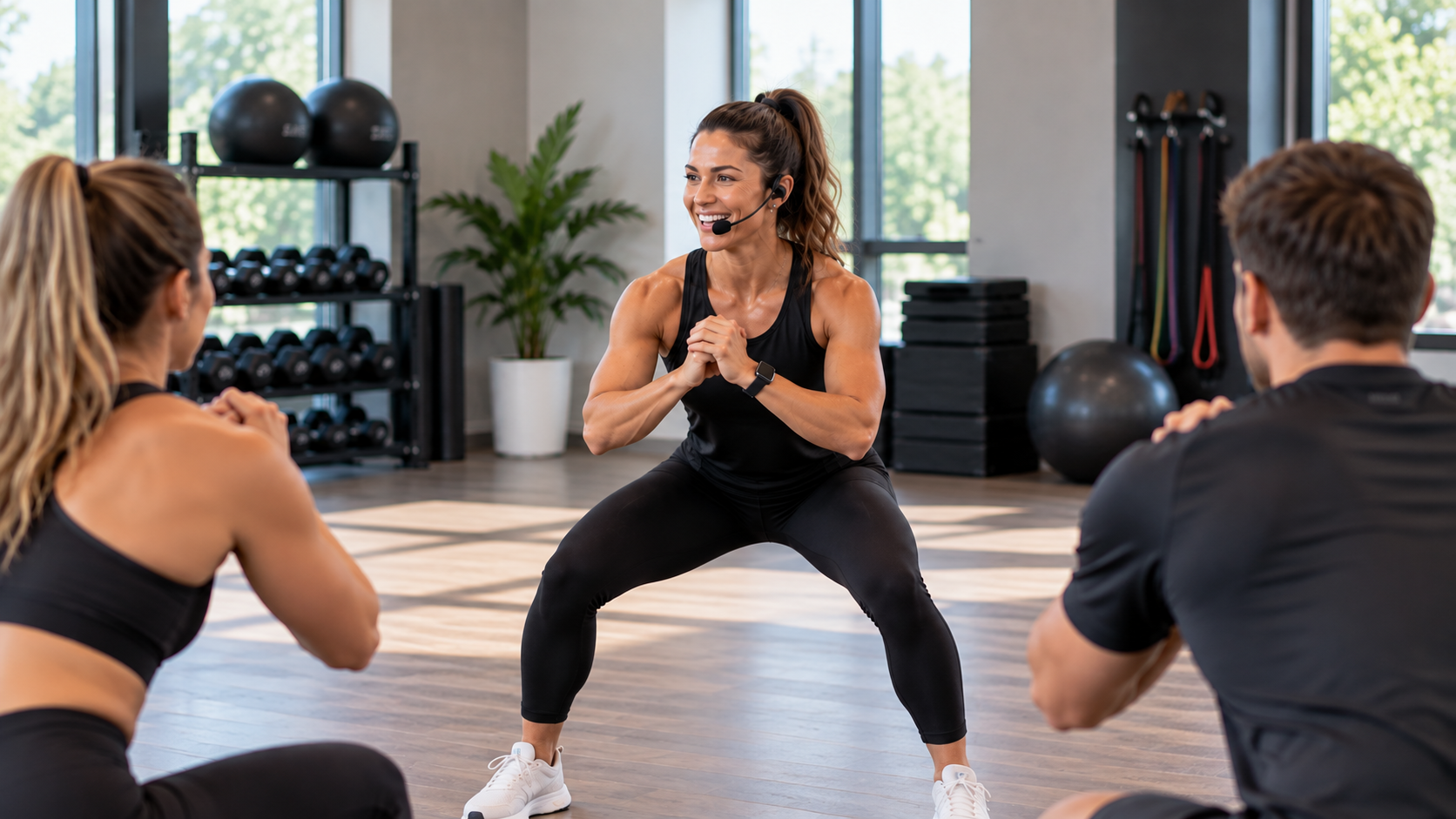
What it is not: gym management software. Mindbody, Zen Planner, and Zenoti handle membership billing, scheduling, and check-ins — not hiring, and you may need both. The BLS counts 370,100 fitness trainer and instructor jobs as of 2024, with 12% growth projected through 2034 — that volume, and the churn behind it, is why a dedicated hiring tool exists.
Why Fitness Hiring Is Different From Every Other Industry
A record 77 million Americans — roughly one in four aged six and older — were members of a gym, studio, or fitness facility in 2024, up 20% since 2019 (Health & Fitness Association). More members means more demand for trainers and front desk staff — demand that’s structural, not cyclical.
The turnover picture inside that growth is equally structural. Industry estimates point to significant churn in personal training roles — income ceiling, burnout, commission-heavy and split-shift schedules, no benefits, and compensation that often depends on building a client book that can take years. That’s the economic architecture of the industry, not a management failure. The BLS projects 74,200 annual openings against a total of 370,100 positions — a workforce cycling through roughly 20% of its ranks a year. And you’re not just screening for availability: the certification layer, which restaurant and retail hiring don’t require, directly affects member safety and your liability exposure.
The ghosting dynamic is identical to food service: applicants apply to multiple studios at once, and the first operator to respond gets the interview. Per HFA’s 2025 data, nearly one in four gym members (23%) used a personal trainer in 2024 and one in three (32%) did small-group training.
The January Resolution Surge: Hire Before the Rush, Not During It
January is the fitness industry’s most predictable annual hiring event, and the problem isn’t awareness — it’s timing. If you need a trainer on the floor January 2nd, work backwards: onboarding by December 26, offer accepted by December 20, interviews by December 15, active screening by December 1, job posts live by November 15. That’s a six-to-seven-week window, and it shrinks fast when any step involves back-and-forth.
| Action Required | Without Software | With Fitness Hiring Software |
|---|---|---|
| Job post creation | 45–90 min (write, format, upload to each board) | Under 3 minutes from a phone |
| Distribution to boards | Manual — one board at a time | Automatic on post |
| Initial screening | Manual review, 20–40 min per applicant | Operator-set criteria filter on submission |
| Interview scheduling | Email/text back-and-forth, 1–3 days | Automated, same day |
| Onboarding docs | Paper/email, follow-up required | Digital, trackable, done before day one |
We built StaffedUp because a Saturday with no line cook creates the same pressure a January 2nd class with no instructor does. Two mechanisms specifically address surge volume: QR code / scan-to-apply captures applicants already in your space, and automated interview scheduling closes the 24–48 hour window between submission and scheduled interview, where candidates ghost to a faster-responding competitor.
Screening for Trainer Certifications Inside Your Fitness Hiring Software
The industry accepts trainer certifications without always scrutinizing the gap between certifying bodies — a liability gap that starts at the application, not the interview. The National Commission for Certifying Agencies (NCCA) is the standard accrediting body for professional fitness certifications; the major NCCA-accredited personal-training credentials are ACE, NASM, NSCA (CPT and CSCS), and ACSM. Weekend or online-only certifications with minimal exam standards are not NCCA-accredited, and the distinction matters for member safety and your insurance position. Requirements vary by state and facility type; check local regulations before you post.
The right place to capture this is the application — a sample question set for your ATS fields:
| Question | Response Format |
|---|---|
| What certification(s) do you currently hold? | Text — certifying body + credential + expiration |
| Is your certification NCCA-accredited? | Yes / No / Unsure |
| Upload a copy of your current certification card. | Required document upload |
| Do you hold a current CPR/AED certification? | Yes/No + expiration date |
| Are you available for these hours? [operator specifies] | Availability grid |
| Describe your experience with the populations you’d train. | Short text |
StaffedUp supports full application customization — custom questions, required document uploads, and operator-defined criteria — and smart screening handles the initial filter. A required cert upload also catches candidates who misrepresent credentials before you’ve invested any time. ACE, NASM, NSCA, and ACSM all maintain online credential lookup tools; verify before you extend an offer.
Single Studio vs. Multi-Location Gym: What Changes
A single Pilates studio hiring one instructor every eight months and a four-location CrossFit franchise onboarding six trainers per location a year are not running the same operation. For a single location, the needs are straightforward: fast posting, multi-board distribution, certification screening in the application, automated scheduling, and a simple inbox of qualified applicants.
For a multi-location operator the problem is different. Without centralized visibility, each GM runs an independent process — one posts on Facebook, one calls Indeed, one forgets until the Tuesday before the role’s needed — with no consistency and no owner-level view without four phone calls. The enterprise and multi-unit setup solves this with a centralized dashboard, location-specific postings with role-specific criteria, and screening that doesn’t vary by manager judgment. Ryan French, who manages MDP Restaurant Group across seven locations, solved exactly this — one platform, consistent criteria, location-level visibility. The challenge is identical for a five-location fitness group: platform structure, not vertical, is what scales.
Why Fitness Applicants Ghost — and How to Close the Window
The danger window is 24–48 hours after submission — if you haven’t responded and scheduled inside it, your candidate has likely accepted a call from someone else. Danielle K., who runs an independent bar, posted Thursday night and had three qualified applicants by Friday morning — hired for the Saturday shift. The vertical is bar service, not fitness, but the urgency is identical: a Saturday class with no instructor is the same emergency as a Saturday bar with no staff. Three things in the job posting itself reduce ghosting, no software required:
- State the exact shift hours. “Saturday and Sunday, 6am–2pm” loses applicants who can’t work those hours before they apply and ghost. That’s a feature.
- Include pay range upfront. Applicants who ghost after learning the pay in the interview are a predictable problem — eliminate it at the top of the funnel.
- Name specific expectations. “Lead two group classes per shift, available for member questions between sessions” beats “energetic team player.”
Independent Contractor or Employee? What to Know Before You Post
Personal trainers are frequently hired as independent contractors. Some arrangements are structured correctly; many are not — and misclassification can mean back taxes, penalties, and unpaid benefits liability. The basic IRS and DOL distinction comes down to behavioral control: does your facility control how the trainer does the work — hours, methods, clientele — not just the outcome? If yes, that points toward employee status. Classification law varies significantly by state; California, New York, and others apply stricter tests than the federal standard. The DOL’s worker-classification guidance outlines the federal framework; state labor departments publish state-specific standards.
This is not legal advice. Classification rules vary by state and can change — talk to an employment attorney or your state labor department before classifying a trainer as a contractor. It matters for your setup because job-posting language, application questions, onboarding documents, and offer letters differ materially for contractors versus W-2 employees. Know the classification before you post.
How to Evaluate Fitness Hiring Software — Including When You Don’t Need It Yet
Not every fitness operator needs a dedicated ATS. No other vendor will write that sentence, because it undermines their funnel. You don’t need it yet if you hire one person a year or less from a reliable referral pool and your instructor shows no signs of leaving — a well-written Indeed post and a single interview may serve you better than a $29/month subscription. You do need it if you’re hiring more than two or three people a year, you’ve had a ghosted interview or no-show recently, you’re approaching January without your lineup set, or you’re opening a second location and your process can’t scale.
When you do evaluate options, weigh what matters for this industry: automatic distribution to Indeed, Google Jobs, and major niche boards; custom questions and required cert-doc uploads; posting in under five minutes with no sales call; flat monthly pricing with unlimited posts; and, for multi-unit operators, a centralized dashboard with location-level posting.
StaffedUp pricing: $1 for your first post, then $29/month, unlimited active posts. A qualified applicant in your inbox within 24 hours or you pay nothing — $0 for the month, automatically reversed. No contract, no setup call, cancel anytime in-app. Sean O., who runs an Irish Pub & Grill, spent $400/month on Indeed for three months and got zero hires; his first StaffedUp post at $1 produced a qualified applicant in 18 hours. The board question and the retention question are connected.
Your first job post is $1. Post your first fitness role. If you don’t have a qualified applicant — meeting your criteria, available for your hours, within your radius, with a completed application — within 24 hours, you pay nothing; the charge is reversed automatically. Post from your phone in under 3 minutes: no setup call, no demo, no contract, cancel in-app. After the first post, it’s $29/month for unlimited active job posts.
Frequently Asked Questions
What is the best hiring software for gyms and fitness studios?
There’s no single best platform — the right choice depends on how often you hire, whether you’re a single boutique or a multi-location franchise, and whether you need certification screening built into the application. For operators who need to post quickly, reach multiple boards, and screen against role-specific criteria including certifications, a purpose-built ATS fits. For someone hiring one person a year from a referral pool, it may be more than you need.
What certifications should I require when hiring a personal trainer?
At minimum, require certifications accredited by the National Commission for Certifying Agencies (NCCA) — the major ones are ACE, NASM, NSCA (CPT or CSCS), and ACSM. Require a current CPR/AED certification separately. Requirements vary by state and facility type; check local regulations before you post, and build these as required application fields.
How do I verify personal trainer certifications when hiring?
Require a current certification-card upload as a required application field; verify directly with the certifying body — ACE, NASM, NSCA, and ACSM all maintain online credential lookup tools; and note the expiration date, building re-verification into onboarding at renewal. Candidates who misrepresent credentials are a real scenario, and catching it at the application stage costs you nothing.
How far in advance should I hire for the January fitness rush?
Aim to have job posts live by November 15, active screening underway by December 1, interviews complete by December 15, and onboarding finished by December 26 — so your roster is set before January 2nd. That’s a six-to-seven-week window. Fitness hiring software compresses each step: posting in under three minutes, automatic distribution, operator-defined screening from day one, and automated scheduling.
What’s the difference between gym management software and fitness hiring software?
Gym management software — Mindbody, Zen Planner, Zenoti — handles memberships, billing, scheduling, and check-ins. It is not built to source or screen job applicants. Fitness hiring software (an ATS) handles the employment side: posting jobs, distributing to boards, screening applicants against your criteria including certifications and availability, scheduling interviews, and onboarding. You may need both; they don’t overlap.
Can I try StaffedUp for my gym or fitness studio without a big commitment?
Yes. Your first job post is $1. If you don’t receive a qualified applicant within 24 hours, you pay nothing — the charge is reversed automatically. After that, it’s $29/month with unlimited active job posts. No setup call, no demo, no contract — cancel anytime in-app. Post from your phone in under three minutes. Current terms at staffedup.com/hire.
Sources
- Bureau of Labor Statistics, Occupational Outlook Handbook: Fitness Trainers and Instructors — 370,100 jobs (2024), 12% growth projected through 2034.
- Health & Fitness Association, One in Four Americans Belonged to a Gym in 2024 (April 2025) — 77 million members, up 20% since 2019.
- Health & Fitness Association, How 77 Million Fitness Members Work Out — 23% personal-trainer usage, 32% small-group training.
- National Commission for Certifying Agencies (NCCA), Accreditation Standards.
- U.S. Department of Labor, Wage and Hour Division, Worker Misclassification.
- StaffedUp platform data: 8x more applicants, 77% shorter time-to-hire, 45% decreased turnover — internal aggregate.

Hire Smarter, Faster
StaffedUp simplifies hiring for restaurant & hospitality operators. Post your first job for $1.